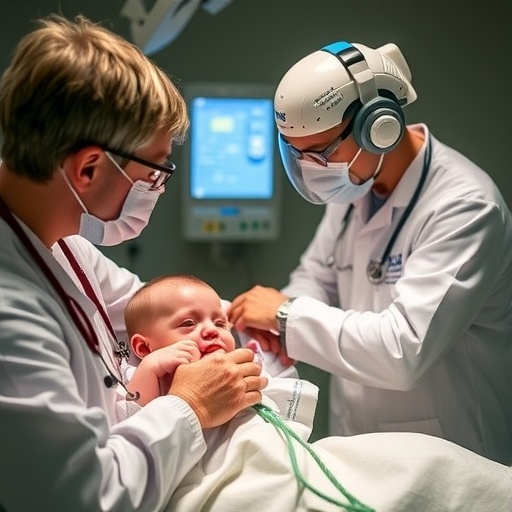
In a groundbreaking study published in the Journal of Perinatology in April 2026, researchers have taken a scientific leap into the autonomous generation of neonatal care advice by artificial intelligence. The investigation spearheaded by Tang, X., Yang, X., Zhu, D., and colleagues delves into a head-to-head comparison of responses delivered by ChatGPT, an advanced AI chatbot, against those crafted by seasoned neonatologists on an online medical consultation forum for preterm infant care. This research stands at the intersection of neonatal medicine and AI technology, seeking to ascertain whether machine-generated advice can augment or potentially rival physician expertise in this sensitive and critical field.
The impetus behind this study arises from the increasing reliance on digital platforms for healthcare consultations and the meteoric rise of AI conversational agents. Preterm infant care is exceptionally nuanced, demanding specialized clinical judgment that balances evidence-based guidelines with individual clinical circumstances. With AI rapidly evolving, it has become imperative to rigorously evaluate whether chatbot-generated information meets the stringent demands of neonatal care or whether it inadvertently propagates oversimplifications that might misguide anxious parents and less specialized caregivers.
The methodology employed in this evaluation study was meticulous and multifaceted. Questions posted by parents and caregivers about preterm infant care on an open-access medical forum were compiled. These queries were then independently addressed by practicing neonatologists and ChatGPT. To ensure objectivity, the study design involved blinding responders to avoid biases and included a standardized rubric assessing the accuracy, relevance, clarity, and safety of the advice given. This dual-responder model allowed for a direct comparison between human and AI-generated content, offering an empirical basis to judge AI’s current role in neonatal support.
One of the striking revelations from the comparative analysis was the degree of concordance and discordance between ChatGPT and physician responses. While ChatGPT demonstrated a remarkable capacity to synthesize large volumes of medical literature and generate coherent, jargon-free replies, subtle but crucial clinical nuances were sometimes absent. Neonatologists, drawing on years of hands-on clinical experience, provided context-rich responses imbued with a depth of understanding of individual patient variability that the AI chatbot could not fully emulate.
Despite these limitations, ChatGPT showed potential in supporting basic informational needs, especially in contexts where timely consultation with a neonatologist is unavailable. In many instances, the AI provided comprehensive overviews on topics such as feeding practices, common neonatal complications, and developmental milestones, showcasing its utility as a first-line informational resource. Its proficiency in delivering empathetic, approachable responses also underscored the evolution of AI in mimicking human conversational patterns, albeit without the weighted responsibility for medical decision-making.
The evaluation further uncovered instances where AI responses lacked adequate safety caveats or warning signs typically emphasized by physicians. Neonatologist advice often contained reminders about the necessity for in-person evaluations, alerting caregivers to when urgent clinical interventions were essential. This distinction highlights the irreplaceable role of human clinical judgment and the ethical considerations inherent in AI deployment in healthcare, especially involving vulnerable populations like preterm infants.
This study is not without its implications for the future of medical consultations. The integration of AI-powered tools as preliminary adjuncts could alleviate the burden on healthcare systems, particularly in resource-limited settings or during off-hours. However, this promising tableau is tempered by the necessity for rigorous validation frameworks and continuous refinement of AI algorithms to ensure safety and reliability in medical contexts.
From a technological standpoint, this research underscores the current capabilities and boundaries of natural language processing and machine learning models in healthcare communication. The AI’s performance reveals strengths in knowledge retrieval and articulating established medical information, yet also exposes challenges, including understanding emotional subtleties, interpreting ambiguous queries, and adapting recommendations based on complex clinical scenarios that extend beyond rule-based decision trees.
Ethical considerations also loom large in this arena. The potential for AI chatbots to disseminate misinformation—whether due to outdated training data or misinterpretation of nuanced clinical questions—can have dire consequences. Thus, the authors argue for stringent monitoring and oversight mechanisms, possibly integrating real-time physician review or hybrid AI-human response systems to safeguard patient well-being.
Moreover, this study offers insights into the user experience dimension of healthcare AI. Caregivers accessing ChatGPT responses reported high satisfaction with the clarity and immediacy of answers but expressed reservations about the lack of personalized reassurances and direct opportunities to ask follow-up questions tailored to individual infants’ conditions. This feedback accentuates the continuing importance of human empathy and adaptability in medical communication.
The research opens avenues for future investigations focusing on the iterative improvement of AI models through exposure to diverse clinical scenarios and incorporating real-world feedback loops. Leveraging advances in explainable AI could also enhance transparency, enabling users and clinicians alike to understand the rationale behind chatbot recommendations, thus fostering trust and accountability.
In conclusion, the study by Tang and colleagues vividly illustrates the evolving interplay between artificial intelligence and neonatology. While ChatGPT exhibits impressive competence as an educational and supportive tool for preterm infant care, it falls short of supplanting specialized physician expertise. Instead, it carves out a complementary role that, with continued development and ethical vigilance, could revolutionize how caregivers access vital neonatal information worldwide. This landmark evaluation augurs a future where AI and human clinicians collaboratively enhance neonatal outcomes, but it also serves as a clarion call for prudent integration grounded in evidence and compassion.
Subject of Research: Comparison of preterm infant care advice generated by ChatGPT versus neonatologists.
Article Title: Comparing physician and artificial intelligence chatbot responses to preterm infant care questions posted to a public medical consultation forum: evaluation study.
Article References:
Tang, X., Yang, X., Zhu, D. et al. Comparing physician and artificial intelligence chatbot responses to preterm infant care questions posted to a public medical consultation forum: evaluation study. J Perinatol (2026). https://doi.org/10.1038/s41372-026-02664-3
Image Credits: AI Generated
DOI: 15 April 2026
Tags: AI accuracy in preterm infant careAI in neonatal medicineAI-driven medical consultation risksautonomous neonatal advice generationChatGPT vs neonatologists studydigital healthcare consultations preterm infantsethical considerations AI neonatal careevidence-based neonatal guidelines AIimpact of AI on neonatal clinical judgmentimproving preterm infant outcomes with AIneonatal care AI chatbot evaluationpreterm infant care AI comparison