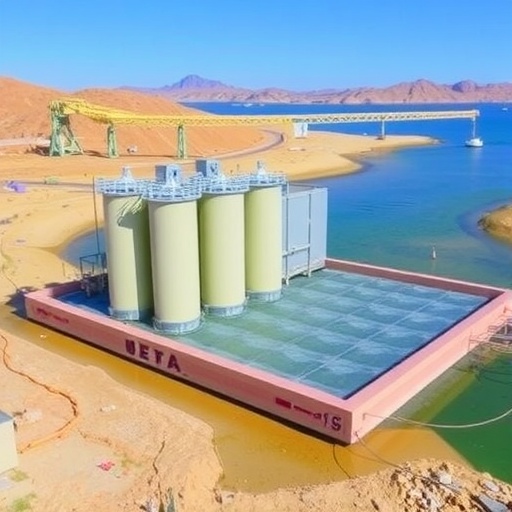
In a groundbreaking development that could revolutionize the future of water purification technology, researchers have unveiled a novel approach to enhancing water desalination using advanced mixed matrix membranes. The team led by Plata-Gryl, Galiano, Russo, and colleagues has engineered a sophisticated membrane system based on polyvinylidene fluoride (PVDF) combined with a zeolite material known as chabazite. Published recently in Scientific Reports (2026), this research presents significant strides toward addressing the global water scarcity crisis by improving vacuum membrane distillation (VMD) efficiency and performance.
Water scarcity is an escalating global challenge, exacerbated by population growth, climate change, and industrial demands. Desalination technologies have long been touted as viable solutions, but the energy-intensive nature and limitations in current membrane materials have posed barriers to widespread adoption. The new PVDF-chabazite mixed matrix membranes (MMMs) showcased by the team promise to overcome these obstacles by integrating the unique physicochemical properties of the chabazite zeolite within the PVDF polymer matrix. This amalgamation enhances membrane selectivity, permeability, and thermal stability—key parameters that dictate the efficiency of VMD processes.
Vacuum membrane distillation, a thermally driven separation process, exploits vapor pressure differences across hydrophobic membranes to extract pure water from saline feed streams. However, traditional membranes often suffer from fouling, wetting, and limited water vapor flux, curtailing their long-term operational durability and productivity. By embedding chabazite crystals, which are microporous aluminosilicate frameworks with exceptional molecular sieving capabilities, the researchers have harnessed increased hydrophobicity and pore uniformity. These attributes facilitate superior water vapor transport while effectively rejecting dissolved salts and contaminants, thereby ensuring high-quality permeate.
The synthesis methodology employed to fabricate the PVDF-chabazite MMMs is meticulously optimized to guarantee uniform dispersion of zeolite particles within the polymer matrix. The research paper details the solvothermal synthesis of nanocrystalline chabazite zeolites, followed by their incorporation into PVDF via solvent casting techniques. This hybrid membrane structure exhibits enhanced mechanical strength and thermal resistance, making it suitable for vacuum membrane distillation systems operating at elevated temperatures. Characterization techniques such as scanning electron microscopy (SEM), X-ray diffraction (XRD), and Fourier-transform infrared spectroscopy (FTIR) validate the integrated membrane’s morphology, crystalline structure, and chemical interactions.
Performance evaluation under controlled laboratory conditions demonstrated a marked increase in water vapor flux, with the PVDF-chabazite membranes outperforming pristine PVDF membranes by a substantial margin. Salt rejection rates exceeded 99.9%, underscoring the membrane’s potential for producing potable water even from highly saline feedwaters. The hydrophobic nature combined with the unique porous architecture of chabazite reduces membrane wetting—a common failure mode in membrane distillation—thus extending operational lifespan and reliability.
Thermal efficiency is a pivotal advantage of the PVDF-chabazite membranes. The membranes sustain performance at higher temperatures without degradation, effectively leveraging the thermal gradients essential for vacuum membrane distillation. The mixed matrix design minimizes heat loss and diffusive resistance, ensuring that energy input translates directly into increased vapor generation and transport. This results in reduced overall energy consumption per volume of desalinated water, a critical parameter for scaling desalination technologies sustainably.
The interdisciplinary nature of this research integrates materials science, chemical engineering, and environmental technology. It reflects a growing trend in harnessing inorganic-organic hybrid materials to achieve breakthroughs in separation sciences. The PVDF polymer provides a flexible, robust base, while chabazite brings sophisticated selectivity and permeability traits ordinarily unattainable in polymer-only membranes. This synergistic combination is indicative of future directions for membrane development.
Beyond the laboratory, the findings hold promising implications for real-world applications in water-stressed regions globally. The adaptability of the membrane fabrication process may enable cost-effective production at scale, which is crucial for adoption in municipal and industrial water treatment facilities. Furthermore, the enhanced desalination efficiency could lower the ecological footprint associated with conventional thermal desalination plants, aligning with global goals for sustainable water management.
The researchers also note the potential for customizing the mixed matrix membranes by varying zeolite concentrations and particle sizes to tailor selectivity and flux parameters for specific feedwater compositions or treatment objectives. This versatility opens avenues for targeting not only saline water but also challenging wastewaters laden with organic and inorganic pollutants, widening the membrane’s applicability.
Moreover, the incorporation of chabazite is particularly innovative given its cage-like pore structure, which is adept at selectively transporting water molecules while barring larger ions and contaminants. This nanoporous characteristic endows the membrane with a unique separation mechanism beyond simple size exclusion, involving adsorption-desorption dynamics that improve flux without sacrificing rejection efficiency. Such nanostructured behavior marks a significant advancement in membrane technology.
While the initial results are compelling, the authors also emphasize the need for extended pilot-scale testing to fully validate long-term performance under variable operational conditions. Issues such as scaling potential, membrane cleaning protocols, and resistance to biofouling will require comprehensive assessment before commercial deployment. Nonetheless, the study lays a robust foundation for future investigations and industrial collaborations aimed at refining membrane distillation technologies.
The work by Plata-Gryl and colleagues embodies the kind of innovative research critical for tackling some of the 21st century’s most pressing challenges. By converging advanced materials engineering with practical desalination needs, their study shines a light on a promising pathway toward accessible, efficient, and sustainable freshwater production. As climate pressures intensify and water demands surge, such breakthroughs could prove transformative in securing water resilience on a global scale.
In sum, the novel PVDF-chabazite mixed matrix membranes represent a milestone in membrane distillation research. They combine the best attributes of synthetic polymers and natural zeolites, resulting in a hybrid material with enhanced performance metrics tailored specifically for vacuum membrane distillation. This synergy addresses key limitations of existing membranes and champions a technology with the potential to revolutionize desalination processes worldwide.
The publication in Scientific Reports heralds this development to the scientific community and underscores the collective pursuit of innovative water purification methods. By pushing the frontiers of membrane science, this research advances our capacity to create clean water solutions that are both effective and sustainable, thus contributing significantly to global efforts in environmental stewardship and human wellbeing.
Subject of Research:
Enhanced water desalination using PVDF-chabazite mixed matrix membranes in vacuum membrane distillation.
Article Title:
Enhanced water desalination via PVDF-chabazite mixed matrix membranes in vacuum membrane distillation.
Article References:
Plata-Gryl, M., Galiano, F., Russo, F. et al. Enhanced water desalination via PVDF-chabazite mixed matrix membranes in vacuum membrane distillation. Sci Rep (2026). https://doi.org/10.1038/s41598-026-48961-x
Image Credits: AI Generated
Tags: addressing global water scarcity with membranesadvanced water desalination technologyenergy-efficient water purification methodsimproving membrane selectivity and permeabilityinnovative polymer-zeolite composite membranesintegration of chabazite zeolite in PVDFovercoming fouling in membrane distillationPVDF-chabazite mixed matrix membranessustainable solutions for saline water treatmentthermal stability in desalination membranesvacuum membrane distillation efficiencyzeolite-based membrane materials