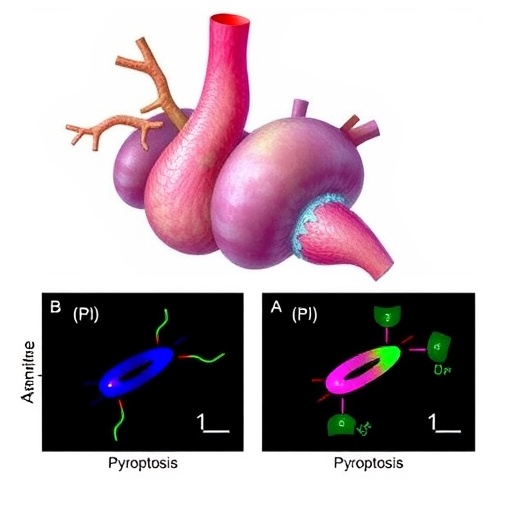
In a groundbreaking study published in Nature Communications, researchers Zhao, Lin, Zhu, and colleagues elucidate the critical role of Pyruvate Dehydrogenase Kinase 4 (PDK4) in the pathogenesis of abdominal aortic aneurysm (AAA). This devastating vascular disease, characterized by the localized dilation of the abdominal aorta, has long challenged clinicians due to its silent progression and catastrophic risk of rupture. The team reveals that PDK4 acts as a pivotal regulator by orchestrating metabolic reprogramming within vascular smooth muscle cells (VSMCs) and triggering inflammatory cell death via NLRP3 inflammasome-mediated pyroptosis, thus providing a fresh mechanistic perspective on AAA formation.
Abdominal aortic aneurysm represents an urgent clinical problem, primarily affecting aged populations and often remaining asymptomatic until rupture, which carries a mortality rate exceeding 80%. Despite considerable research efforts, the molecular underpinnings driving aneurysmal dilation and vessel wall degradation remain incompletely understood. This study shines light on the metabolic and inflammatory pathways coupling smooth muscle cell dysfunction and vessel wall weakening, a nexus previously described but not delineated with this molecular precision.
Central to this investigation is PDK4, an enzyme classically known for its role in modulating mitochondrial metabolism through the phosphorylation and inhibition of the pyruvate dehydrogenase complex (PDC). By altering the conversion of pyruvate to acetyl-CoA, PDK4 effectively shifts cellular energy metabolism from oxidative phosphorylation to glycolysis. Such metabolic reprogramming resembles a Warburg-like effect, previously described in cancer and immune cells, but less explored in vascular pathology. The authors demonstrate that PDK4 upregulation in VSMCs induces a metabolic shift that fuels pathologic processes, elucidating a novel connection between metabolism and vascular degeneration.
The researchers employed a combination of in vivo murine models and ex vivo analyses of human AAA tissues to validate their findings. Notably, they observed enhanced PDK4 expression specifically in the aneurysmal aortic media compared to healthy controls. This overexpression correlated with markers of metabolic dysfunction, such as reduced mitochondrial respiration and increased glycolytic flux, underscoring the link between metabolic alterations and aneurysm development. These findings highlight the metabolic vulnerability of VSMCs in AAA pathogenesis.
Crucially, the study delves into the inflammatory consequences of PDK4-driven metabolic remodeling. PDK4’s activation was found to promote the assembly of the NLRP3 inflammasome, a multiprotein complex implicated in innate immunity and sterile inflammation. Activation of NLRP3 initiates the cleavage of pro-caspase-1 to active caspase-1, which then catalyzes the maturation of pro-inflammatory cytokines such as IL-1β and IL-18, and drives the inflammatory form of cell death known as pyroptosis. The authors provide compelling evidence that pyroptotic death of VSMCs exacerbates vessel wall inflammation and degradation, thereby accelerating aneurysm progression.
Metabolic imaging and molecular assays revealed that PDK4-mediated mitochondrial dysfunction led to increased reactive oxygen species (ROS) production, an established activator of the NLRP3 inflammasome. This mechanistic insight links energy metabolism to inflammatory signaling pathways — a crosstalk that amplifies tissue injury within the aortic wall. The study thereby positions PDK4 as a metabolic gatekeeper regulating immune effector activation in the vascular context.
To further validate the causative role of PDK4, loss-of-function experiments were performed using PDK4 knockout mice subjected to aneurysm-inducing stimuli. Remarkably, these animals exhibited attenuated aneurysm formation, preserved VSMC phenotype, and reduced inflammasome activation compared to wild-type controls. This genetic evidence solidifies the enzyme’s pathological role and raises the prospect of targeting PDK4 therapeutically to modulate AAA progression.
In parallel, pharmacological inhibition of PDK4 using specific small-molecule inhibitors was shown to suppress metabolic aberrations and inflammasome activation in cultured human VSMCs derived from aneurysmal tissue. These findings provide translational potential, suggesting that intervening at the level of metabolic regulation can effectively dampen inflammatory cascades and cell death pathways implicated in aneurysm pathophysiology.
The intertwining of metabolic and inflammatory signaling represents a paradigm shift for vascular biology and disease intervention. By positioning PDK4 as a linchpin in these processes, this study challenges the traditional view of AAA as merely a degenerative disorder, highlighting it instead as a metabolically driven inflammatory disease. This comprehensive mechanistic framework opens new avenues for biomarker discovery and individualized therapeutic strategies.
Moreover, the study also suggests that metabolic modulation may be a strategy to preserve VSMC contractile phenotype and extracellular matrix integrity, both critical for aortic wall structural stability. Preservation of mitochondrial function emerges as a therapeutic objective to counteract VSMC loss and aberrant remodeling in AAA, a concept that aligns with emerging research in related cardiovascular conditions.
The clinical implications of targeting PDK4 extend beyond aneurysm biology. Considering PDK4’s role in systemic metabolism and inflammation, pharmacological modulation could influence comorbidities often associated with AAA, including metabolic syndrome, diabetes, and atherosclerosis. However, careful consideration of systemic effects and tissue-specific actions will be paramount to developing safe and effective therapies.
This study further underscores the growing recognition of pyroptosis as a critical form of programmed cell death in cardiovascular diseases. The identification of NLRP3 inflammasome as a downstream effector of metabolic dysfunction in smooth muscle cells expands the repertoire of pyroptosis-induced vascular damage, informing future research on inflammation-targeted interventions.
The research team also highlights potential mechanistic interactions with other metabolic regulators and signaling pathways, suggesting that PDK4 may act within a broader network influencing vascular homeostasis. Understanding these complex molecular relationships is essential for designing combinational therapies or identifying new drug targets.
Finally, this manuscript stands as a testament to the power of interdisciplinary research integrating metabolism, immunology, and vascular biology. The convergence of these fields promises to unravel complex disease mechanisms and translates into innovative therapies aimed at preventing catastrophic vascular events.
In conclusion, Zhao et al. present a novel and compelling model where PDK4 drives abdominal aortic aneurysm progression by inducing metabolic rewiring in vascular smooth muscle cells, which in turn activates NLRP3 inflammasome-mediated pyroptosis. This mechanistic insight reveals PDK4 as a promising therapeutic target and sets the stage for future investigations into metabolic-inflammatory crosstalk in vascular diseases, heralding new hope for improved patient outcomes in AAA.
Subject of Research: The role of PDK4 in abdominal aortic aneurysm pathogenesis through smooth muscle cell metabolic reprogramming and inflammation.
Article Title: PDK4 drives abdominal aortic aneurysm by promoting smooth muscle cell metabolic reprogramming and NLRP3-mediated pyroptosis.
Article References:
Zhao, L., Lin, X., Zhu, Z. et al. PDK4 drives abdominal aortic aneurysm by promoting smooth muscle cell metabolic reprogramming and NLRP3-mediated pyroptosis. Nat Commun (2026). https://doi.org/10.1038/s41467-026-71610-w
Image Credits: AI Generated
Tags: aneurysm vessel wall degradation mechanismsinflammatory pathways in abdominal aortic aneurysmmetabolic reprogramming in vascular smooth muscle cellsmetabolic shift in aneurysm pathogenesismitochondrial metabolism in vascular diseasemolecular mechanisms of aneurysm formationNLRP3 inflammasome-mediated pyroptosisPDK4 role in abdominal aortic aneurysmpyruvate dehydrogenase kinase 4 and VSMC dysfunctionsmooth muscle cell metabolic regulationtargeting Pvascular inflammation and cell death