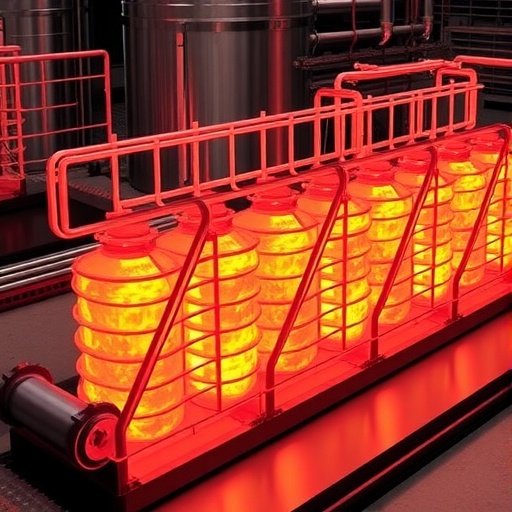
As the urgency to curb carbon emissions intensifies globally, the challenge of managing vast industrial energy requirements alongside waste heat recovery is becoming increasingly pronounced. Industrial sectors are responsible for nearly 40% of the growth in worldwide electricity consumption, underscoring the critical need for innovative energy storage solutions that can efficiently harness and alleviate this demand. In response, scientific researchers are turning their attention to an emerging technology known as the Carnot battery, which holds substantial promise for long-duration energy storage applications by leveraging thermal energy.
A pioneering study recently published in the prestigious journal ENGINEERING Energy by a multidisciplinary team from Zhejiang University and its affiliates has made significant strides in elevating the practicality and operational efficiency of Carnot batteries, particularly within complex, real-world industrial settings. At the heart of their breakthrough lies the development of an innovative “quasi-dynamic” mathematical modeling framework tailored specifically for Thermally Integrated Carnot Batteries (TI-CB), designed to navigate the inherently unstable and fluctuating environmental conditions characteristic of factory waste heat outputs.
Traditional lithium-ion batteries, while effective for short-term storage, fall short when addressing the long-term and high-capacity demands of industrial environments. Carnot batteries differentiate themselves by storing surplus electricity as thermal energy through the deliberate creation of temperature gradients between distinct hot and cold reservoirs. This stored thermal energy can then be reconverted into electricity during periods of demand, offering a dual-functionality that is particularly beneficial for stabilizing renewable-powered grids and enhancing overall energy efficiency. Of specific interest are TI-CB systems utilizing Organic Rankine Cycles (ORC), which optimize the harvesting and upgrading of low-to-medium grade waste heat typically found in industrial processes, operating efficiently at temperatures ranging from 60°C to 90°C.
Despite their theoretical advantages, a major stumbling block for Carnot battery technology arises from the inherently variable nature of industrial waste heat—temperatures and flow rates rarely remain steady, rendering steady-state modeling approaches inadequate for predicting real-world performance. Recognizing this gap, the researchers aimed to replicate the non-linear and fluctuating conditions encountered in actual industrial operations. Their objective was to quantify the impact of off-design and dynamic conditions on the energy round-trip efficiency over extended operating periods, thus providing insights that bridge theoretical constructs with practical engineering challenges.
To achieve these goals, the research team devised a quasi-dynamic model coupled with a robust evaluation framework that explicitly incorporates time delays occurring between the charging (heat absorption) and discharging (electricity generation) phases. This model facilitates nuanced simulations that account for transient system behaviors often overlooked in steady-state assumptions. Leveraging multivariable sampling techniques, the team executed thousands of simulation runs to systematically dissect how design variables and operational fluctuations influence overall Carnot battery efficiency, revealing critical failure points and optimization paths.
Among the most striking revelations was the asymmetrical sensitivity of the battery’s operational phases to fluctuating parameters. The analysis showed that the discharging phase, governed primarily by the ORC process, is exceptionally vulnerable to variations in mass flow rate compared to the charging phase controlled by the heat pump. Fluctuations in this discharging cycle precipitate dramatic reductions in round-trip efficiency, signaling the necessity for advanced control strategies that prioritize stability and precise modulation on the output side of the system.
Another pivotal finding concerns the trade-offs inherent in thermal management. While intuitively, higher temperature gradients across the heat source promise enhanced thermodynamic performance, the researchers highlighted significant irreversible heat losses that escalate as this temperature difference widens. This phenomenon results in a precipitous decline in round-trip efficiency, from an optimal peak near 62.6% down to a concerning low of 45.8%, underscoring the delicate balance engineers must navigate between maximizing energy conversion potential and mitigating thermal dissipation.
The choice of working fluid emerged as a crucial engineering decision with far-reaching consequences for system resilience and performance. The study compared various organic fluids, each with distinct thermophysical properties and stability envelopes. R1336mzz(Z), for instance, demonstrated the highest peak thermodynamic efficiency but exhibited pronounced volatility and sensitivity under dynamic, fluctuating conditions. In contrast, R1233zd(E) displayed robust stability and consistent performance across a wide operating range, positioning it as the most viable candidate for scalable industrial implementation where operational consistency is paramount.
This comprehensive and methodical modeling effort marks a significant milestone in translating the theoretical allure of Carnot batteries into tangible energy solutions capable of meeting industrial demands. By illuminating the interactions between off-design operational dynamics and system efficiencies, the research offers a prescriptive roadmap for engineering design considerations, optimization criteria, and control mechanisms tailored to industrial energy landscapes.
As grids increasingly incorporate renewable energy sources characterized by intermittency and variability, Carnot batteries equipped with finely tuned control strategies and optimal working fluids could become instrumental in mitigating fluctuations, ensuring energy reliability, and advancing the global carbon neutrality agenda. Moreover, waste heat—once regarded as an unavoidable byproduct—can be recast as a valuable resource, contributing to circular energy economies and reducing overall industrial carbon footprints.
Looking ahead, the integration of dynamic modeling methodologies with advanced materials and adaptive control systems promises to catalyze further enhancements in Carnot battery technology. Such innovations could unlock unprecedented efficiencies and deployment flexibility, enabling industrial parks worldwide to harness waste heat streams and participate actively in decentralized, sustainable energy ecosystems.
The Zhejiang University-led study thus not only advances academic understanding but also offers critical, actionable insights that stakeholders ranging from industrial engineers to policy-makers can leverage. By bridging the gap between laboratory models and industry realities, this work accelerates the timeline for widespread Carnot battery adoption, reinforcing its role as a cornerstone in the evolving landscape of clean energy technologies.
In sum, the quasi-dynamic modeling framework and associated findings represent a pivotal evolution in energy storage research, demonstrating that the convergence of thermodynamics, engineering ingenuity, and computational simulation is essential to solving some of the planet’s most pressing energy and environmental challenges. The future of industrial energy efficiency—and by extension, global sustainability—stands to benefit profoundly from these advancements.
Subject of Research: Not applicable
Article Title: Performance optimization of thermal integrated-Carnot battery for waste heat utilization in industrial integrated energy systems
News Publication Date: 25-Jan-2026
Web References:
https://link.springer.com/journal/11708
http://dx.doi.org/10.1007/s11708-026-1055-3
Image Credits: HIGHER EDUCATION PRESS
Keywords
Carnot battery, thermal energy storage, waste heat utilization, industrial energy systems, Organic Rankine Cycle, TI-CB, quasi-dynamic modeling, energy efficiency optimization, renewable integration, temperature fluctuations, working fluids, round-trip efficiency
Tags: carbon emission reduction technologiesCarnot battery technologydynamic modeling for energy storageenergy storage in manufacturingfactory waste heat utilizationindustrial waste heat recoveryinnovative energy storage frameworkslong-duration thermal energy storagequasi-dynamic mathematical modelssustainable industrial energy solutionsthermal energy storage systemsthermally integrated Carnot batteries