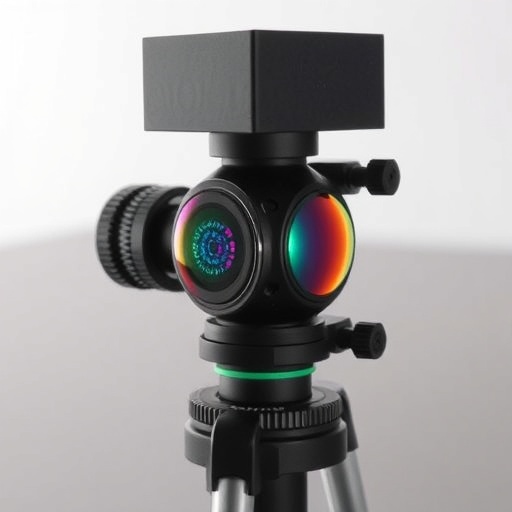
In a groundbreaking advancement poised to redefine the landscape of optical measurement technology, researchers Wang, Shurvinton, Pradhan, and their team have unveiled a novel speckle-based curvature optical metrology method. Published on April 8, 2026, in the prestigious journal Light: Science & Applications, this innovative technique leverages the complex interference patterns known as speckles to achieve unprecedented precision in curvature measurement. This development promises significant applications across various scientific and engineering disciplines, paving the way for more accurate and efficient optical metrology solutions.
Optical metrology has long been an essential tool for scientists and engineers, enabling the precise characterization of surfaces, shapes, and curvatures of materials. Traditional curvature measurement techniques often struggle with limitations related to sensitivity, resolution, and susceptibility to environmental disturbances. The new speckle-based approach elegantly overcomes many of these challenges by exploiting the unique properties of speckle patterns generated through coherent light scattering. This transformative strategy capitalizes on subtle changes in speckle morphology induced by surface curvature variations, thus offering a direct and non-contact method for curvature quantification.
At the core of this breakthrough is the understanding of speckle phenomena, which occur when a coherent light source, such as a laser, illuminates a rough surface or a medium containing microstructural irregularities. The scattered light waves interfere constructively and destructively to form a granular intensity pattern called speckles. While traditionally considered a nuisance in imaging applications due to their noisy appearance, speckles have increasingly been investigated for their potential to encode rich spatial and structural information about the scattering surfaces. The researchers have harnessed this inherent complexity, engineering a computational framework that deciphers curvature information embedded in speckle dynamics with exceptional accuracy.
The methodology devised by Wang and colleagues involves illuminating the test surface with a laser and capturing the resulting speckle pattern via high-resolution imaging optics. Sophisticated image processing algorithms then analyze the spatial statistics and correlation properties of the speckle field. By monitoring subtle alterations in speckle size, shape, and intensity distribution, the system extracts precise measurements of local curvature changes. This contrasts sharply with traditional curvature sensors that often require direct contact or complex interferometry setups, thereby making the novel approach significantly more adaptable and less invasive.
Critically, this speckle-based curvature metrology excels in sensitivity and spatial resolution, attributes essential for applications ranging from microfabrication quality control to biomedical diagnostics. The technique’s capacity to resolve minute curvature differences with nanoscale accuracy equips it to address challenges in fields such as microelectromechanical systems (MEMS), flexible electronics, and tissue engineering. For example, in biomedical contexts, understanding the curvature changes in cellular membranes or biomaterial surfaces can provide vital insights into disease progression and tissue mechanics that were previously difficult to assess noninvasively.
The researchers further demonstrated the robustness of their technique by validating it against established metrology standards. Experimental results confirmed that the speckle-based system achieves consistency and repeatability on par with, or surpassing, conventional optical interferometric and mechanical methods. Importantly, the technique maintains high fidelity even under mildly perturbed environmental conditions, such as vibrations or temperature fluctuations, highlighting its suitability for practical real-world applications.
Technological integration is another noteworthy advantage of this method. The optical setup is relatively compact and cost-effective, relying primarily on off-the-shelf laser sources, imaging sensors, and computational resources. This accessibility encourages widespread adoption in industrial and research environments, breaking down barriers posed by the complexity and expense of existing curvature measurement solutions. Moreover, the computational aspect leverages advanced machine learning techniques to boost interpretative accuracy and speed, automating the curvature extraction process and enabling real-time monitoring capabilities.
The implications of this advancement stretch beyond simple curvature measurement. By providing a new lens through which to view and quantify surface morphology changes, the speckle-based technique opens avenues for dynamic deformation analysis, wear monitoring, and even structural health diagnostics in materials science. For example, engineers could employ such systems to track stress-induced micro-deformations in aerospace components or civil infrastructure, greatly enhancing predictive maintenance and durability assessments.
Furthermore, the speckle-based method aligns with the current drive toward non-contact and non-destructive testing methods in metrology, a crucial trend as industries seek to minimize damage and contamination risks during inspections. The technique’s reliance on light scattering makes it inherently non-invasive, ensuring that delicate or sensitive samples remain intact and unaltered during measurement. This characteristic is particularly vital in precision manufacturing sectors and biological applications where sample integrity is paramount.
The team’s work is grounded in rigorous theoretical modeling, which elucidates the physical relationship between curvature-induced phase variations on the surface and the consequent speckle pattern transformations. By combining optical physics, statistical optics, and signal processing, their multidisciplinary approach bridges fundamental science with practical instrumentation. This synthesis exemplifies how fundamental understanding can drive technological innovation, yielding new tools that catalyze progress across diverse fields.
Notably, the researchers anticipate that the speckle-based curvature metrology approach can be further enhanced through integration with advanced photonic components such as adaptive optics and ultrafast detectors. These enhancements could enable higher time-resolution measurements of transient curvature phenomena, empowering studies of dynamic processes like mechanical vibrations, fluid-structure interactions, and soft matter mechanics. The potential to capture such rapid events non-invasively holds significant promise for both fundamental research and industrial monitoring.
Beyond the realms of scientific inquiry and industry, this technological advancement may also inspire new directions in optical device design and materials characterization. By harnessing speckle patterns as rich information carriers, future optical metrology devices might incorporate machine vision and artificial intelligence to autonomously assess and interpret complex surface geometries. This could democratize high-precision metrology, extending its benefits to smaller-scale laboratories and manufacturing setups worldwide, ultimately driving innovation at multiple scales.
In an era where precision and speed are becoming inseparable demands, the speckle-based curvature optical metrology method marks a significant stride toward meeting these criteria simultaneously. Its blend of simplicity, adaptability, and performance signifies a paradigm shift in how curvature can be measured across scales and contexts. The method’s scalability further enhances its attractiveness, suggesting that it might one day be implemented in handheld devices or integrated into robotic inspection systems, expanding the horizons of automated quality assurance.
Crucially, the publication of this research in Light: Science & Applications underscores its importance and timeliness. As optical metrology technologies continue to evolve, such innovative approaches will be essential to address emerging challenges in material science, nanotechnology, and bioengineering. The speckle-based curvature metrology framework stands as a testament to the creative potential of interdisciplinary research in optics, promising to reshape the measurement landscape with far-reaching impacts.
As with any pioneering technology, future investigations will focus on refining the method for specific applications and exploring its limitations in diverse environmental and material contexts. Nonetheless, the current evidence highlights the method’s robust performance and expansive applicability, putting it at the forefront of contemporary optical metrology innovations. The implications for industry and academia alike are profound, heralding a new era of precise, quick, and non-invasive curvature analysis powered by the subtle art of speckle pattern interpretation.
In conclusion, Wang and his team’s speckle-based curvature optical metrology represents not only a novel scientific achievement but also a transformative technological advancement. By turning what was once seen as a stochastic phenomenon into a practical measurement tool, this work challenges conventional perceptions and opens up a vast horizon of opportunities. It is a vivid reminder that in science, sometimes the key to innovation lies hidden within the noise itself.
Subject of Research: Speckle-based curvature optical metrology technique for precise, non-contact surface curvature measurement.
Article Title: Speckle-based curvature optical metrology.
Article References:
Wang, H., Shurvinton, R., Pradhan, P. et al. Speckle-based curvature optical metrology. Light Sci Appl 15, 192 (2026). https://doi.org/10.1038/s41377-026-02257-x
Image Credits: AI Generated.
DOI: 08 April 2026
Keywords: Optical metrology, speckle pattern analysis, curvature measurement, non-contact sensing, surface morphology, laser speckle, signal processing, machine learning in optics, precision measurement, biomedical diagnostics.
Tags: coherent light scattering applicationscurvature measurement techniquesenvironmental disturbance-resistant metrologyhigh-precision optical surface characterizationlaser speckle interference patternsnon-contact curvature quantificationoptical measurement technology innovationsoptical metrology advancementsscientific optical measurement toolsspeckle pattern morphology analysisspeckle-based curvature measurementsurface shape characterization methods