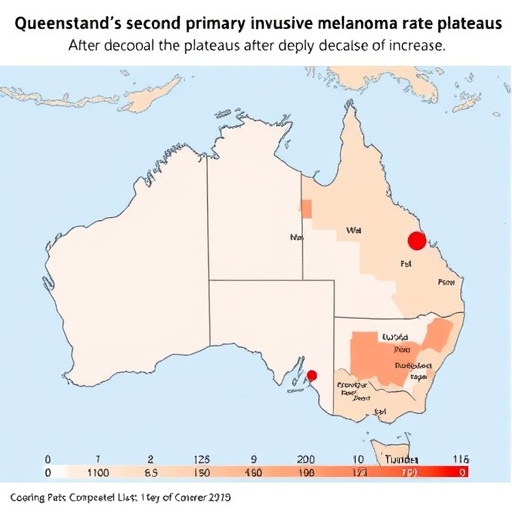
In a groundbreaking large-scale study encompassing over 100,000 individuals diagnosed with invasive cutaneous melanoma in Queensland, Australia, researchers have uncovered a hopeful shift in the epidemiology of second primary melanomas. Published in the Journal of Investigative Dermatology, this comprehensive investigation reveals that the previously rising trend in the incidence of second primary invasive melanomas is now showing signs of plateauing, marking a pivotal milestone in melanoma research and public health.
Queensland has long been recognized as the region with the world’s highest incidence rates of invasive melanoma, a formidable skin cancer known for its aggressive nature and fatal potential if untreated. Those diagnosed with a primary invasive melanoma are at a significantly elevated risk — roughly fivefold — of developing a second invasive melanoma. This heightened susceptibility not only increases morbidity but also the chances of mortality, highlighting the urgency of interventions aimed at risk reduction.
Until now, data on trends concerning second primary melanomas have been notably sparse. The present study is the first to offer conclusive evidence depicting stabilization in the cumulative incidence of subsequent invasive melanomas after an initial diagnosis. The implications of this finding are far-reaching, signaling a potential turning point in the ongoing battle against melanoma’s burden on public health systems.
Utilizing the extensive dataset curated by the Queensland Oncology Repository, under the stewardship of Cancer Alliance Queensland, investigators analyzed records of 101,035 patients diagnosed between 1982 and 2022, with follow-up extending through 2023. The cohort primarily consisted of males, accounting for 58% of the population, with a median age at diagnosis of 61 years. This demographic detail underscores the demographic segments that are disproportionately impacted.
Professor Mark Smithers, leading the research team and an authority in melanoma surveillance, explains the statistical methodology employed. After adjusting for competing mortality risks and accounting for different lengths of patient follow-up, findings estimate that individuals with an initial invasive melanoma have a one-in-six likelihood of receiving a second invasive melanoma diagnosis within a 40-year span. This longitudinal perspective sheds light on the extensive risk horizon faced by melanoma survivors.
The temporal analysis adds nuance to the data. Patients diagnosed between 1982 and 1991 had a 5% risk of second melanoma diagnosis within ten years, a figure that peaked to nearly 8% for diagnoses made between 2002 and 2011, before declining slightly to just over 7% for the 2012-2022 cohort. This pattern reveals a complex interplay of factors over time influencing melanoma development beyond the initial tumor.
Crucially, the deceleration in incidence rates aligns temporally with the inception and persistence of rigorous sun safety awareness campaigns initiated in Queensland during the early 1980s. These public health initiatives have focused on curtailing ultraviolet (UV) radiation exposure, educating both the public and healthcare professionals on the morphological characteristics of melanoma lesions and the imperative for early detection.
Further amplifying the positive trajectory is the role of enhanced clinical surveillance. Advancements in dermatological screening techniques and heightened vigilance by healthcare providers have led to an increased detection rate of melanomas at in situ or early invasive stages, thereby precluding progression and potentially reducing the risk of subsequent invasive tumors.
Demographic transitions within Queensland’s population may also partially explain the evolving epidemiology. Census data indicates a marked increase in residents born overseas—from 12% in 1971 to 23% in 2021—many of whom likely experienced less intense UV exposure during early life and possess skin phototypes characterized by higher melanin content, both factors protective against melanoma genesis.
Despite the encouraging trends, Professor Smithers emphasizes that vigilance must not wane, particularly among subgroups still demonstrating heightened vulnerability. Males and older individuals continue to represent the highest-risk cohorts for second primary melanoma development, necessitating ongoing targeted education and prevention strategies tailored to these populations.
Public health messaging continues to underscore the importance of physical sun protection measures, including protective clothing, broad-brimmed hats, and the use of high-spectrum sunscreens. These interventions, advocated alongside educational initiatives geared toward the early recognition of suspicious skin lesions, remain cornerstone elements in curbing melanoma incidence and improving long-term outcomes for survivors.
Editorial commentary from Dr. David E. Fisher, a distinguished dermatologist at Harvard Medical School, contextualizes these findings within the broader melanoma research landscape. He observes that the study exemplifies how shifts in human behavior, grounded in sustained public health efforts, can directly influence disease trajectories. The prospect of substantially preventable melanoma burden is now transitioning from ambition to reality, offering renewed hope in the fight against this deadly malignancy.
This investigative milestone reaffirms that multi-decadal, concerted efforts encompassing public education, behavioral modification, and clinical vigilance are translating into tangible epidemiological benefits. As melanoma incidence stabilizes among those at highest risk, the momentum generated by these findings is poised to invigorate future research and preventative frameworks globally.
Moving forward, continued investment in comprehensive skin cancer surveillance and educational outreach will be essential in maintaining and furthering progress. The distinct demographic and behavioral dynamics inherent to Queensland provide a vital model for replication in other high-incidence settings worldwide, reinforcing the integral relationship between public health initiatives and measurable cancer control success.
In summary, the study’s results herald a promising inflection point in melanoma management, underscoring the efficacy of sustained public health programs combined with vigilant clinical practice. Although challenges persist, especially in high-risk groups, the stabilization of second primary melanoma incidence offers an inspiring testament to the power of prevention and early detection in combating skin cancer.
Subject of Research: People
Article Title: Second primary invasive cutaneous melanomas in Queensland over 4 decades
News Publication Date: April 7, 2026
Web References: https://doi.org/10.1016/j.jid.2026.01.026
References: Journal of Investigative Dermatology
Keywords: melanoma, invasive cutaneous melanoma, second primary melanoma, skin cancer, Queensland, sun safety campaigns, ultraviolet radiation, cancer epidemiology, melanoma risk, public health, cancer surveillance, UV exposure, skin cancer prevention
Tags: invasive cutaneous melanoma Queenslandinvasive melanoma diagnosis statisticslarge-scale melanoma studymelanoma epidemiology trendsmelanoma morbidity and mortalitymelanoma patient follow-up outcomesmelanoma prevention interventionsmelanoma public health impactmelanoma recurrence ratesmelanoma research milestonesmelanoma risk reduction strategiessecond primary invasive melanoma incidence