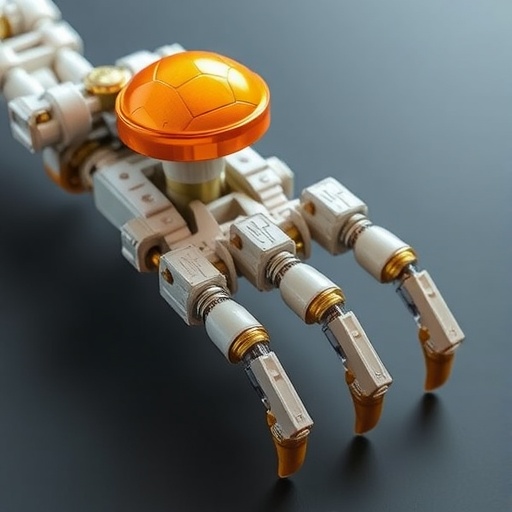
In an extraordinary leap forward for soft robotics, a groundbreaking study published in npj Flexible Electronics has unveiled a pioneering approach combining bioinspired design with asymmetric structural synergy to achieve closed-loop piezoelectric energy harvesting and ionic actuation. This innovative work, led by Yao, Jiao, Xia, and colleagues, introduces a novel framework that not only advances the fundamental understanding of soft robotic systems but also charts a clear path toward highly efficient, self-sustaining robotic devices that could revolutionize multiple industries.
At the heart of this research lies the challenge of integrating energy harvesting and actuation mechanisms within soft robots, which traditionally struggle to reconcile flexibility and power autonomy. Drawing inspiration from biological systems, particularly the asymmetric yet harmonized structures found in muscle and skeletal arrangements, the researchers have crafted a system that leverages structural asymmetry to enhance both energy conversion and responsive movement in soft materials. This bioinspired strategy disrupts conventional design paradigms and offers an elegant solution to longstanding efficiency constraints.
Central to the innovation is the use of piezoelectric materials embedded asymmetrically within the soft robot’s framework. Piezoelectric materials generate electric charge in response to mechanical stress, thus providing a natural means of converting mechanical deformation—such as bending or compressing—into usable electrical energy. By strategically orienting these materials within the robot’s body, the team accomplished an amplified energy harvesting effect, where mechanical actions not only drive movement but concurrently produce electrical power to feed back into the system.
The closed-loop configuration epitomizes the synergy between energy capture and actuation. Unlike open-loop systems, which dissipate harvested energy or rely on external supplies, the closed-loop design allows the robot to dynamically regulate its own power generation and usage. Specifically, the ionic actuators respond directly to piezoelectrically generated electrical stimuli, producing contraction and relaxation movements that mimic biological muscle function. This tight coupling of harvesting and actuation creates a continuous feedback mechanism, significantly improving both operational efficiency and sustainability.
The detailed fabrication process underpins the overall performance enhancements observed. The researchers used flexible polymer matrices embedded with piezoelectric nanofibers arranged in gradient and asymmetric patterns, mimicking the variable density and orientation of connective tissues in living organisms. This meticulous structural arrangement allows localized stress concentrations that optimize electrical output while maintaining mechanical compliance, a crucial balance for durable yet responsive robotic components.
Moreover, the ionic actuators employed differ fundamentally from traditional electromagnetic or pneumatic actuators. Operated via ion migration under electrical fields, these actuators induce volumetric changes within polymer electrolytes, yielding smooth, muscle-like motion without bulky hardware. Integrating these with the piezoelectric harvesters in a harmonious structural design enables the robot to achieve fluid and nuanced movements which open new horizons for applications requiring delicate interaction or adaptability.
A comprehensive suite of experiments validated the concept under various mechanical loading scenarios. Results demonstrated that asymmetric placement of piezoelectric elements not only increased the harvested energy by over 40% compared to symmetric designs but also improved the actuation response time and amplitude significantly. This empirical evidence confirms that deliberate structural asymmetry, far from being a simple irregularity, constitutes a fundamental principle for optimizing soft robotic functionality.
Another remarkable outcome is the system’s self-sustaining operational capacity. The closed-loop mechanism implies that after an initial activation, the robot can perpetuate its motion autonomously by continuously harvesting environmental mechanical energy—such as bending motions or external vibrations—and converting it into ionic actuation. This capability could drastically reduce dependence on external batteries or tethered power sources, paving the way for truly autonomous soft robots.
Potential applications of this technology are vast and transformative. In the biomedical field, soft robots capable of harvesting energy from body movements and performing ionic actuation could lead to next-generation implants or prosthetics with enhanced responsiveness and longevity. Industrial automation may also benefit from flexible robotic manipulators capable of operating in complex, unstructured environments without external energy constraints.
The bioinspired design philosophy reflected in this study highlights nature’s proficiency in optimizing multifunctional systems through asymmetry and material gradients. By embracing these evolutionary principles, the researchers have demonstrated that engineering need not mimic biological form superficially but can adopt deeper structural and functional principles to solve modern technological challenges effectively.
Furthermore, the study’s implications extend beyond soft robotics alone, suggesting new avenues for flexible electronics and energy harvesting devices. Piezoelectric materials arranged in asymmetric constructs could be incorporated into wearable technologies, smart textiles, or environmental sensors, offering concurrently mechanical adaptability and energy autonomy.
From an engineering perspective, the integration of closed-loop piezoelectric harvesting with ionic actuation represents a highly interdisciplinary advancement, merging mechanics, materials science, electrochemistry, and robotics. This holistic approach instills robustness and adaptability into systems where traditional rigid robotics would falter.
The experimental methodology included advanced characterization techniques such as scanning electron microscopy to elucidate nanofiber alignment, electrical impedance spectroscopy for actuator response, and dynamic mechanical analysis to optimize polymer flexibility. These meticulous characterizations were essential to ascertain the precise relationships between structural asymmetry, energy output, and actuation efficacy.
Looking ahead, the researchers envision further refining the architecture by incorporating adaptive materials capable of self-healing or environmental responsiveness, potentially enhancing durability and functional complexity. Incorporating machine learning algorithms to modulate closed-loop feedback dynamically might also optimize performance across varying operational contexts.
This landmark study stands as a beacon of innovation, illuminating the path toward a new generation of smart, autonomous soft robots that seamlessly blend energy harvesting and actuation. The bioinspired asymmetric structural synergy framework challenges conventional designs and opens therewith unprecedented opportunities for flexible electronics and robotics technologies, ultimately expanding the frontier of what these systems can achieve.
In summary, the work presented by Yao, Jiao, Xia, and colleagues epitomizes a significant leap toward highly efficient, self-powered soft robotic systems. The extraordinary fusion of asymmetric piezoelectric energy harvesting with ionic actuators within a closed-loop framework embodies a future where soft robots not only mimic life’s movements but also its remarkable efficiencies and sustainability. This fusion promises to redefine robotics across healthcare, environment, and manufacturing landscapes with a new standard of flexibility and autonomy.
Subject of Research: Soft robotics, energy harvesting, piezoelectric materials, ionic actuation, bioinspired structural design
Article Title: Bioinspired asymmetric structural synergy for soft robotics: closed-loop piezoelectric harvesting and ionic actuation
Article References:
Yao, H., Jiao, Y., Xia, Z. et al. Bioinspired asymmetric structural synergy for soft robotics: closed-loop piezoelectric harvesting and ionic actuation. npj Flex Electron (2026). https://doi.org/10.1038/s41528-026-00570-4
Image Credits: AI Generated
Tags: asymmetric structural synergy in roboticsbioinspired muscle skeletal systemsbioinspired soft robotics designclosed-loop piezoelectric energy harvestingefficiency in soft robotics systemsenergy autonomy in flexible robotsenergy conversion in soft materialsflexible robot power solutionsionic actuation in soft robotsnovel soft robotic actuator frameworkspiezoelectric materials in roboticsself-sustaining soft robotic devices