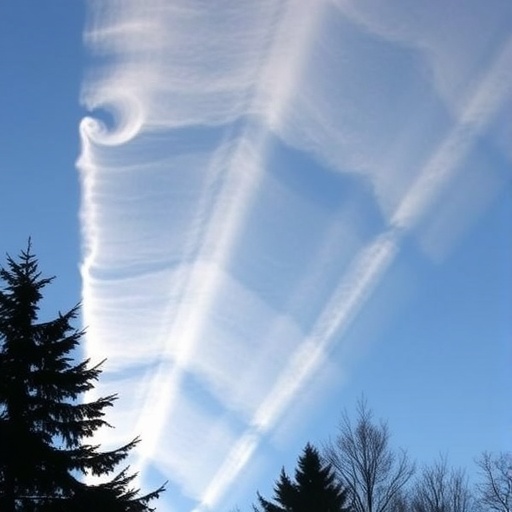
In a groundbreaking study published on April 2, 2026, researchers have revealed that aircraft contrail formation can occur significantly even at remarkably low soot emission levels, challenging long-held assumptions about the primary nucleation mechanisms within jet engine exhaust plumes. This discovery, achieved through an advanced aerosol and contrail microphysics (ACM) model enhanced to include new pathways of volatile particle formation, uncovers the critical roles that lubrication oil vapors and low-volatile organic aerosols play in contrail ice nucleation, particularly under lean-burn combustion conditions.
Traditionally, soot particles emitted from aircraft engines were understood to be the principal nuclei for contrail ice crystal formation. However, the improved ACM model now explicitly accounts for the nucleation and condensation processes of lubrication oil vapors vented into the engine exhaust stream. The model further integrates the contribution of low-volatile organic aerosols formed from incomplete combustion of fuel hydrocarbons. This holistic approach offers a nuanced understanding of the particle population in the exhaust plume and better matches contrail observations, especially in low-soot regimes.
Contrail ice crystal numbers, a crucial determinant of contrail optical properties and climate impact, show a strong sensitivity to the type of fuel used—chiefly its sulfur and aromatic hydrocarbon content. For sulfur-rich Jet A-1 fuel, the model and observational data converge to suggest that newly formed volatile sulfate aerosol particles account for a majority of ice nuclei, supplemented by minor inputs from organic and lubrication oil particles. The implication here is profound: even minimal emissions of sulfur can drive contrail formation via volatile sulfate nucleation in conditions where soot particles are scarce.
Conversely, when the fuel sulfur content is lowered using hydroprocessed esters and fatty acids synthetic paraffinic kerosene (HEFA-SPK) blends with reduced sulfur levels, contrail ice crystal numbers diminish dramatically, by approximately a factor of three. This reduction underscores the impact of sulfur on volatile sulfate aerosol production. Yet, despite this decrease, significant ice nucleation persists, attributable to volatile organic compounds and lubrication oil vapors released into the engine core. The model’s reproduction of measured contrail ice crystal counts using emission indices of lubrication oil and organics validates this critical alternate nucleation mechanism.
To push the boundaries further, ultralow-sulfur fuels with sulfur contents as low as 3 parts per million by mass (ppmm) have shown an order of magnitude reduction in contrail ice crystals, reinforcing the negligible role of sulfur in volatile particle formation at these concentrations. Under such stringent sulfur limits, organic vapor and lubrication oil emissions emerge as dominant pathways for contrail aerosol nucleation and growth, revealing a heretofore underappreciated control on contrail microphysics that may redefine aviation climate impact modeling.
Comprehensive sensitivity analyses with the microphysical contrail model corroborate these findings by demonstrating how subtle variations in soluble organic emissions can govern contrail formation dynamics in low-soot regimes. This expanded framework moves beyond the canonical picture relying solely on soot as ice nuclei. Instead, it recognizes the synergy of volatile sulfate aerosols, lubrication oil particulates, and organics in ice crystal formation—offering a mechanistic explanation consistent with observed contrail particle size distributions and concentration levels.
Notably, measurements indicate slightly larger ice crystals in contrails derived from HEFA-blend fuels compared with conventional Jet A-1 when combustion occurs under lean-burn and forced rich-burn conditions. This observation is interpreted as resulting from a more evenly distributed water vapor load among fewer ice nucleation sites, allowing crystals to grow larger. These empirical insights lend weight to the hypothesis that fuel composition intricately affects not only ice nuclei numbers but also crystal growth morphology and contrail radiative characteristics.
The evolutionary leap in contrail modeling comes at a critical juncture as the aviation industry strides toward the adoption of low-aromatic, low-sulfur alternative fuels to mitigate global warming effects. The clear identification of lubrication oil and organic vapors as viable ice-nucleating agents calls for re-evaluation of emission standards and contrail mitigation strategies. It also highlights the necessity for holistic approaches that consider all aerosol sources emanating from engine exhaust, rather than narrowly focusing on soot reduction alone.
Furthermore, the model simulations, performed at various ambient temperatures representative of upper tropospheric conditions, illustrate that contrail ice crystal numbers decrease with increasing temperature for the same fuel type and combustion regime. This temperature dependency aligns with fundamental nucleation theory but also stresses the importance of environmental conditions in governing contrail climate forcing potential, thus framing policies that might consider operational altitude adjustments to minimize contrail impacts.
Integrating these complex aerosol-chemistry interactions, the updated ACM contrail model offers unprecedented predictive power for contrail ice crystal number emissions across a broad spectrum of fuel compositions, combustion modes, and atmospheric thermodynamic states. Its congruence with extensive experimental data—spanning both recent campaigns and legacy measurements from soot-rich combustor configurations—underscores the robustness and utility of this modeling approach for future contrail research and mitigation planning.
This work not only advances the scientific understanding of contrail microphysics but also carries tangible implications for aviation’s environmental footprint. By pinpointing key variables influencing contrail ice nucleation beyond soot, it opens avenues for optimizing fuel formulations and engine designs geared toward minimal contrail formation, thereby helping to unlock pathways toward greener aviation.
In conclusion, the remarkable findings of this study stress the importance of volatile aerosol species, including sulfate, organics, and lubrication oil vapors, in contrail formation under low-soot emissions. This multifaceted view reconciles previously unexplained contrail observations and charts a course for more sophisticated contrail mitigation techniques aligned with the emergent low-emission fuel landscape, reshaping how the aviation sector confronts its climatic challenge.
Subject of Research:
Contrail formation mechanisms under low soot emission conditions influenced by fuel composition, lubrication oil vapors, and volatile organic aerosols in jet engine exhaust.
Article Title:
Substantial aircraft contrail formation at low soot emission levels.
Article References:
Voigt, C., Märkl, R., Sauer, D. et al. Substantial aircraft contrail formation at low soot emission levels. Nature 652, 112–118 (2026). https://doi.org/10.1038/s41586-026-10286-0
Image Credits:
AI Generated
DOI:
https://doi.org/10.1038/s41586-026-10286-0
Keywords:
Contrail formation, low soot emissions, aircraft exhaust aerosols, volatile sulfate aerosol, lubrication oil vapor, low-volatile organic aerosol, HEFA-SPK fuel, Jet A-1 fuel, ice nucleation, aerosol microphysics, aviation climate impact, combustion regimes
Tags: advanced contrail microphysics modelingaerosol and contrail microphysics modelaircraft contrail formation at low soot levelsaircraft fuel sulfur impact on contrailsaromatic hydrocarbons in jet fuel contrailscontrail optical properties and climate impactjet engine exhaust nucleation mechanismslean-burn combustion contrail effectslow-volatile organic aerosols in exhaustlubrication oil vapor in contrail formationsoot-independent contrail ice nucleationvolatile particle formation in jet exhaust