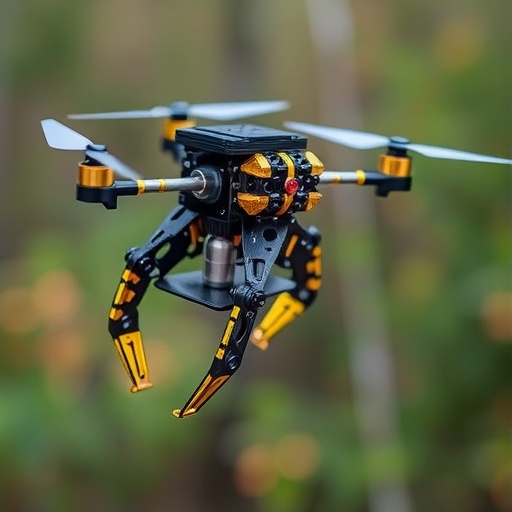
Unmanned aerial vehicles (UAVs) have become indispensable tools for a range of applications, from environmental monitoring to disaster response. Nevertheless, their operational endurance is fundamentally limited by onboard energy reserves, primarily because these vehicles continuously expend power to generate lift during hovering. To address this challenge, researchers have focused on innovative ways to extend UAV mission duration without drastically increasing energy storage. Among the most promising approaches is enabling UAVs to perch on surfaces such as branches, poles, or other natural and artificial supports. This perching capability allows the aerial platform to replace energy-intensive hovering with energy-efficient, structurally supported resting.
However, developing UAV perching mechanisms entails overcoming several engineering hurdles. Existing robotic grippers inspired by biological systems typically demand precise coordination between flight dynamics and the grasping actuation sequence. Moreover, many current designs require a continuous or intermittent supply of power to maintain a stable grasp after perching, which reduces the energy savings gained by perching. In recent years, bistable grippers—mechanical systems characterized by two stable equilibrium states—have shown promise for reducing control complexity and minimizing power consumption by leveraging passive engagement. Despite this, conventional bistable designs often suffer from a fixed energy barrier because of their mechanical configuration, which curtails adaptability and the ideal balance between sensitivity during triggering and robustness during grasp retention.
In a groundbreaking study, a research team led by Lulu Han at Sun Yat-Sen University has introduced a novel magnetic tensegrity-enabled bistable robotic gripper (MTRG) that marks a significant advancement in UAV perching technology. The core innovation of this gripper lies in its ability to passively modulate the energy barrier between its stable states using the interplay of magnetic forces and cable tensions—without relying on external control or additional energy input during operation. This design allows the system to harmonize the competing demands of compliant triggering and secure grasp retention, which has long posed a trade-off in bistable robotic grippers.
Structurally, the MTRG comprises two finger-like rigid frames connected via hinges to a base platform. The fingers are linked by non-elastic cables and sliding supports, contributing to the tensegrity architecture—a type of structure that maintains its integrity through a balance of tension and compression elements. Integral to this configuration are two neodymium magnets whose nonlinear interaction drives the bistable behavior. In the initial state, magnetic attraction and cable tension are balanced to keep the gripper open. Upon applying an external force, this delicate equilibrium is disrupted, rapidly propelling the fingers into a closed grasping position.
To facilitate repeated gripping cycles, the research incorporated a novel active reset mechanism into the system. This mechanism features an inflatable airbag and an elastic restoring element embedded in the gripper’s base, which work in concert to transition the gripper back to its open state following a grasp. The integration of pneumatic components, specifically the airbag, into the resetting process marks a critical step toward achieving cyclic usability and robustness in real-world UAV applications.
The research team employed a comprehensive theoretical modeling framework grounded in the geometric configuration of the gripper to optimize its design parameters. Parametric analyses investigated the impacts of magnet spacing, magnetic force magnitudes, cable tension, and energy transitions between states, culminating in a design region that delicately balances triggering sensitivity with reliable grasping stability. Rigorous experimental evaluations using high-speed imaging and quasi-static mechanical testing substantiated these theoretical insights, enabling precise quantification of closing dynamics, triggering forces, and failure loads.
Remarkably, the MTRG exhibits a highly asymmetric energy barrier profile due to the nonlinear magnetic interactions engineered into the system. Transitioning from the open state to the grasping state requires a minimal energy input of roughly 0.58 joules, whereas reverting from the grasped to the open state demands nearly 48.88 joules, establishing an energy disparity of about 85 times. This asymmetry empowers the gripper to close swiftly within approximately 42 milliseconds under minimal triggering forces, measured experimentally at a maximum of 0.15 newtons. The holding force capability is equally impressive, with the gripper demonstrating a failure force surpassing 25 newtons—an order of magnitude roughly 200 times higher than the triggering force.
Beyond static performance metrics, the gripper’s resilience under dynamic environmental conditions was assessed. While grasp stability experienced expected declines with increasing vibration frequency, these results nonetheless confirmed meaningful environmental adaptability, crucial for practical UAV missions where external disturbances are prevalent. Additionally, the gripper’s holding abilities improved by 30% on rough surfaces, and it effectively supported payloads ranging from 0.45 to 2.07 kilograms, demonstrating versatility across different operational scenarios.
The pneumatic reset mechanism was sensitively optimized, with the airbag functioning reliably at an inflation pressure of 28 kilopascals. The integrated system achieved a reset time of approximately 15 seconds and deflation within 20 seconds, significantly enhancing the gripper’s potential for continuous, repeatable operation in the field. Such innovations allow UAVs to perch and then quickly redeploy, maintaining mission flexibility while conserving energy.
To validate the system’s efficacy in aerial applications, the MTRG was integrated onto a multirotor UAV platform, accompanied by onboard pumping, pulse-width modulation control, sensory, and communication modules. Energy consumption tests comparing hovering with perching scenarios on the UAV confirmed the substantial energy-saving benefits of the perching mechanism. Outdoor demonstrations underscore the gripper’s reliable performance across various environmental conditions, while ultra-wideband (UWB) location tracking verified precise positional stability during grasping.
This work not only pushes the frontier of UAV operational endurance but also contributes fundamentally to the design paradigms of bistable robotic systems. The magnetically actuated tensegrity mechanism harnesses physical intelligence to passively reconcile the longstanding challenge of simultaneously achieving low-cost triggering and high holding reliability in bistable grippers. By leveraging adaptive energy-barrier modulation, the gripper provides a sophisticated yet energy-efficient solution to perching—a crucial capability for future aerial robotic tasks operating in complex, unstructured environments.
In conclusion, the magnetic tensegrity-enabled bistable robotic gripper developed by Lulu Han and colleagues represents a paradigm shift for UAV perching technology. The confluence of passive energy modulation, rapid and robust grasping, and an active pneumatic resetting system enables extended mission duration, operational adaptability, and reliable deployment. As UAVs continue to proliferate across diverse sectors, this innovation offers a compelling path toward sustainable, energy-efficient aerial robotics that can undertake long-duration environmental monitoring, high-altitude operations, and intricate tasks within complex ecosystems.
Subject of Research: Magnetic tensegrity-enabled bistable robotic gripper for UAV perching.
Article Title: Magnetic Tensegrity-Enabled Robotic Gripper with Adaptive Energy Barrier for UAV Perching.
News Publication Date: March 9, 2026.
Image Credits: Lulu Han, Sun Yat-Sen University.
Keywords
UAV perching, bistable gripper, magnetic tensegrity, energy barrier modulation, robotic grasping, pneumatic reset mechanism, aerial robotics, adaptive grasping, energy efficiency, nonlinear magnetic interaction, physically intelligent mechanisms, multirotor UAV.
Tags: adaptive energy barrier mechanismsautonomous UAV perch and releasebiologically inspired UAV graspingbistable robotic grippersenergy-efficient UAV perching systemsinnovative UAV support mechanismsmagnetic tensegrity in roboticsmechanical design for UAV landingpassive engagement gripper technologyrobotic gripper for UAV perchingUAV energy consumption reductionUAV mission endurance extension