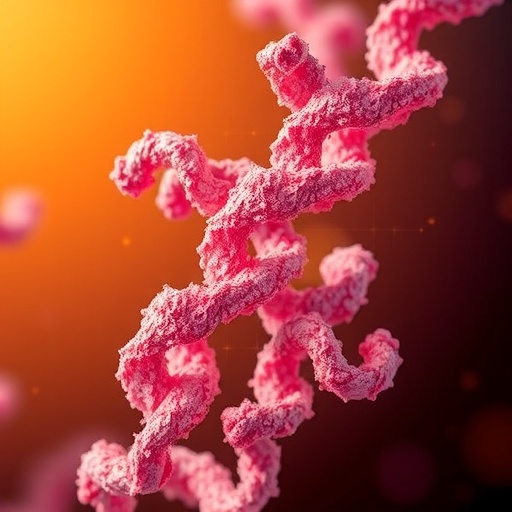
In the rapidly evolving field of structural biology, the accurate prediction of protein structures from amino acid sequences remains a monumental challenge. Traditional methods, such as those relying heavily on homologous sequence information, have made significant strides but continue to demand considerable computational resources and extensive databases of evolutionary data. Recently, an innovative approach known as Two-Dimensional Geometric Template Diffusion (TDFold) has emerged, promising to redefine the landscape of single-sequence protein structure prediction with remarkable accuracy and efficiency.
TDFold addresses one of the critical limitations of many existing protein prediction tools: the dependency on multiple sequence alignments and homologous structures. The approach is poised to revolutionize structure prediction by relying solely on individual sequences, bypassing the need for extensive evolutionary data mining. At its core, TDFold utilizes a diffusion model that generates geometrically precise pairwise distance and orientation constraints between amino acid residues in a two-dimensional matrix format. This innovation enables the method to capture spatial relationships inherent to the folded protein without the computational overhead typically associated with homology-based techniques.
The methodology of TDFold is ingeniously split into two primary stages. The first stage involves the generation of two-dimensional geometric templates which effectively capture the pairwise fiber-optic patterns of residue interactions. These templates serve as foundational guides for the subsequent prediction stage. The second stage is characterized by an integrative learning framework where the protein sequence collaborates synergistically with the geometric templates. This collaborative learning paradigm allows for a coherent translation from abstract geometries to detailed three-dimensional conformations, ensuring high fidelity in the final protein model.
One of the groundbreaking elements of TDFold lies in its capacity to outperform state-of-the-art protein language models such as ESMFold and OmegaFold, as well as homology-based giants like AlphaFold2, AlphaFold3, and RoseTTAFold. Notably, TDFold achieves superior predictive accuracy even when working with proteins lacking homologous counterparts, a notorious blind spot for many traditional methods. This capability stems from its innovative use of geometric diffusion mechanisms coupled with a robust training regime that emphasizes generalizability from limited data.
Efficiency in computational biology workflows is paramount, especially for institutions without access to sprawling computational infrastructures. Here, TDFold distinguishes itself not only by its accuracy but also by dramatically reducing resource consumption. The streamlined architecture leverages dimensionality reduction and effective learning strategies to minimize memory usage and inference time. Consequently, researchers in resource-constrained environments—from academic labs to smaller biotech companies—gain unprecedented access to powerful predictive tools that were once dominated by resource-intensive frameworks.
A notable domain where TDFold showcases its prowess is in datasets characterized by homology insufficiency, such as the Orphan and Orphan25 datasets. These datasets comprise protein sequences without clear evolutionary relatives, which traditionally hamper predictive accuracy. Through extensive testing on these challenging datasets, TDFold consistently delivered high-quality structural predictions that rival or exceed those attained by more computationally heavy homologous methods, highlighting its potential in frontier protein engineering and novel protein discovery.
Moreover, the CASP (Critical Assessment of Protein Structure Prediction) benchmarks serve as molten testing grounds for emerging computational models, and TDFold has made significant inroads here as well. In these rigorous and diverse assessments, TDFold has demonstrated its unique balance of speed and precision, often outperforming or matching the predictions of models dependent on substantial evolutionary information. These results underscore TDFold’s potential as a versatile tool that can adapt to a wide range of protein sequences, including those that elude traditional homology-based approaches.
The implications of TDFold are vast. By democratizing access to accurate protein structure models without the prerequisite of large-scale homologous datasets, this technology could accelerate drug discovery, enzyme design, and many other applications dependent on structural insights. The reduction in computational expense and increase in prediction speed imply that previously prohibitive studies can now be undertaken more routinely, expanding the horizon of structural biology research.
From a technical perspective, TDFold’s architecture exemplifies the fusion of machine learning innovations with domain-specific geometric understanding. The two-dimensional diffusion process mirrors physical diffusion phenomena, adjusted to propagate spatial constraints through the residue network. This analogy enables the model to capture complex intra-molecular interactions without resorting to exhaustive combinatorial approaches. Furthermore, the collaborative learning network integrates sequence embeddings with geometric templates, allowing the model to refine its predictions iteratively and coherently.
The success of TDFold also contributes to the growing narrative that single-sequence methods can, under appropriate algorithmic frameworks, challenge the dominance of multiple sequence alignment-based models. This paradigm shift is particularly relevant given the exponential increase in available metagenomic data, where many sequences remain orphaned or await functional characterization. TDFold’s approach ensures that even such sequences can be connected to structural models, providing vital clues about their function and potential utility.
As the scientific community navigates the challenges of understanding the proteome’s vast complexity, tools like TDFold stand out by bridging gaps in dataset availability and computational power. The model’s ability to generalize across protein classes and maintain efficiency will likely inspire a new generation of hybrid predictive frameworks, further accelerating the biological discovery pipeline.
It is also important to highlight the potential educational impact of TDFold. By lowering the barriers to entry for protein structure prediction, universities and teaching institutions can incorporate cutting-edge computational biology into their curricula without the need for substantial computing resources. This democratization of access ultimately fosters a more inclusive scientific environment, nurturing a wider pool of future leaders in protein science.
Despite its promising performance, TDFold also opens avenues for future research and development. Integrating additional modalities such as biochemical constraints, dynamic simulation refinements, or hybrid experimental data could enhance model robustness and applicability to even more challenging protein targets, including large complexes or intrinsically disordered regions.
In conclusion, the introduction of the Two-Dimensional Geometric Template Diffusion method marks a significant leap forward in protein structure prediction. By combining geometric precision, collaborative learning, and efficient resource utilization, TDFold sets a new benchmark for single-sequence-based modeling. This breakthrough not only advances theoretical understanding but also transforms practical approaches, making protein structure prediction faster, more accessible, and exquisitely accurate. Its impact is poised to resonate across the life sciences, from molecular biology research to pharmaceutical innovation.
Subject of Research: Protein structure prediction using single amino acid sequences without reliance on homologous information.
Article Title: Two-dimensional geometric template diffusion for boosting single-sequence protein structure prediction.
Article References:
Wang, X., Zhang, T., Cui, Z. et al. Two-dimensional geometric template diffusion for boosting single-sequence protein structure prediction. Nat Mach Intell (2026). https://doi.org/10.1038/s42256-026-01210-2
Image Credits: AI Generated
DOI: https://doi.org/10.1038/s42256-026-01210-2
Tags: amino acid spatial relationshipscomputational structural biologyevolutionary data-free structure predictiongeometric diffusion in biologyhomology-independent protein modelingpairwise distance constraints in proteinsprotein folding diffusion modelsprotein folding efficiency improvementsprotein structure predictionsingle-sequence protein foldingTDFold methodtwo-dimensional geometric template diffusion