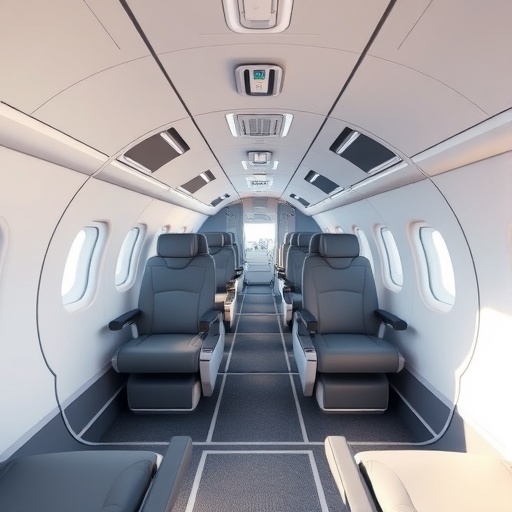
In a remarkable stride toward enhancing aviation safety, a team of international researchers has conducted an extensive study examining how the distribution of elderly passengers impacts emergency evacuation times in the Airbus A320 cabin, particularly under the stress of a dual-engine fire scenario. This research intersects the pressing demographic shift towards an aging global population with the stringent regulatory demands placed on aircraft evacuation protocols, notably the Federal Aviation Administration’s (FAA) requirement that a full aircraft must be evacuated within 90 seconds in emergency situations.
The Airbus A320, chosen for this study due to its widespread use as a narrow-body aircraft, serves as a critical platform to model and simulate emergency evacuations. The investigators employed advanced computer-aided design to create full-scale digital replicas of the cabin, varying the seating layouts and passenger demographics to reflect realistic scenarios. Their simulations leveraged Pathfinder software, a leading industry-standard tool used to model human behavior and movement during evacuations, enabling precise predictions regarding how passengers navigate restrictive aircraft aisles and exit rows under duress.
Researchers identified that not merely the presence of elderly passengers, but their proportional representation and spatial allocation within the cabin dramatically affect evacuation times. Scenarios featuring a higher density of older adults in clustered positions resulted in significant delays, highlighting the interplay between reduced mobility, cognitive decision-making speed, and the physical constraints of the aircraft environment. Intriguingly, the simulation that achieved the fastest evacuation time incorporated two rows of first-class seating at the aircraft’s front, accommodating 152 passengers including 30 elderly individuals evenly dispersed throughout the cabin, yet still required 141 seconds—well beyond the regulatory 90-second threshold.
This delay underscores a critical challenge—cognitive decline, which frequently accompanies aging, negatively influences situational awareness and reaction times during emergencies. Combined with diminished dexterity and potential sensory impairments, elderly passengers may require additional support or tailored strategies to expedite evacuation without compromising safety. The implications of these findings extend to operational policies, suggesting that airlines could benefit from revisiting seating arrangements and safety briefing protocols, possibly incorporating specialized attentiveness toward older demographics.
Historically, incidents like the “Miracle on the Hudson,” though rare, exemplify the severe risks posed by dual-engine failures or fires, bringing dual-engine emergencies from theoretical scenarios into tangible crises. The study’s emphasis on this rare but impactful event category underlines a commitment to anticipating worst-case situations, affirming an emphasis on utmost preparedness in aviation safety standards.
Technically, the simulations incorporated variables such as cabin layout configurations, passenger age ratios (with a distinct focus on elderly subsets), and spatial distribution models, revealing the compound effect of these parameters on total egress timings. The research contributes a nuanced understanding of how human factors—especially regarding an aging traveler population—can be integrated into evacuation models to refine regulatory safety mandates and operational guidelines.
Looking forward, the study authors acknowledge the complexity introduced by other vulnerable populations, including children, infants, and pregnant passengers, whose physiological characteristics and behavioral responses can equally influence evacuation dynamics. Future research aims to integrate these groups into simulation frameworks, progressively enriching the fidelity of evacuation modeling and fostering comprehensive strategies for all passenger categories.
In conclusion, this research presents a salient case for airlines to proactively adapt their risk management frameworks by factoring in the demographic realities of their passengers. Strategic seating distributions, augmented safety briefings tailored for elderly travelers, and potentially revised evacuation protocols could collectively enhance passenger safety outcomes. As the aviation industry grapples with evolving global demographics, integrating scientific insights such as these becomes paramount to maintaining rigorous safety standards.
The study, set to be published in AIP Advances, represents an invaluable contribution to the fields of transportation safety engineering and human factors research, pushing the boundaries of how technology and demographic science converge to safeguard lives. Through innovative simulation methods and a clear focus on practical applicability, it serves both academia and the airline industry by illuminating pathways toward optimizing emergency response effectiveness in contemporary commercial aviation.
Subject of Research: The impact of elderly passenger distribution on evacuation efficiency in the Airbus A320 under dual-engine fire emergencies.
Article Title: Effect of elderly passenger distribution on A320 aircraft evacuation under dual-engine fire scenarios
News Publication Date: March 31, 2026
Web References: https://doi.org/10.1063/5.0310405
Image Credits: Zhao et al.
Keywords
Aircraft evacuation, Airbus A320, elderly passengers, emergency safety, dual-engine fire, evacuation modeling, human factors, Pathfinder simulation, aviation safety, aging population, passenger distribution, cognitive decline
Tags: Airbus A320 cabin designaircraft aisle movement dynamicsaircraft evacuation efficiencyaviation safety researchcomputer-aided cabin modelingdemographic influence on evacuationdual-engine fire emergencyelderly passengers impact on evacuationemergency evacuation simulationFAA evacuation regulationsnarrow-body aircraft evacuationPathfinder evacuation software