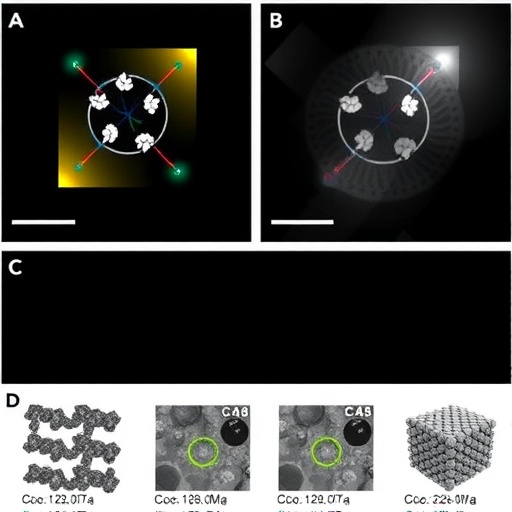
In the global race to combat climate change and develop sustainable energy technologies, the photocatalytic conversion of carbon dioxide (CO₂) into valuable fuels and chemicals presents an exceptionally promising avenue. Recently, researchers have unveiled a groundbreaking catalyst design that leverages the unique properties of palladium (Pd) species within a three-dimensional ordered macroporous (3DOM) indium oxide (In₂O₃) matrix, achieving remarkable performance in solar-driven CO₂ reduction using water (H₂O) as a hydrogen source. This innovative approach not only enhances catalytic efficiency but also provides critical insights into the intricate mechanisms underlying photocatalytic CO₂ conversion.
One of the core challenges in photocatalytic CO₂ reduction lies in the simultaneous optimization of both charge separation and proton transfer dynamics. These processes govern the efficiency of the half-reactions: the reduction of CO₂ to carbon monoxide (CO) and the oxidation of water to oxygen (O₂). Addressing this complexity requires engineering catalysts with multiple active sites that can facilitate these dual pathways concurrently and synergistically. To this end, the research team, led by Professor Benxia Li at Zhejiang Sci-Tech University, has designed a catalyst integrating both Pd single atoms (Pd₁) and Pd clusters (Pd_c) anchored within a 3DOM In₂O₃ framework. This architecture aims to harness the distinct catalytic properties of isolated atoms and nanoscale clusters within a highly porous and accessible support.
The 3DOM structure of In₂O₃ offers a large surface area and interconnected pore network, crucial for mass transport and substrate accessibility. This ordered macroporosity greatly enhances the exposure of active sites and facilitates the diffusion of reactants and intermediates, thereby optimizing reaction kinetics. Pd single atoms embedded in this matrix serve as highly selective active centers for the CO₂ reduction reaction, catalyzing the selective formation of CO with high efficiency. Meanwhile, Pd clusters exhibit localized surface plasmon resonance (LSPR), a phenomenon that amplifies their light absorption capabilities and induces a photothermal effect.
This photothermal effect, unleashed through the plasmonic excitation of Pd clusters under simulated sunlight, causes a rapid temperature increase on the catalyst surface, reaching temperatures around 230 °C. Such localized heating accelerates reaction kinetics by lowering activation energy barriers and improving charge carrier mobility, effectively coupling light absorption with thermal catalysis. Thus, this dual photocatalytic-photothermal mechanism introduces a new dimension to solar-driven catalysis, bridging photonic and thermal effects in a single catalyst system.
In terms of synthesis, the Pd₁+c/3DOM-In₂O₃ catalyst was fabricated via a template-assisted in situ pyrolysis method, followed by a controlled thermal treatment in a reducing atmosphere of mixed hydrogen and argon gases. This process ensures the stable coexistence of Pd single atoms and clusters, preserving the integrity of the 3DOM In₂O₃ scaffold. By carefully tuning synthesis parameters, the researchers achieved a balanced distribution of Pd species that facilitated the vital synergy between distinct catalytic sites.
Performance tests under simulated sunlight irradiation demonstrated that this catalyst attained an impressive CO evolution rate of approximately 192.52 μmol per gram of catalyst per hour. Importantly, selectivity towards CO production reached 88.51%, underscoring the catalyst’s ability to steer reaction pathways efficiently while suppressing competing side reactions such as hydrogen evolution. This level of activity and selectivity places the Pd-based 3DOM catalyst at the forefront of emerging photocatalysts in the field of solar fuel generation.
To unravel the catalytic mechanisms at the atomic level, the study employed density functional theory (DFT) calculations. These computational insights revealed that Pd clusters significantly reduce the thermodynamic barriers associated with H₂O dissociation, thereby facilitating proton-coupled electron transfer processes essential for CO₂ reduction. Concurrently, isolated Pd single atoms act as prime catalytic sites for the activation and selective reduction of CO₂ to CO. The enhanced CO₂ adsorption on neighboring Pd clusters further augments the overall catalytic activity through a cooperative interaction between atomically dispersed species and clustered ensembles.
This dual-site synergy also optimizes charge carrier dynamics by improving the separation and migration of photogenerated electrons and holes within the photocatalyst. The improved charge dynamics reduce recombination losses, boosting the overall quantum efficiency of the system. Such an integrated catalytic platform exemplifies the design principles necessary to overcome traditional limitations in photocatalytic CO₂ conversion technologies.
Beyond providing a potent catalyst for solar fuel production, this research offers broader implications for the design of multicomponent catalysts in heterogeneous photocatalysis. The architecture demonstrated here could inspire analogous strategies utilizing other metal single atoms and clusters embedded in tailored porous semiconductor supports. By rationally combining the unique attributes of single atoms’ selectivity with clusters’ plasmonic properties, future catalysts could target a wide range of complex chemical transformations under solar irradiation.
Moreover, the use of 3DOM In₂O₃ as a scaffold underscores the importance of hierarchical porosity and structural design in catalysis. Macroporous frameworks not only improve substrate diffusion and active site exposure but also enable better thermal management, which is critical when harnessing photothermal effects. Such design considerations are likely to influence next-generation photocatalyst development for energy conversion and environmental remediation applications.
The implications of this work extend to addressing critical energy and climate challenges through innovative materials chemistry. By converting abundant and inert CO₂ molecules into carbon-based fuels using sunlight and water, this catalytic system contributes towards sustainable carbon recycling. This approach could significantly reduce greenhouse gas emissions while generating renewable chemical feedstocks, thus supporting circular carbon economy goals.
Published in the esteemed Chinese Journal of Catalysis, the findings underscore the growing global interest in advanced catalysis research underpinned by atomic-scale engineering and photothermal coupling. The collaboration of experimental synthesis, characterization, and theoretical modeling demonstrates a comprehensive path forward in photocatalyst design, combining mechanistic understanding with practical application.
This research not only marks a notable advance in photocatalytic CO₂ reduction but also exemplifies how interdisciplinary integration of materials science, surface chemistry, and photophysics can drive innovation in renewable energy technologies. As solar-driven CO₂ conversion moves closer to practical implementation, the lessons herein will help navigate the challenges of efficiency, selectivity, and stability in real-world conditions.
In summary, the pioneering Pd₁+c/3DOM-In₂O₃ catalyst system represents a new paradigm in solar fuel catalysis. By exploiting synergistic single atoms and clusters with 3DOM architecture and plasmonic photothermal effects, it achieves exceptional catalytic activity and selectivity for CO₂ reduction to CO. This approach offers a compelling blueprint for future sustainable catalysis systems that integrate multifunctional active sites and hierarchical material design to harness sunlight effectively for carbon resource utilization.
Subject of Research:
Photocatalytic reduction of carbon dioxide (CO₂) using water (H₂O) on Pd single atoms and clusters embedded in ordered macroporous indium oxide (In₂O₃) for solar fuel generation.
Article Title:
Synergistic Pd species anchored in ordered macroporous In2O3 boosting solar-driven CO2 and H2O conversion
News Publication Date:
11-Feb-2026
Web References:
DOI: 10.1016/S1872-2067(25)64919-9
Journal: Chinese Journal of Catalysis
Image Credits:
Chinese Journal of Catalysis
Keywords
Photocatalysis, CO2 Reduction, Palladium Single Atoms, Palladium Clusters, Indium Oxide, 3DOM Structure, Photothermal Effect, Localized Surface Plasmon Resonance, Solar Fuels, Density Functional Theory, Catalytic Synergy, Renewable Energy
Tags: 3D ordered macroporous materialscharge separation in photocatalystsCO2 to carbon monoxide conversionordered macroporous In2O3Pd cluster catalysisPd single atom catalysisphotocatalytic CO2 reductionproton transfer in photocatalysissolar-driven CO2 conversionsustainable energy catalysissynergistic palladium catalystswater oxidation in photocatalysis