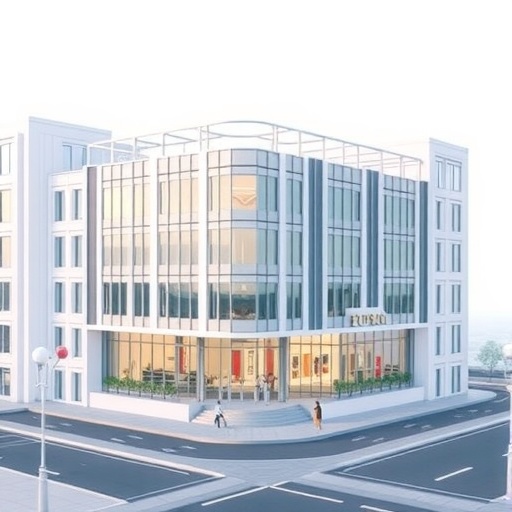
In the rapidly evolving sphere of architectural design, the transformation of textual concepts into visual representations is a crucial yet challenging task. Architects often grapple with the complexities of translating rough ideas and textual descriptions into accurate, detailed images that reflect their vision. Emerging advancements in text-to-image artificial intelligence models hold the promise of revolutionizing this process by enabling the generation of high-quality architectural designs through simple text prompts. Despite their potential, these models have historically struggled with precision, particularly in capturing detailed spatial and structural elements such as the exact number of floors or the precise arrangement of facade components.
At the forefront of addressing these limitations, a research team from the Japan Advanced Institute of Science and Technology (JAIST) has developed an innovative retrieval-augmented generation framework that significantly enhances AI’s ability to generate accurate architectural visuals directly from textual prompts. This system integrates external architectural datasets into the generation process, allowing the AI model to reference authentic building components and configurations. By bridging the gap between raw textual input and concrete architectural elements, this approach ensures that generated images maintain structural integrity and align closely with the original design intent.
Conventional text-to-image diffusion models often falter because their training datasets lack comprehensive annotations regarding architectural nuances. For instance, instructing a model to generate a “five-story building” frequently results in images with an inconsistent number of floors, as the AI cannot accurately interpret or visualize the vertical configuration from the text alone. The JAIST team’s solution creatively involves a multi-stage methodology that mirrors real-world architectural workflows, moving away from direct rendering towards a more granular, stepwise generation process that prioritizes structure and detail.
The process begins with the system translating the textual prompt into a rudimentary structural sketch capturing the overall layout and shape of the building, including the explicit number of floors. This foundational sketch serves as a spatial blueprint, ensuring that the fundamental dimensions and configurations are correct from the outset. Subsequently, the sketch undergoes a refinement phase whereby specific architectural details—such as windows, doors, and facade elements—are systematically incorporated using a curated database of real building components. This retrieval-augmented mechanism provides a reference baseline, grounding the synthetic elements in tangible architectural reality.
Following this refinement, the system synthesizes the detailed sketch with the original text prompt to produce a high-resolution, photorealistic image of a building that faithfully embodies the intended design specifications. This three-step pipeline—initial sketching, data-driven detailing, and integrated rendering—marks a departure from existing monolithic generative models, introducing modularity and interpretability that architects can appreciate and leverage.
To rigorously evaluate their framework, the researchers conducted experiments focusing on campus building designs, a domain where precise control over structural aspects such as floor counts and window placements is paramount. They constructed specialized datasets, including a “building box” collection featuring 2,200 images outlining structural forms, a component database with 4,000 images showcasing variations of windows and entrances, and a paired dataset linking sketches, text prompts, and final renderings comprising 1,600 instances. These datasets provided the rich, detailed annotations necessary for the model to learn accurate correspondences between textual instructions and visual elements.
Empirical results provide compelling evidence of the system’s efficacy. The framework achieved a 70.5% accuracy rate in aligning vertical building configurations with the textual prompts—a significant improvement over baseline diffusion models that lack retrieval integration. Furthermore, it demonstrated superior performance across multiple quality metrics, including structural accuracy, visual realism, and semantic alignment between images and descriptions. Such quantitative outcomes underscore the potential of retrieval augmentation in overcoming longstanding hurdles in architectural image generation.
Complementing objective assessments, a subjective user study with 56 graduate students specializing in architecture and design yielded highly favorable evaluations. Participants rated the system with average scores exceeding 4 on a 5-point Likert scale for image quality, prompt-image fidelity, and the accuracy of architectural details. These findings suggest that beyond algorithmic benchmarks, the tool resonates well with end users, providing outputs that architects find visually and conceptually credible.
The implications of this novel framework are profound for architectural workflows, particularly during early-stage design and client presentations. Architects and designers could utilize this technology to swiftly generate and revise visual proposals, incorporating immediate feedback without the need for labor-intensive manual modeling or expensive rendering software. This agility has the potential to compress design iteration cycles, facilitating more interactive and collaborative planning sessions.
Moreover, urban planners and real estate developers stand to benefit from the ability to visualize numerous design options efficiently, all while adhering to spatial and regulatory constraints embedded in the generation process. By democratizing access to high-fidelity architectural visualization tools, this approach empowers smaller teams and individual designers who traditionally faced barriers due to cost and technical expertise.
The research, published in the journal Frontiers of Architectural Research on March 26, 2026, is the product of a collaborative effort led by Associate Professor Haoran Xie of JAIST along with Associate Professor Ye Zhang of Tianjin University. Their work exemplifies the convergence of computational simulation, human-centered AI, and architectural design, pioneering pathways where machines augment human creativity without supplanting critical professional judgment.
Dr. Xie emphasizes the transformative potential of their system: “High-quality architectural visualization has long demanded significant expertise and costly software solutions. Our framework disrupts this paradigm by making realistic design visualization accessible, allowing individuals and small teams to actively shape their environments with tools once reserved for specialists.”
Looking ahead, the integration of retrieval-augmented generative models into design practice foretells a future where AI not only expedites the production of architectural imagery but also improves its accuracy and relevance. As these technologies mature, they are expected to weave into the fabric of architectural education, collaborative design, and client engagement, fostering environments where creative vision is tangibly realized with unprecedented ease.
In conclusion, the retrieval-augmented multi-stage approach spearheaded by JAIST researchers marks a significant advancement in generative AI’s application to architecture. By aligning building representations closely with textual design intent and grounding image generation in concrete architectural examples, this framework elevates the fidelity and practicality of AI-driven visualization. Such innovations promise to accelerate creativity, enhance communication, and democratize architectural design across disciplines and scales.
Subject of Research: Not applicable
Article Title: Controllable Generation of Building Representations: Aligning Campus Building Design Intent with Multi-Stage Retrieval-Augmented Diffusion Models
News Publication Date: 26-Mar-2026
References: DOI: 10.1016/j.foar.2026.01.018
Image Credits: Associate Professor Haoran Xie from the Japan Advanced Institute of Science and Technology
Keywords
Applied sciences and engineering, Architecture, Engineering, Technology, Artificial intelligence
Tags: advanced AI for architectural creativityAI in building visualizationAI-assisted facade component arrangementAI-generated spatial and structural accuracyarchitectural text prompt translationhigh-precision AI architectural modelsintegration of architectural datasets in AIJapan Advanced Institute of Science and Technology researchovercoming AI limitations in architecturephotorealistic architectural design generationretrieval-augmented generation frameworktext-to-image artificial intelligence