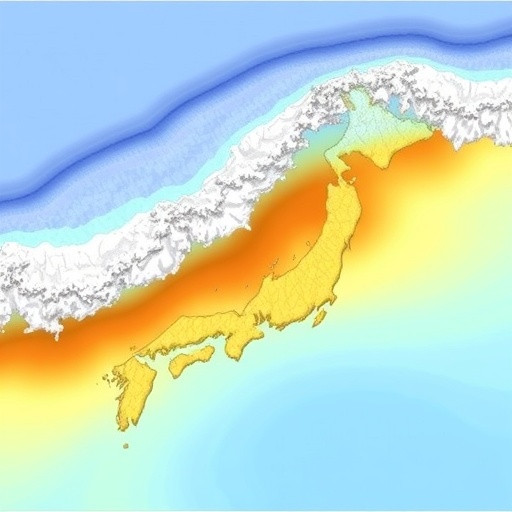
In the relentless pursuit to better understand and predict natural disasters, a groundbreaking study has emerged from the realm of applied mathematics, targeting one of the most devastating phenomena on Earth—tsunami waves. The recently published paper by Damag, Saif, Alshammari, and their collaborators introduces innovative hybrid expansion methods tailored to fractional non-linear mathematical systems, with a special focus on the utilization of Erdélyi-Kober derivative operators. This research represents a significant leap forward in the theoretical modeling of tsunami dynamics and holds immense potential for improving disaster preparedness worldwide.
Tsunami waves, triggered by undersea earthquakes, landslides, or volcanic eruptions, propagate vast distances, often devastating coastal regions. Traditional mathematical models tend to rely on integral or classical differential equations that, although useful, fall short of capturing the intricate subtleties and complexities inherent in real-world tsunami wave behavior. The present study breaks away from conventional approaches by employing fractional calculus—a branch of mathematical analysis that extends the concept of integer-order derivatives to non-integer orders. This approach is particularly adept at describing memory and hereditary properties in physical processes, which are crucial for capturing the dynamics of tsunami waves.
Central to the authors’ methodology are the Erdélyi-Kober derivative operators, sophisticated fractional differential operators that generalize the classical derivatives with weighted integral kernels. These operators enable a more flexible and accurate description of the dynamical systems governing wave propagation, accommodating non-linearity and variability in the medium. The integration of Erdélyi-Kober operators into the fractional framework allows for enhanced handling of boundary conditions and complex geometrical configurations commonly encountered in tsunami modeling.
The researchers further innovated by developing hybrid expansion methods to solve these highly nonlinear fractional differential equations. Unlike classical series expansion techniques, these hybrid methods combine different types of expansions, effectively mitigating issues related to convergence and computational complexity. This advancement means that the precise behavior of tsunami waves can be simulated more efficiently and over longer timescales, providing a deeper insight into their initiation, propagation, and impact phases.
Mathematically, the study addresses the fractional non-linear equations characterizing the wave dynamics in tsunami events. By carefully constructing a hybrid scheme that incorporates both analytical and numerical strategies, the authors navigate through the challenges posed by fractional non-local operators and non-linear terms. Their solution approach results in expressions that explicitly capture the wave amplitude, speed, and energy distribution—key parameters in assessing tsunami hazards.
One of the stark innovations lies in the treatment of memory effects inherent in fractional derivatives. Unlike classical integer-order derivatives, fractional derivatives can encapsulate the history-dependent nature of physical systems. This attribute is fundamentally important for tsunami waves, whose generation and evolution depend not only on instantaneous forces but also on cumulative past interactions underwater and along the coastlines. The Erdélyi-Kober derivative’s weighted nature allows for a tailored memory kernel, amplifying the accuracy of these effects in simulation models.
The implications of this research extend beyond the mathematical realm into practical applications in geophysics and hazard mitigation. Accurate tsunami wave modeling is indispensable for predicting arrival times and impact severity, thereby guiding evacuation plans and infrastructure resilience strategies. The refined models arising from this study promise improved forecast reliability, which is crucial for vulnerable populations in tsunami-prone regions around the Pacific Rim and the Indian Ocean.
Furthermore, the hybrid expansion techniques developed could potentially be adapted to other nonlinear fractional systems beyond tsunami modeling. The flexibility and robustness demonstrated by the Erdélyi-Kober based framework make it an attractive tool for tackling complex phenomena in fields such as bioengineering, fluid dynamics, and seismic wave propagation. This ubiquity underscores the significance of the theoretical advancements introduced and opens new avenues for interdisciplinary research.
The interdisciplinary nature of this work also exemplifies the synergy between pure mathematics and applied sciences. The intricate blend of fractional calculus with computational techniques, as showcased in this study, reflects an emerging paradigm in scientific inquiry where abstract mathematical concepts translate directly into tangible societal benefits. This bridging of theory and practice is vital in facing the challenges posed by natural disasters intensified by climate change.
Critically, the research addresses some long-standing challenges in fractional differential equations, primarily the issue of finding suitable analytical and semi-analytical solutions to nonlinear problems. Traditional numerical methods often demand significant computational resources and can suffer from instability in certain parameter regimes. The hybrid expansion method presents a stable and resource-efficient alternative, thereby democratizing access to sophisticated modeling tools for researchers and policymakers alike.
The authors’ comprehensive examination includes rigorous validation of their models against benchmark problems and existing numerical simulations. This validation process enhances credibility and paves the way for future experimental collaborations and field studies. Such synergized efforts can further refine the parameters used in the models, progressively increasing their accuracy and utility in real-time tsunami monitoring systems.
Moreover, the modularity of the proposed method means that it can be incrementally improved or customized to incorporate additional physical effects such as varying seabed topology, wave-wave interactions, and dissipation mechanisms. This adaptability is essential for evolving predictive models to keep pace with the growing complexity of environmental data and computational capabilities.
The study’s prospective outlook points toward integration with modern data assimilation techniques and machine learning algorithms. As high-resolution oceanographic and seismic data become increasingly available, coupling these data with the fractional hybrid models could significantly augment forecast precision. This integration could usher in a new era of dynamic, data-driven tsunami warning systems that preemptively mitigate disaster impacts with unprecedented accuracy and speed.
In conclusion, the pioneering contribution by Damag, Saif, Alshammari, and colleagues in developing hybrid expansion methods rooted in the Erdélyi-Kober fractional derivative framework represents a milestone in tsunami wave research. It exemplifies how advanced mathematical frameworks can illuminate the complex physics of natural disasters and equip societies with the tools necessary to anticipate and respond effectively. As global climate patterns evolve, such forward-thinking research becomes increasingly indispensable, underscoring the vitality of continued investment in mathematical sciences as a cornerstone of resilience and sustainability.
Subject of Research: Fractional nonlinear mathematical modeling and tsunami wave theory using Erdélyi-Kober derivative operators.
Article Title: Hybrid expansion methods for fractional non-linear mathematical systems with Erdelyi-Kober derivative operators in theory of tsunami wave modeling.
Article References:
Damag, F.H., Saif, A., Alshammari, M. et al. Hybrid expansion methods for fractional non-linear mathematical systems with Erdelyi-Kober derivative operators in theory of tsunami wave modeling.
Sci Rep (2026). https://doi.org/10.1038/s41598-026-46268-5
Image Credits: AI Generated
Tags: advanced tsunami mathematical modelsapplied mathematics for natural disastersErdélyi-Kober derivative operatorsfractional calculus in tsunami predictionfractional differential equations in geophysicsfractional non-linear mathematical systemshybrid methods for tsunami modelingmathematical analysis of coastal hazardsmemory effects in tsunami propagationnon-integer order derivatives in modelingtsunami disaster preparedness modelingtsunami wave dynamics