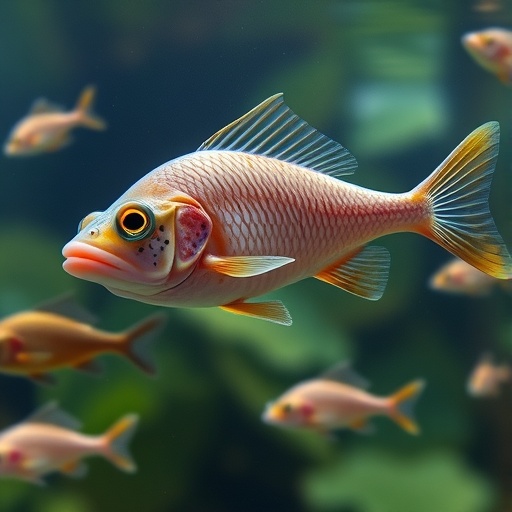
Scientists at the University of Missouri are rewriting biological dogma through their groundbreaking study of the Amazon molly, an all-female fish species that has thrived for over 100,000 years despite reproducing asexually. Traditionally, asexual reproduction has been deemed an evolutionary dead end, as clonal species are expected to accumulate deleterious mutations, resulting in reduced genetic diversity and an eventual slide toward extinction. This assumption, however, is upended by the Amazon molly’s remarkable genetic health and longevity, a mystery that Missouri researchers Wes Warren and Edward Ricemeyer have now illuminated by uncovering the pivotal role of gene conversion in this species.
The Amazon molly was first identified as the first vertebrate capable of asexual reproduction in 1932, a hybrid offspring of a male Poecilia latipinna and a female Poecilia mexicana. Since its emergence, this lineage has exclusively cloned itself, defying expectations that it would survive no longer than 10,000 years. Instead, it has persisted and prospered beyond a centennial threshold, prompting scientists to investigate the molecular underpinnings that enable such resilience. Initial genomic analyses conducted by Warren in 2018 revealed a genome surprisingly intact and reminiscent of sexually reproducing species, contradicting the anticipated accumulation of harmful mutations.
Central to this paradigm shift is a process known as gene conversion, where one allele’s sequence overwrites the other, effectively repairing damaged DNA within an asexual genome. For a decade, demonstrating this molecular mechanism in the Amazon molly’s genome remained elusive due to technological limitations. However, with advancements in long-read sequencing techniques, Warren and Ricemeyer harnessed the power to decode and compare the dual parental genomes embedded within the fish’s cells at a granular level, enabling them to detect differential mutation rates and active gene conversion events.
Their findings were nothing short of astonishing: the two parental genomes did not mutate at the same pace within this clonal species—one exhibited accelerated mutation rates while the other remained comparatively stable. This phenomenon starkly challenges the long-held assumption that both genomes within an organism undergo equivalent mutational pressures shaped by environmental or population dynamics. Peer reviewers initially expressed skepticism, underscoring the study’s groundbreaking nature and prompting the researchers to amass comprehensive evidence validating these unexpected results.
Gene conversion appeared finely tuned, striking a balance between maintaining genetic diversity and minimizing deleterious mutation buildup. This regulatory equilibrium ensured that beneficial genetic variants spread throughout the population while harmful mutations were progressively excised. The Amazon molly, therefore, achieves a genomic robustness normally exclusive to sexually reproducing species, where recombination and selection naturally purge deleterious alleles.
Warren highlights the evolutionary innovation inherent in this fish: it combines the reproductive independence afforded by parthenogenesis with the genomic maintenance capabilities historically attributed to sexual reproduction. His research, conducted in the University of Missouri’s Bond Life Sciences Center and published in the prestigious journal Nature, challenges the foundational concept that asexual reproduction inevitably leads to genetic decay and extinction.
This new understanding compels reevaluation of the evolutionary potential and lifespan of asexual species beyond the Amazon molly. The study raises the compelling possibility that gene conversion may underpin survival strategies in other clonal animals, such as Komodo dragons and New Mexico whiptail lizards, which have long intrigued biologists for their reproductive modalities.
Beyond evolutionary biology, this discovery has broad implications across multiple scientific disciplines. Gene conversion, by elucidating natural DNA repair mechanisms, intersects with medical genetics and cancer biology where genomic stability is paramount. Insights into these mechanisms may ultimately translate into improved therapeutic strategies aimed at controlling mutational burdens in human diseases.
Moreover, the application of long-read sequencing technology underscores a transformative moment in genomics, allowing researchers unprecedented resolution into complex genetic phenomena. By mapping parental genome divergence and mutation dynamics, this approach paves the way for future studies to reveal intricate genomic interactions that shape adaptation and survival.
Reflecting on the broader impact of their work, Ricemeyer emphasizes how deciphering nature’s diverse reproductive strategies enriches our understanding of life itself. These findings anchor fundamental questions about species origin, adaptability, and the evolutionary routes that have shaped biodiversity on our planet.
The University of Missouri team’s innovative research celebrates the Amazon molly not merely as a scientific curiosity but as a paradigm-shifting model to explore genetic resilience and evolutionary innovation. As this field advances, we may soon rewrite textbooks on the evolutionary capacity of asexual organisms and uncover novel genetic mechanisms critical to the survival of diverse life forms.
Subject of Research: Animals
Article Title: Gene conversion empowers natural selection in a clonal fish species
News Publication Date: 11-Mar-2026
Web References: DOI: 10.1038/s41586-026-10180-9
Image Credits: Credit: University of Missouri
Keywords: Genetics, Biochemistry, Developmental biology, Computational biology, Ecology, Evolutionary biology, Cell biology, Immunology, Microbiology, Molecular biology, Organismal biology, Parasitology, Physiology, Signal transduction, Life sciences
Tags: all-female fish species longevityAmazon molly asexual reproductionasexual vertebrate geneticsevolutionary biology asexual speciesgene conversion in fishgenetic diversity in clonal organismsgenetic health of Amazon mollygenome stability in asexual specieshybrid fish species evolutionmolecular mechanisms of fish reproductionovercoming Muller’s ratchet in fishUniversity of Missouri fish study