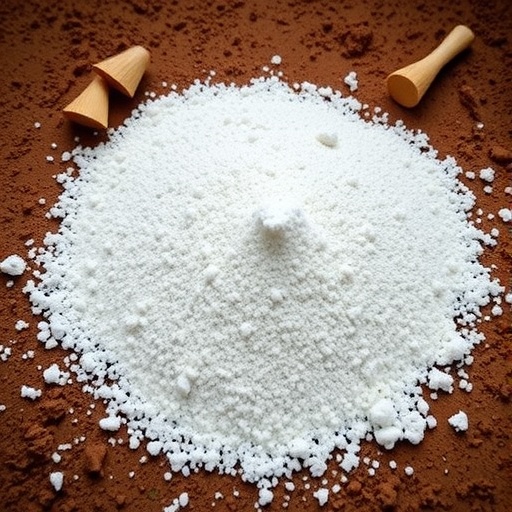
In a groundbreaking advancement for geotechnical engineering, a research team from Yunnan University in China has unveiled pivotal insights into enhancing the resilience of red soil, a notoriously unstable and dispersive soil type prevalent in many regions. This soil’s proclivity to lose strength and integrity when exposed to moisture renders it vulnerable to geological disasters such as landslides, debris flows, and collapses, posing severe risks for infrastructure and human safety. The team’s innovative approach leverages building gypsum powder, an eco-friendly and economically viable by-product sourced from construction waste, to substantially improve red soil’s mechanical properties, even under adverse environmental conditions marked by chemical pollution and cyclical wetting and drying.
Red soil’s inherent weaknesses have long challenged engineers tasked with stabilizing terrain prone to natural calamities. When saturated, its cohesion and frictional resistance decline sharply, undermining slope stability and increasing disaster susceptibility. The introduction of building gypsum powder into red soil not only strengthens its structural framework but also exemplifies a circular economy approach—transforming construction debris into a valuable resource for soil reinforcement. This dual benefit addresses environmental concerns linked to landfill burden while providing a cost-effective pathway for soil stabilization.
Led by Professor Yinlei Sun from the School of Architecture and Planning, the research delves deep into the complex interplay between soil microstructure and macroscopic mechanical behavior. Employing a comprehensive suite of experimental methodologies—including direct shear and consolidation testing combined with advanced microscopic assessments such as Scanning Electron Microscopy (SEM), X-ray Diffraction (XRD), and X-ray Fluorescence (XRF)—the study elucidates how building gypsum powder alters red soil at mineralogical and structural levels. These examinations reveal how gypsum particles interact with soil constituents, fostering denser packing, pore refinement, and improved load-bearing capacity.
Intriguingly, the study explores the resistance of treated red soil to chemical contaminants common in polluted environments, focusing on acetic acid, sodium sulfate, and sodium hydroxide exposure during cyclic wet-dry conditions. The findings disclose that acetic acid accelerates gypsum dissolution, exacerbating pore development and causing pronounced weakening of the soil matrix. Conversely, sodium sulfate manifests a dual effect; at low concentrations, it crystallizes within soil pores, enhancing strength, while at elevated concentrations, salt crystallization induces expansive pressures that compromise structural integrity. Sodium hydroxide uniquely contributes by thickening the electrical double layer surrounding soil particles, promoting colloid precipitation that consolidates the soil framework and mitigates dry-wet cycling damage.
The mechanical property alterations under fluctuating environmental conditions are meticulously quantified. Cohesion, internal friction angle, shear strength, and compressive strength—all critical parameters dictating soil stability—demonstrate variable responses influenced by contaminant type and cycling frequency. This dynamic underscores the complexity of soil behavior in real-world scenarios and the necessity for tailored amendment strategies when deploying gypsum powder as a soil modifier.
The investigation’s microstructural analyses reinforce these macroscopic observations, showing that repetitive dry-wet cycling progressively enlarges pore spaces and loosens soil structure, directly correlating with degrading mechanical resilience. Utilizing fractal theory and gray correlation analyses, researchers established a robust quantitative framework linking micro-scale pore characteristics to macro-scale mechanical performance. This novel integration of microstructural parameters and mechanical metrics represents a significant stride toward predictive modeling of soil behavior under environmental stressors.
Beyond its scientific contributions, this research embodies pragmatic implications for land management and engineering design in red soil regions. The effective stabilization of such soils with building gypsum powder can drastically reduce the likelihood of catastrophic slope failures, safeguarding communities and infrastructure. Additionally, the environmentally conscious reuse of gypsum waste underscores a sustainable approach to geotechnical engineering, aligning with global imperatives to minimize industrial waste and promote resource circularity.
Looking forward, the research team aims to refine modification protocols by investigating optimal gypsum powder dosages and evaluating long-term soil stability under multi-factorial environmental exposures. Efforts will also focus on innovating cost-efficient and environmentally benign soil improvement methodologies, ensuring that the benefits observed at laboratory scale translate effectively to large-scale field applications.
The implications of this research extend beyond academic inquiry; they forge a path toward resilient, sustainable infrastructure development in regions encumbered by red soil instability. The comprehensive approach integrating materials science, environmental chemistry, and geotechnical engineering propels the discourse on soil improvement techniques into a new era—one that balances technical innovation with ecological responsibility.
By advancing understanding of how building gypsum powder mediates the response of red soil to environmental challenges, this study equips engineers and policymakers with powerful tools to mitigate geological risks. Such advances are not merely academic triumphs but essential steps toward securing safe human habitats amid the inexorable pressures of environmental change.
This research, funded by prominent agencies including the National Natural Science Foundation of China and the Natural Science Foundation of Yunnan Province, and published in the respected journal Civil Engineering Sciences, exemplifies the crucial intersection of innovation, sustainability, and practical problem-solving in modern engineering sciences.
Subject of Research: Not applicable
Article Title: Influence of Dry–Wet Cycles and Chemical Pollution on Red Soil Improved with Building Gypsum Powder
News Publication Date: 23-Feb-2026
Web References: DOI 10.34133/cesci.0015
References: Not available
Image Credits: The Authors, Civil Engineering Sciences
Keywords
Red soil, building gypsum powder, soil stabilization, dry-wet cycles, chemical contamination, shear strength, compressive strength, microstructure, geotechnical engineering, environmental sustainability, waste recycling, sediment strength
Tags: building gypsum powder for soil reinforcementchemical pollution impact on soilcircular economy in construction waste reuseconstruction waste recycling benefitseco-friendly soil improvement methodseffects of dry-wet cycles on soil strengthenhancing soil mechanical propertiesgeotechnical engineering innovationsmoisture-induced soil degradationred soil stabilization techniquesslope stability in dispersive soilssoil treatment for landslide prevention