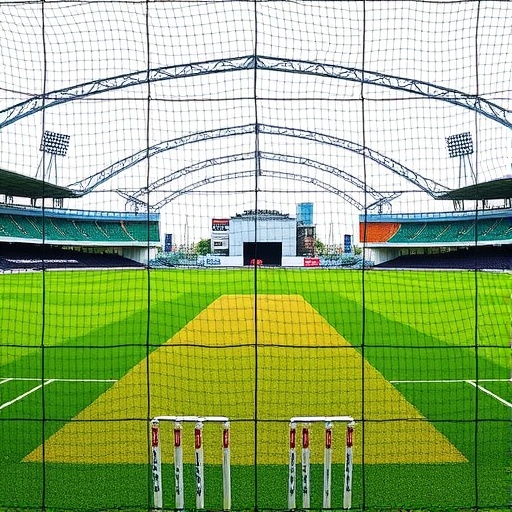
In the dynamic and unpredictable world of cricket, the calculation of fair play targets during interrupted matches has long been a thorny issue, captivating statisticians, players, and fans alike. The recently published study by Samanta, Allahviranloo, Mrsic, and their colleagues presents a groundbreaking advancement in this domain, introducing an innovative fusion of fuzzy logic and contextual indices into the Duckworth–Lewis–Stern (DLS) method. This work, appearing in Scientific Reports in 2026, offers a transformative approach to revising cricket targets that promises enhanced fairness and precision, even amidst the most complex game interruptions.
Historically, the DLS method has been the standard bearer for recalculating targets when weather or other unforeseen circumstances cause stoppages in limited-overs cricket. This technique leverages pre-calculated resource tables based on wickets lost and overs remaining, offering a statistically grounded estimation of fair scoring targets. However, despite its widespread acceptance and undeniable utility, the DLS method occasionally struggles to accommodate the nuances of match context and uncertainty inherent in real-time game conditions. The new model tackles these shortcomings head-on by embracing the principles of fuzzy logic, marrying mathematical rigor with flexibility.
Fuzzy logic, an approach that thrives in environments of ambiguity and partial truths, is well suited to the unpredictability of cricket matches. Unlike traditional binary systems which classify situations as either true or false, fuzzy logic assigns a continuum of truth values, allowing computational models to interpret nuances and vagueness inherent in data. By embedding fuzzy logic into the DLS framework, the researchers have created a system that can more naturally interpret the shades of uncertainty that pervade innings disrupted by rain delays or other interruptions.
A pivotal feature of this enhanced model is the integration of contextual indices—variables that capture the match’s specific circumstances beyond traditional counting of wickets and remaining deliveries. These indices might include pitch conditions, team strengths, momentum shifts, or weather peculiarities, factors that often escape quantitative modeling but critically influence a team’s scoring potential. By quantifying such elements and weaving them seamlessly into the calculation process, the model embodies a truly holistic outlook on target revision.
The methodological rigor underpinning this study is compelling. The researchers developed a multi-dimensional algorithm that calculates revised targets by dynamically evaluating fuzzy sets representing various game states. They synthesized historical data from hundreds of interrupted matches to calibrate the contextual indices and fine-tune membership functions guiding the fuzzy logic operations. This exhaustive data-driven calibration assures that the model’s outputs are not merely theoretical but rooted in empirical reality.
Moreover, the model undergoes continuous updating as the match unfolds, allowing for real-time revision of targets that reflect current game momentum and emergent uncertainties. This adaptive capacity is a substantial leap forward compared to traditional static DLS tables, which have limited capacity to adapt once the interruption occurs. By promoting flexibility and responsiveness, the new method aligns closely with the chaotic nature of cricket, ensuring that target revisions are fairer and better tuned to each unique scenario.
Importantly, the study’s implications are not confined solely to cricket. The framework demonstrated by the authors can be extrapolated to other sports or domains where interruptions necessitate dynamic adjustments in performance targets under uncertainty. The integration of fuzzy logic with domain-specific contextual factors offers a versatile paradigm for decision-making in systems characterized by complexity and incomplete information.
From a mathematical standpoint, the paper provides intricate details on the fuzzy membership functions employed in representing overs remaining and wickets lost, alongside the design of new contextual indices. These indices are carefully constructed using principal component analysis to distill the most significant match factors impacting scoring potential. The researchers also detail the algorithm’s fuzzy inference engine, explaining how rule-based evaluations convert fuzzy inputs into actionable revised targets.
Statistical validation of this model was achieved through rigorous cross-validation techniques applied to a diverse dataset of historical matches. The results demonstrate that the fuzzy logic-enhanced DLS outperforms existing methods in terms of accuracy and fairness metrics, especially in matches with multiple interruptions or fluctuating playing conditions. This empirical endorsement underscores the practical viability of the approach in real competitive settings.
Critics might question the increased computational complexity of this method. However, the team addresses these concerns by highlighting the model’s efficient algorithmic structure, optimized for rapid calculations even on standard computational platforms. The deployment feasibility is further enhanced by the model’s compatibility with existing cricket scoring software, paving the way for swift adoption by cricketing authorities and broadcasters.
The human element is not neglected in this research. The authors engage with professional cricketers, coaches, and umpires to verify the interpretability and perceived fairness of the revised targets produced by their system. The broadly positive feedback from this stakeholder engagement suggests that the model aligns well with on-ground intuitions about fairness and game flow, fostering wider acceptance.
Looking ahead, the authors propose avenues for further refinement, including the incorporation of machine learning techniques to adaptively learn and update contextual indices from live data streams. Such continuous learning mechanisms could render the model even more robust and nuanced, enhancing predictive accuracy and fairness in ever-evolving cricket environments.
In sum, this pioneering marriage of fuzzy logic with the Duckworth–Lewis–Stern methodology and contextual indices fundamentally redefines how cricket’s complex interruptions should be handled. The study not only elevates mathematical modeling in sports analytics but also enriches the broader discourse on fair play, underscoring how advances in computation and data science can resolve long-standing challenges in sports governance.
As cricket continues to captivate global audiences, innovations such as these ensure that the spirit of fairness keeps pace with the sport’s growing complexity and high stakes. By embracing uncertainty and contextual richness, the new model champions a more just resolution to interrupted matches and unlocks exciting possibilities for analytics-driven fairness across sports disciplines.
The full details of this transformative work are accessible through the Scientific Reports publication, offering cricket strategists, statisticians, and fans a compelling new lens through which to view and manage the game’s unpredictable interruptions. This marks a watershed moment where cutting-edge mathematics tangibly improves the experience and integrity of cricket worldwide.
Subject of Research: Cricket target revision methods using fuzzy logic and contextual indices integrated into Duckworth–Lewis–Stern modeling.
Article Title: Duckworth–Lewis–Stern modeling with fuzzy logic and contextual indices for target revision in cricket.
Article References:
Samanta, S., Allahviranloo, T., Mrsic, L. et al. Duckworth–Lewis–Stern modeling with fuzzy logic and contextual indices for target revision in cricket. Sci Rep (2026). https://doi.org/10.1038/s41598-026-44750-8
Image Credits: AI Generated
Tags: advanced cricket statisticscontextual indices in cricketcricket target recalculationDuckworth–Lewis–Stern method improvementfuzzy logic for dynamic scoringfuzzy logic in sports analyticsinterrupted cricket match fairnesslimited-overs cricket scoring methodsmathematical modeling of cricket targetsprecision in cricket target settingreal-time game condition adaptationuncertainty handling in sports