


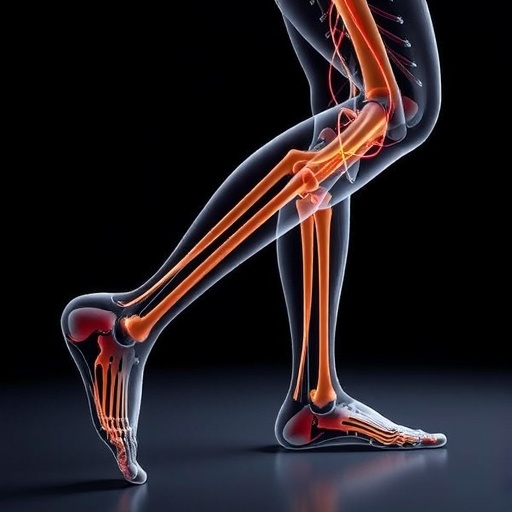
Pioneering Neurotechnology Decodes Leg Movements from Peripheral Nerve Signals, Paving the Way for Next-Generation Prosthetic Legs
In a groundbreaking development, researchers have, for the first time, successfully decoded detailed leg movements directly from the peripheral nerves of individuals with above-knee amputations. This milestone, achieved by a team led at Chalmers University of Technology in Sweden, marks a significant stride towards prosthetic legs that seamlessly integrate with the human nervous system, offering more natural and intuitive control than ever before. Central to their breakthrough is the use of innovative implantable neurotechnology paired with artificial intelligence algorithms modeled on the nervous system’s intrinsic signaling language.
For decades, advancements in prosthetics have aimed at restoring function and independence to amputees, but existing solutions have largely been hindered by technological and biological constraints. While arm and hand prostheses sometimes leverage residual muscle activity to interpret user intent, this approach is largely unfeasible for leg amputees following major limb loss, as the essential muscles may no longer be present or functional. Consequently, prosthetic legs predominantly rely on mechanical adaptations and sensor-based automatic adjustments rather than direct, volitional control, leaving a profound gap in user experience and efficacy.
To transcend these limitations, the Chalmers-led research team focused on directly harnessing the nerve signals that persist within the remnant nerve tissues post-amputation. Their core insight lies in the understanding that although the physical limb is no longer present, the nervous system continues to generate motor commands intending limb movement. The challenge has been reliably capturing and decoding these faint, complex electrical impulses from peripheral nerves, which has eluded researchers, especially in lower limb amputees.
The breakthrough was possible through the deployment of ultrathin, flexible neural implants inserted into the tibial branch of the sciatic nerve—a major conduit for leg motor and sensory information. These implants, each no thicker than a human hair, enable precise intraneural recordings of bioelectrical signals during motor attempts made by the participants to move their phantom limbs, including subtle actions such as toe wiggling. This represents an unprecedented achievement in both neuroengineering and prosthetic control paradigms.
Yet reading raw nerve signals is only half the battle. To translate this neural chatter into actionable commands for prosthetic devices, the team employed an advanced AI methodology rooted in Spiking Neural Networks (SNNs). Unlike traditional neural networks that handle continuous numerical data, SNNs process information as discrete, temporally coded electrical spikes—mirroring the language of biological neurons. This alignment with natural neural dynamics enables highly efficient and biologically plausible decoding of peripheral nerve activity, extracting motor intentions from sparse and noisy datasets.
Elisa Donati of ETH Zürich, a senior author of the study, emphasizes that leveraging the nervous system’s native communication format allows for the development of low-power, compact AI models tailored for real-time implantable systems. This sophisticated integration holds promise not only for decoding complex leg movements with remarkable accuracy but also for establishing a foundation for prosthetic devices that can sense and respond bidirectionally with the user’s nervous system.
The bidirectional nature of the neural implants sets this work apart from previous efforts that necessitated separate devices for motor control and sensory feedback. By utilizing the same electrodes for both stimulating nerves to restore touch sensation and recording signals for movement intent, the technology mirrors the natural feedback loop present in biological limbs. This dual capability offers prosthetic users an unprecedentedly rich experience, potentially restoring both voluntary movement and the sensation of contact with the environment.
In their pioneering study published in “Nature Communications,” the researchers tested the system on two above-knee amputees, demonstrating that movement attempts of distinct joints—including knees, ankles, and toes—can be decoded with high fidelity. This milestone validates the hypothesis that nerve signals, even when the physical limb is absent, encode intricate motor commands that can be harnessed for prosthetic control. The study significantly expands the scope of neural prosthetics research beyond the traditionally investigated upper limbs to leg amputees, who represent a majority of the amputee population worldwide.
The implications of this technology are profound. By enabling neural signals recorded directly from peripheral nerves to drive prosthetic limbs, the approach promises legs that respond intuitively to a user’s intent, seamlessly blending with their mental commands. Such prosthetics would alleviate the cognitive and physical burden of controlling artificial limbs via indirect means and open doors for dynamic, adaptive assistance in activities of daily living, sports, and rehabilitation.
Looking forward, the team is poised to integrate this revolutionary neural decoding system into functional prosthetic legs. This critical next step will test the method’s efficacy in real-world conditions where closed-loop sensory-motor interaction is essential. The promise of an implantable device that simultaneously interprets movement intent and delivers nuanced sensory feedback could redefine the field, moving prostheses from mechanical tools to extensions of self.
The convergence of state-of-the-art neurotechnology and AI-driven interpretation represented in this study epitomizes a new era in biomedical engineering. By unraveling the language of nerve communication through biologically inspired computation, researchers are creating devices that restore not only lost function but vital aspects of the sensory experience. This achievement signifies a transformative leap towards prosthetic limbs that genuinely integrate with the human nervous system.
Researchers anticipate that these innovations will not only revolutionize prosthetic legs but may extend to other types of limb prostheses in the future. The approach offers a modular and scalable platform for interpreting peripheral nerve activity, potentially unlocking advanced neurocontrol for arms, hands, and beyond.
Ultimately, this work exemplifies the power of interdisciplinary collaboration, merging insights from neuroscience, materials science, computer science, and clinical medicine. By decoding phantom limb movements with fine spatiotemporal detail, the study provides an inspiring blueprint for how technology can restore agency and sensory connection to those affected by limb loss, transforming lives in profound ways.
Subject of Research: Not applicable
Article Title: Decoding phantom limb movements from intraneural recordings
News Publication Date: 8-Feb-2026
Web References: http://dx.doi.org/10.1038/s41467-026-69297-0
References: Rossi, C., Bumbasirevic, M., Čvančara, P., Stieglitz, T., Raspopovic, S., Donati, E., & Valle, G. (2026). Decoding phantom limb movements from intraneural recordings. Nature Communications.
Image Credits: Pietro Comaschi
Keywords: Neurotechnology, Peripheral Nerves, Prosthetic Legs, Neural Implants, Spiking Neural Networks, Artificial Intelligence, Phantom Limb, Motor Decoding, Sensory Feedback, Neural Interface, Amputation, Biomedical Engineering
Tags: above-knee amputation prostheticsadvanced limb prosthetic technologyAI-driven prosthetic controlChalmers University neuroprosthetics researchimplantable neural interfacesintuitive leg prosthesis movementnervous system integration prostheticsneural signal processing for amputeesneurotechnology for prosthetic legsnext-generation leg prosthesesperipheral nerve signal decodingvolitional control of prosthetic legs


