In a groundbreaking study from the University of Konstanz, researchers have unveiled an unprecedented mechanism governing sliding friction—one that emerges entirely without mechanical contact and is instead driven purely by the collective dynamics of magnets. This new paradigm defies the centuries-old Amontons’ law, which asserts that friction rises proportionally with load, by demonstrating that magnetic friction can actually reach a peak and then diminish as the effective load changes, mediated by intricate internal magnetic interactions and ordering frustrations.
Amontons’ law has long been treasured in physics as a fundamental empirical rule, connecting the everyday resistance encountered when moving objects with the force pressing them together. Traditionally, the increased friction with load has been attributed to microscopic surface deformations that multiply points of contact, thus demanding greater applied effort to initiate and maintain motion. In classical tribological systems, these deformations rarely induce significant changes in the intrinsic material structure, rendering Amontons’ observation robust across macroscopic scales and familiar conditions.
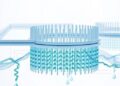
However, the study challenges this paradigm by venturing into a regime where sliding doesn’t simply move rigid surfaces against each other but actively modifies the internal magnetic order within contacting layers. The experimental framework utilized a meticulously engineered two-dimensional lattice of rotatable magnetic elements situated above a fixed magnetic layer. Despite the absence of direct mechanical contact between these layers, magnetic coupling induces a frictional force, enabling the unique isolation of magnetic contributions to frictional phenomena.
By systematically adjusting the gap separating the magnetic layers, the researchers could finely tune the effective load experienced by the system. This crucial control parameter dictated the delicate balance of magnetic interactions within the top layer’s rotors as they responded collectively to the motion, offering direct visual and quantitative measurements of evolving magnetic configurations during sliding — a remarkable insight into the internal state of frictional interfaces.
At the extremes of large and minimal layer separation, friction was surprisingly minimal, indicating that aligned internal magnetic states favored smooth relative motion with weak energy dissipation. Contrastingly, it was at intermediate separations that the system exhibited profound complexity. Here, the upper magnetic rotors tended to favor an antiparallel arrangement of magnetic moments, whereas the fixed bottom layer energetically preferred parallel alignment. This conflicting preference generated a magnetically frustrated state characterized by a delicate dynamic instability.
This frustration forced the rotors into a mechanically driven hysteresis loop, where the magnetic moments continuously switched between metastable configurations in response to layer sliding. Unlike classical friction, where energy loss stems from physical surface irregularities and wear, here dissipation originated purely from repeated magnetic reorientations. The hysteretic switching thus amplified energy loss and generated a striking non-monotonic friction profile with a clear peak at this frustrated state.
From a theoretical standpoint, the authors articulate this phenomenon as a novel form of contactless friction emerging from spin dynamics rather than physical asperities. The breakdown of Amontons’ law becomes not an exception but a natural consequence of the microscale magnetization transitions undergoing cyclic, history-dependent changes under mechanical driving. This redefinition challenges the traditional friction models that rely on surface topography and mechanical deformation and calls for new frameworks integrating magnetic order parameters.
Lead experimentalist Hongri Gu notes that the system’s ability to switch magnetic states collectively under motion is a unique insight into friction as an intrinsically nonequilibrium, dynamic process. By manipulating the interlayer distance, the team effectively controlled the competition between magnetic interactions, offering a tunable frictional response absent in conventional contact friction. This tunability hints at future possibilities of engineered frictional properties tailored through magnetic fields or device geometry.
Professor Clemens Bechinger emphasizes the absence of surface wear in this mechanism, underscoring the importance of purely internal and collective magnetic rearrangements as the sole source of energy dissipation. As a result, this paradigm promises frictional devices free from traditional wear and degradation, extending the durability and lifespan of mechanical components, particularly in sensitive technological settings.
Because the physical principles governing this phenomenon are scale invariant, these findings can extend beyond tabletop experiments. They are directly relevant to atomically thin magnetic materials and two-dimensional magnets where small mechanical displacements can drastically influence magnetic ordering. This opens promising pathways for friction-based magnetic characterization and manipulation at the nanoscale, marrying tribology with the physics of low-dimensional magnetism.
By leveraging magnetic hysteresis effects, the study paves the way for contactless frictional interfaces with remotely adjustable properties. Such magnetically tunable friction could revolutionize the development of frictional metamaterials, adaptive dampers, and novel contactless control elements functioning across micro- and nanoelectromechanical systems (MEMS and NEMS), where traditional mechanical wear imposes critical lifetime limitations.
Applications extend beyond miniature devices. Magnetic friction mechanisms may enhance the performance of magnetic bearings, vibration isolation platforms, and multifunctional thin-film magnetic technologies, enriching energy efficiency and control precision. Fundamentally, this research inaugurates an entirely new approach for probing collective spin dynamics via mechanical protocols, merging concepts from materials science, physics, and engineering.
As magnetic friction becomes an established frontier, it provides a rich landscape for both fundamental inquiry and technological innovation. By dissolving the old boundaries between surface wear, mechanical contact, and internal reorganization, the study challenges us to rethink friction itself as an emergent property conditioned by sophisticated internal material dynamics. This profound shift promises to spur further investigations and applications harnessing the magnetic spin undercurrents of frictional forces.
Subject of Research:
Magnetic friction emerging from collective rotor dynamics in layered magnetic systems.
Article Title:
Nonmonotonic Magnetic Friction from Collective Rotor Dynamics
News Publication Date:
18 March 2026
Web References:
http://dx.doi.org/10.1038/s41563-026-02538-1
Image Credits:
Hongri Gu
Keywords
Tribology, Magnetic friction, Spin dynamics, Magnetic frustration, Contactless friction, Magnetism, Magnetic hysteresis, Nanomagnetic materials, Magneto-mechanical coupling, Friction metamaterials, MEMS, NEMS
Tags: Amontons’ law challengescollective magnet dynamicsfriction peak and reductionfrictional force and load relationshipinternal magnetic interactionsmagnetic friction mechanismsmagnetic ordering frustrationsmagnetic surface interactionsnon-contact friction phenomenasliding friction without contacttribology and magnetic systemstwo-dimensional magnetic lattices