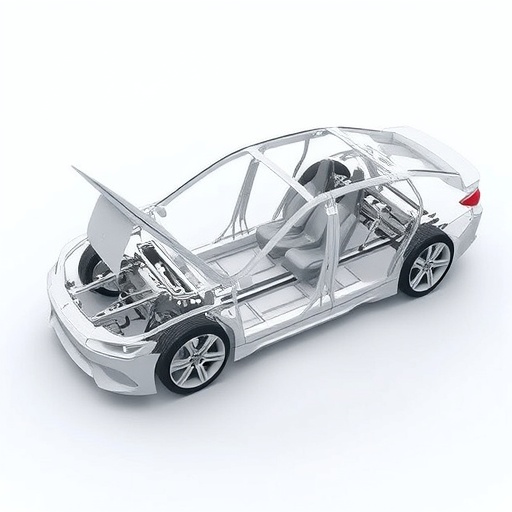
In a groundbreaking study set to redefine materials science in automotive engineering, researchers have unveiled remarkable advancements in hybrid composite materials aimed at elevating structural performance and durability. This research, conducted by Mohammed, Shaik, L. L. S, M., and colleagues, explores the mechanical properties and ranking of carbon-filled hybrid epoxy composites composed of Kevlar, Basalt, and S-glass fibers. Their investigation, recently published in Scientific Reports, leverages a sophisticated Python-based technique known as TOPSIS (Technique for Order of Preference by Similarity to Ideal Solution) to evaluate and optimize these advanced materials for automotive structural applications.
The pursuit of novel composite materials has long been driven by the automotive industry’s insatiable demand for lightweight yet robust components that ensure safety, fuel efficiency, and longevity. Traditional materials, such as steel and aluminum, often pose limitations due to their weight and corrosion vulnerability. By integrating carbon fillers within hybrid fiber matrices like Kevlar/Basalt/S-glass epoxy composites, the researchers have opened pathways for creating materials that combine superior tensile strength, impact resistance, and thermal stability.
A fundamental component of this study involves the meticulous fabrication of hybrid composites, where the synergy between carbon fillers and multiple fibers provides an unprecedented mechanical framework. Carbon fillers, known for their exceptional stiffness and conductive properties, enhance the epoxy matrix’s load transfer efficiency. Simultaneously, Kevlar fibers contribute high toughness and energy absorption capabilities, Basalt fibers afford chemical and thermal resistance, while S-glass fibers add enhanced tensile strength and durability, making the hybrid composite a truly multi-functional material.
The essence of the research lies in the systematic mechanical characterization of these composites. Through rigorous testing—including tensile, flexural, and impact assessments—the team quantified performance parameters critical to automotive structural integrity. These tests revealed notable improvements in strength-to-weight ratios, suggesting that such hybrid composites could replace conventional metals in load-bearing applications without compromising on safety or reliability.
What sets this investigation apart is the adoption of the TOPSIS method implemented via Python programming to rank various composite formulations. TOPSIS, a multi-criteria decision-making algorithm, enables a comprehensive assessment by comparing alternatives against idealized best and worst-case scenarios. This technique smartly weighs diverse performance metrics, thereby facilitating informed selection of the optimal composite variant that balances mechanical robustness, manufacturability, and cost-effectiveness.
Integrating computational intelligence like TOPSIS into materials design marks a significant paradigm shift. It drastically reduces the trial-and-error approach traditionally associated with composite development, accelerating the innovation cycle while enhancing precision. This methodology holds the promise of revolutionizing the way engineering materials are optimized, particularly in industries where performance and safety standards are rigorously regulated.
From the perspective of automotive applications, the implications are vast. Structural components exposed to varying mechanical stresses—such as chassis parts, suspension systems, and body reinforcements—can benefit substantially from the resilience and lightweight attributes of these hybrid composites. This development dovetails with industry-wide trends towards electrification and autonomous vehicles, where weight reduction directly translates into enhanced energy efficiency and extended range.
Moreover, the environmental impact cannot be overlooked. The enhanced durability and corrosion resistance inherent in these composites reduce the frequency and cost of repairs and replacements. Consequently, this fosters sustainability by minimizing waste and resource usage over the vehicle’s lifecycle. The use of Basalt fibers, derived from abundant volcanic rock, also introduces an eco-friendly aspect, potentially reducing reliance on synthetic materials with high carbon footprints.
The research team also conducted a comparative analysis to benchmark the hybrid composites against existing material standards in the automotive field. This comprehensive evaluation demonstrated superior mechanical properties across the board, establishing the potential for these composites to not only meet but exceed current industry benchmarks. Such a leap positions the automotive sector on the cusp of a materials revolution where hybrid composites dominate structural design paradigms.
A noteworthy challenge addressed by the study revolves around the manufacturing processes compatible with these advanced composites. The team scrutinized the epoxy matrix curing, fiber alignment, and filler dispersion techniques to ensure repeatability and scalability. Mastering these parameters is essential for industrial adoption, as automotive component production demands high throughput along with stringent quality controls.
The synergy between experimental and computational approaches sets a new standard in hybrid composite research. By integrating empirical performance data with decision-making algorithms, the researchers crafted a robust framework for materials selection that future studies can emulate. This methodology fosters a forward-looking vision where AI and machine learning assist not only in materials discovery but also in application-specific optimization.
Furthermore, the study explored the fatigue and long-term durability of these composites under simulated automotive operating conditions. Understanding how materials behave under cyclic loading and environmental stressors is critical for safety certifications and product warranties. The positive endurance characteristics observed hint towards reliability enhancements over conventional materials, positioning these composites favorably for real-world use.
The interdisciplinary nature of this research, bridging materials science, mechanical engineering, computational modeling, and industrial design, illustrates the collaborative approach essential for innovation in complex technical fields. It reflects how combining expertise catalyzes breakthroughs that single-discipline efforts might struggle to achieve, particularly when addressing challenges with significant practical and economic implications.
Looking ahead, the incorporation of carbon fillers within hybrid fiber composites opens new avenues beyond the automotive industry. Aerospace, marine, sports equipment, and even civil infrastructure could benefit from materials demonstrating such tailored mechanical excellence and processing flexibility. The adoption of TOPSIS-based evaluation frameworks further broadens the horizon for application-specific material customization, fostering innovation across various sectors.
In summary, the work by Mohammed, Shaik, L. L. S, M., and their team represents a critical milestone in the evolution of composite materials engineered for automotive structural applications. By merging advanced hybrid fiber systems with cutting-edge computational ranking algorithms, the researchers have carved a pathway toward materials that are not merely substitutes for metals but superior alternatives that address the future needs of durability, sustainability, and performance. Such pioneering developments will undeniably influence automotive design philosophies in the coming decades.
As automotive manufacturers strive to meet stringent regulatory standards and consumer expectations for safety, efficiency, and sustainability, materials innovation like this could be the cornerstone of transformative change. The interplay of carbon fillers with Kevlar, Basalt, and S-glass fibers in an optimized epoxy matrix is set to redefine the landscape of lightweight structural composites, enabling vehicles that are safer, greener, and more economically viable.
The study’s publication in Scientific Reports underscores its significance, providing a comprehensive resource for researchers and industry professionals aiming to harness hybrid composites in practical applications. Future research will likely delve deeper into the optimization of matrix chemistries, filler functionalization, and real-world durability assessments, propelled by the foundational knowledge established through this exemplary work.
With the automotive world on the verge of unprecedented evolution, research efforts such as these not only promise technical improvements but also inspire a broader reimagining of how materials science can integrate with digital tools to expedite and enhance innovation. The successful fusion of mechanical performance analysis with Python-based TOPSIS ranking is a testament to the transformative potential of interdisciplinary research in driving progress.
Subject of Research: Mechanical performance evaluation and optimization of carbon-filled Kevlar/Basalt/S-glass hybrid epoxy composites for automotive structural applications.
Article Title: Mechanical performance and python-based TOPSIS ranking of carbon-filled Kevlar/Basalt/S-glass hybrid epoxy composites for automotive structural applications.
Article References:
Mohammed, R., Shaik, A.S., L. L. S, M. et al. Mechanical performance and python-based TOPSIS ranking of carbon-filled Kevlar/Basalt/S-glass hybrid epoxy composites for automotive structural applications. Sci Rep (2026). https://doi.org/10.1038/s41598-026-44376-w
Image Credits: AI Generated
Tags: advanced composite fabrication methodsautomotive structural strength materialscarbon fillers in compositescarbon-filled epoxy compositeshybrid composite materials for automotiveimpact resistance of hybrid compositesKevlar Basalt S-glass fiber compositeslightweight automotive materialsmechanical properties of hybrid compositesoptimization of automotive compositesthermal stability in automotive compositesTOPSIS technique in materials science