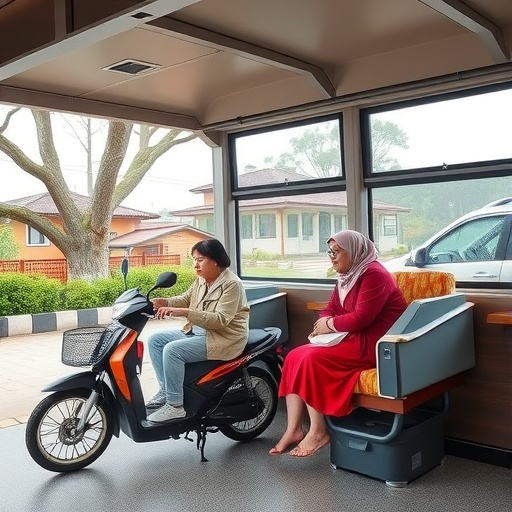
In a groundbreaking study poised to transform rural transportation systems, researchers Ai Q. and Zhang J. delve into the urgent need for elderly-oriented transport solutions, using Zhenglu Town as their experimental ground. As populations age worldwide, the challenge of accommodating the mobility needs of older adults becomes not only a policy priority but also a matter of social equity. This study presents a comprehensive analysis that blends advanced transportation engineering with human-centric design principles, illuminating pathways for sustainable and inclusive rural mobility.
The demographic shift toward an aging population is accelerating in many rural regions, where infrastructure often lags behind urban centers. Zhenglu Town, located in a sparsely populated rural area, epitomizes the struggles faced by elderly residents, who encounter significant barriers to independent travel. These challenges include scarce public transit options, inadequate road safety measures, and limited accessibility features. The research underscores how these factors combine to isolate older adults, exacerbating issues of social exclusion and limiting their participation in community life.
Central to the study is a multi-disciplinary evaluation framework that integrates quantitative transportation data with qualitative assessments of user experience. The authors employ state-of-the-art data collection tools such as GIS mapping, sensor-based traffic flow analysis, and elderly mobility pattern tracking. These data sets reveal critical gaps in the rural transportation network, notably the infrequency of service schedules, lack of demand-responsive transit, and deficiencies in pedestrian infrastructure. This rigorous technical foundation enables precise identification of intervention points tailored to the elderly demographic.
One of the study’s hallmark contributions lies in its nuanced understanding of elderly mobility preferences, which diverge significantly from general population patterns. Unlike younger users, older adults prioritize safety, reliability, and simplicity over speed or convenience. The researchers demonstrate that transport systems optimized solely for efficiency often fail to meet these criteria. By capturing direct feedback from older residents through structured interviews and participatory workshops, the study grounds its recommendations in lived experiences, ensuring relevance and practical applicability.
To address these complex challenges, Ai and Zhang propose a hybrid transportation model that combines fixed-route services with flexible, on-demand shuttles equipped with user-friendly technology interfaces. This model leverages real-time data algorithms to adapt routes and schedules dynamically, enhancing responsiveness to peak travel times and specific destinations frequented by elderly users, such as healthcare facilities and marketplaces. The integration of electric, low-floor vehicles further boosts accessibility while advancing environmental sustainability goals.
The researchers tackle the infrastructural deficits head-on by advocating for upgrades that encompass tactile pavements, improved lighting, and automated pedestrian crossing signals designed with the sensory sensitivities of elderly users in mind. These modifications, although seemingly incremental, create a more navigable physical environment that reduces fall risks and cognitive load. Moreover, the study highlights the cascading benefits of such enhancements, which indirectly promote physical activity and social interaction by fostering safer walking conditions.
Technological innovation is another cornerstone of this study. The authors outline the deployment of wearable assistive devices that communicate with transport vehicles and infrastructure, offering personalized mobility aids. These devices monitor user health metrics and location, facilitating immediate assistance in emergencies and customizable travel alerts. By embedding artificial intelligence into these wearables, the system anticipates potential mobility barriers, proactively prompting adjustments in service delivery to mitigate inconveniences before they arise.
Importantly, the study recognizes the socioeconomic constraints prevalent in rural contexts, where limited budgets and workforce shortages hamper the implementation of ambitious transportation projects. To overcome these hurdles, the authors recommend public-private partnerships and community participation models. Collaborations with local businesses not only generate funding streams but also align transportation services with economic activities, ensuring mutual benefits. Community engagement in planning phases guarantees that implemented solutions resonate culturally and socially with the elderly population.
The Zhenglu Town case study further serves as a prototype for scalability. The methodologies and technologies detailed in this research have broad applicability across diverse rural settings globally. By employing modular design principles, the interventions can be customized according to specific geographic, demographic, and economic parameters. This adaptability enables policymakers and planners to replicate successes while fine-tuning approaches to local realities, promoting widespread adoption of elderly-friendly transportation frameworks.
Beyond the immediate practicalities, the study contributes to theoretical discourse on mobility justice, stressing the ethical imperative to equate transportation access with fundamental human rights. The authors critique traditional transport policies that have historically marginalized vulnerable groups, calling for a paradigm shift towards inclusivity and intergenerational equity. Through rigorous empirical evidence, they make a compelling case that investments in elderly-oriented transport yield dividends in community cohesion, public health, and economic resilience.
The research methodology itself breaks new ground by combining longitudinal studies with experimental deployment. Over a two-year period, various phases of prototype vehicles and infrastructure improvements were introduced in Zhenglu Town, accompanied by continuous feedback loops involving end-users and local authorities. The iterative process enabled real-time refinement and validation of concepts, setting a new standard for participatory research in transport engineering and urban planning fields.
In addressing the technological dimension, the paper explores the integration of Internet of Things (IoT) platforms with traditional transportation control centers. This synthesis facilitates real-time monitoring and analytics, empowering operators to manage resources efficiently and respond swiftly to demand fluctuations. The transparency afforded by these systems also enhances accountability and fosters trust among elderly users, who often regard digital interfaces with skepticism. Training programs tailored to older adults ensure smooth adoption, bridging the digital divide.
Crucially, the environmental impact of the proposed solutions is given due consideration. Transitioning to electric vehicles not only mitigates carbon emissions but also diminishes noise pollution, which can be particularly disorienting for sensitive elderly individuals. The study conducts a life-cycle assessment of the vehicle fleet and infrastructure modifications, confirming the sustainability benefits without compromising economic feasibility. This comprehensive approach underscores the researchers’ commitment to holistic, multi-objective problem-solving.
The implications of this research ripple beyond rural transportation policy to broader societal planning disciplines. By showcasing the potential for inclusive design to enhance quality of life for aging populations, the study invites urban designers, healthcare professionals, and social workers to rethink their roles in constructing age-friendly environments. The intersectionality of transportation with health outcomes, social participation, and mental well-being is elucidated, paving the way for integrated cross-sectoral initiatives.
In conclusion, Ai and Zhang’s study on improving elderly-oriented transportation in rural areas through their detailed case study of Zhenglu Town sets a new benchmark for future research and practice. Their innovative blend of technical rigor, user-centered design, and systemic awareness offers a replicable blueprint for enhancing mobility equity. As rural communities across the globe confront demographic transformations, this research provides a vital roadmap for fostering dignity, independence, and connectivity among older adults through intelligent transportation solutions.
Subject of Research: Elderly-oriented transportation improvement in rural areas
Article Title: Improving elderly-oriented transportation in rural areas through a case study of Zhenglu Town
Article References: Ai, Q., Zhang, J. Improving elderly-oriented transportation in rural areas through a case study of Zhenglu Town. Sci Rep (2026). https://doi.org/10.1038/s41598-026-44046-x
Image Credits: AI Generated
Tags: aging population mobility challengeselderly accessibility in rural areaselderly travel independenceGIS mapping for rural mobilityinclusive rural mobility designmulti-disciplinary transport evaluationrural elderly transportation solutionssensor-based traffic flow analysissocial equity in rural transportsustainable rural transport systemstransportation engineering for older adultsZhenglu Town transport study