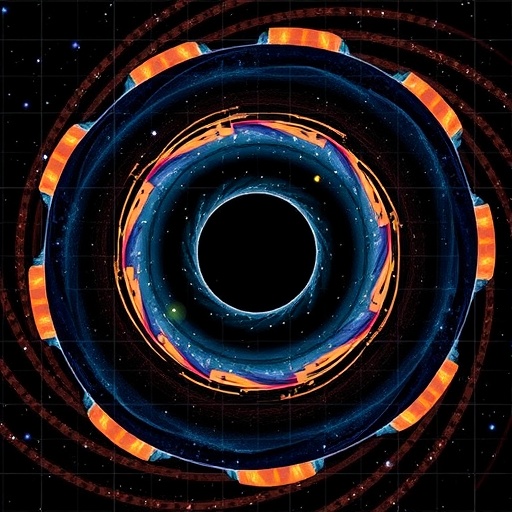
In a groundbreaking study published in The Astrophysical Journal Letters on March 11, 2026, an international team of scientists has unveiled compelling evidence of an eccentric orbit between a neutron star and a black hole preceding their cosmic merger. This discovery upends long-held assumptions about the nature of neutron star-black hole binaries, providing unprecedented insights into the complex astrophysical processes that govern the formation and evolution of such enigmatic systems.
Traditionally, the consensus in astrophysics has been that neutron star-black hole pairs form and evolve into near-perfectly circular orbits as they spiral inward due to the emission of gravitational waves. However, the latest analysis of data from the gravitational-wave event GW200105 reveals that this binary system exhibited a markedly elliptical—or eccentric—orbit just before the merger event. Such orbital eccentricity in a neutron star-black hole merger has never been robustly observed before, signaling that our theoretical frameworks for these binaries must be re-evaluated.
The study was led by researchers at the University of Birmingham, Universidad Autónoma de Madrid, and the Max Planck Institute for Gravitational Physics. Utilizing advanced gravitational-wave data analysis techniques, the team employed a revolutionary waveform model designed at the University of Birmingham’s Institute of Gravitational Wave Astronomy. This model uniquely enabled simultaneous measurement of the binary’s orbital eccentricity along with any spin-induced precessional effects—a combination never before quantified in neutron star-black hole mergers.
Dr. Patricia Schmidt from the University of Birmingham explained the significance of these findings: “The eccentric orbit fundamentally changes our understanding of the progenitors of these systems. It implies that the binary’s formation history is more chaotic and dynamic than previously thought, involving complex gravitational interactions rather than a tranquil, isolated evolution.” Indeed, the eccentricity observed in GW200105 sharply contrasts the near-circular orbits predicted by dominant formation channels, suggesting alternative astrophysical origins.
Geraint Pratten, a Royal Society University Research Fellow at Birmingham, added further context: “The oval shape of the orbit shortly before the collapse betrays a turbulent past. This likely points to dynamical interactions in dense stellar environments—such as globular clusters or galactic nuclei—where multiple stars and compact objects gravitationally influence each other, potentially forming eccentric black hole-neutron star pairs dynamically.”
To achieve these results, the researchers conducted a rigorous Bayesian statistical analysis comparing thousands of theoretical waveform predictions against the observed LIGO and Virgo detector data. This probabilistic approach conclusively excluded a circular orbit at a confidence level exceeding 99.5%, firmly establishing eccentricity as a defining trait of GW200105’s final stages. This level of precision marks a new era in gravitational-wave astrophysics, wherein waveform models must incorporate eccentricity to accurately interpret future observations.
Interestingly, previous studies of GW200105 assumed circular orbits, leading to systematic biases in the inferred masses of the merging objects. The new analysis corrects these estimates, revealing the black hole to be approximately 13 times the mass of the Sun and revising the neutron star mass downward. Additionally, the data show no compelling evidence of significant spin precession, indicating that the system’s eccentricity was likely imprinted at formation rather than influenced by spin-related dynamics during the inspiral phase.
Gonzalo Morras from Universidad Autónoma de Madrid and the Max Planck Institute emphasized how this observation hints at multiple formation mechanisms: “Our results strongly support the idea that not all neutron star-black hole binaries share a universal birthplace or evolutionary pathway. The eccentricity signals formation in dense stellar environments where gravitational encounters are frequent, producing binaries quite distinct from those formed via isolated binary stellar evolution.”
These revelations challenge the prevailing theoretical paradigm that neutron star-black hole mergers predominantly arise from a single dominant evolutionary channel characterized by circular orbital dynamics. Instead, the diversity in orbital properties uncovered by gravitational-wave astronomy demands more comprehensive waveform models capable of capturing the full complexity of these sources. The work presented here represents a significant step toward that goal.
Moreover, this study enriches our understanding of compact binary mergers as a heterogeneous population, underscoring the importance of eccentric orbits as fingerprints of a turbulent astrophysical history. As gravitational-wave observatories continue to increase in sensitivity and detection rates climb, the identification of eccentric mergers will provide vital clues to the dynamical environments where these exotic objects form and interact.
Beyond astrophysical implications, this research exemplifies the power of gravitational-wave astronomy to probe phenomena inaccessible by electromagnetic observations alone. The precise characterization of orbital parameters through gravitational waves offers a unique window into the nature of strong-field gravity and stellar remnants, with profound consequences for fundamental physics and cosmology.
In summary, the detection and analysis of significant orbital eccentricity in the neutron star-black hole merger event GW200105 marks a milestone in astrophysics. It expands our knowledge of how extreme binary systems form, evolve, and ultimately collide, opening new avenues for research and challenging the community to refine models and search strategies for the next generation of gravitational-wave discoveries.
Subject of Research: Not applicable
Article Title: Orbital eccentricity in a neutron star – black hole merger
News Publication Date: 11-Mar-2026
Image Credits: Geraint Pratten, Royal Society University Research Fellow, University of Birmingham
Keywords
Astronomy, Observational astrophysics, Outer space, Black holes, Stars, Neutron stars, Gravitational waves
Tags: astrophysical processes in compact binariesblack hole neutron star merger dynamicschallenges to circular orbit assumptionseccentric orbit gravitational waveselliptical orbits in neutron star black hole mergersformation of eccentric compact object binariesgravitational wave data analysis techniquesgravitational-wave event GW200105 analysisinternational astrophysics research collaborationsneutron star black hole binary evolutionneutron star black hole merger observationswaveform modeling for eccentric binaries