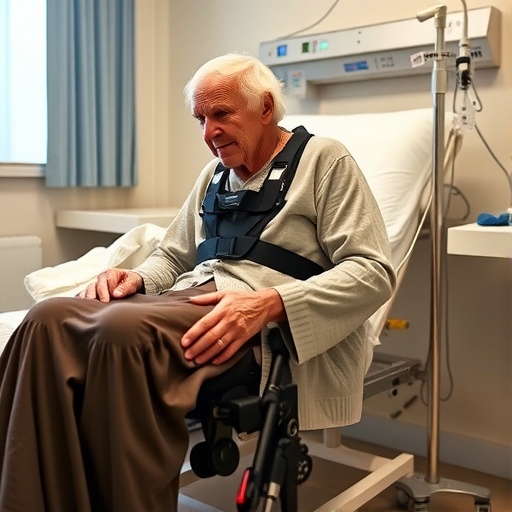
In a groundbreaking advancement poised to revolutionize rehabilitative care, a recent prospective clinical study has illuminated the remarkable potential of lower limb exoskeleton robots in assisting elderly patients afflicted with Intensive Care Unit-acquired weakness (ICU-AW). This debilitating condition, often observed in critically ill patients after extended ICU stays, manifests as profound muscle atrophy and neuromuscular dysfunction, which severely limits mobility and quality of life. The deployment of robotic exoskeletons presents a transformative therapeutic strategy, offering mechanical support while simultaneously promoting active participation in physical rehabilitation.
ICU-acquired weakness emerges predominantly due to prolonged immobilization, systemic inflammation, and critical illness polyneuropathy. These factors converge to provoke catastrophic deterioration of skeletal muscle and neural pathways controlling movement, leaving elderly patients vulnerable to long-term functional incapacitation. Traditional rehabilitative practices, while beneficial, frequently struggle to adequately address the multifaceted challenges imposed by ICU-AW, particularly in older adults with diminished physiological reserves. This has underscored the urgent necessity for innovative modalities designed to augment and accelerate recovery processes.
Lower limb exoskeleton robots, engineered with sophisticated biomechanics and adaptive control algorithms, have been ingeniously adapted to meet the unique demands of this patient population. These wearable devices encompass supportive frames and actuators that assist hip, knee, and ankle articulation, enabling partial or complete weight-bearing and guided movement. Importantly, they are designed to harmonize with the wearer’s residual motor capabilities, offering tailored assistance and resistance to facilitate gradual muscular reconditioning and neural retraining.
The clinical study spearheaded by Jin, X., Wang, Xr., Wang, K., and colleagues delineates the application of these exoskeletons in elderly ICU survivors diagnosed with ICU-AW. Employing a prospective design, the investigation meticulously monitored functional outcomes, muscular strength recovery, and neurophysiological indices over a predefined rehabilitation timeline. The patients engaged in structured sessions using the robotic devices, combining active participation and guided motor assistance to optimize neuromuscular engagement and mitigate disuse atrophy.
Analyzing the intervention’s impact, the researchers reported substantial improvements in gait parameters, lower limb muscle strength, and overall mobility when compared to conventional physiotherapy groups. These benefits were not merely short-lived; follow-up assessments demonstrated sustained functional gains and enhanced independence in activities of daily living. Such outcomes underscore the exoskeleton’s ability not only to restore physical capabilities but also to empower elderly patients with renewed autonomy.
Beyond motor recovery, the study illuminated significant neuroplastic adaptations induced by exoskeleton-assisted rehabilitation. Utilizing electromyography and nerve conduction studies, evidence revealed enhanced neural recruitment patterns and improved peripheral nerve function. This suggests that the robotics-enabled movement paradigms may stimulate regenerative processes at the neuromuscular junction, facilitating more efficient communication between the brain and the musculature. This neurophysiological remodeling holds profound implications for regenerative medicine and rehabilitation science.
From a biomechanical perspective, the exoskeleton’s real-time feedback systems play a pivotal role in rehabilitation. Integrated sensors continuously monitor gait dynamics, joint angles, and muscle activation, dynamically adjusting assistance levels to continuously challenge the patient without risking overexertion or injury. This adaptive control framework epitomizes the convergence of artificial intelligence and human physiology, enabling personalized, data-driven rehabilitation strategies that evolve in step with patient progress.
In addition to therapeutic efficacy, the technological design prioritizes patient safety and comfort—a critical consideration given the frailty inherent in the elderly cohort. Lightweight materials, ergonomic interfaces, and customizable fit ensure the device promotes naturalistic movement patterns and minimizes fatigue. Moreover, the psychological benefits of using cutting-edge robotics foster increased motivation and engagement, further enhancing rehabilitative outcomes and adherence.
The implications of integrating lower limb exoskeletons into standard ICU rehabilitation protocols are far-reaching. Such technology may substantially reduce healthcare burdens by shortening recovery times, decreasing dependency on long-term care facilities, and mitigating secondary complications such as pressure ulcers and thromboembolism caused by prolonged immobility. This could translate to significant cost savings for healthcare systems grappling with aging populations and ICU resource demands.
Challenges remain, however, in scaling deployment and ensuring equitable access. The initial investment in robotic systems, alongside requisite clinician training, constitutes barriers to widespread adoption. Moreover, individual variability in patient condition necessitates nuanced customization and potentially contraindicates use in certain comorbidities. Ongoing refinement of device intelligence, coupled with rigorous multicenter trials, will be essential to validate efficacy across diverse clinical settings and populations.
The study also provokes inquiries into the broader applications of robotic exoskeletons beyond ICU-AW. Conditions such as stroke rehabilitation, spinal cord injury, and neurodegenerative diseases may similarly benefit from these devices’ ability to synergize neuromotor relearning with mechanical assistance. As the technology matures, integrating multimodal feedback—including visual, auditory, and proprioceptive cues—could unlock unprecedented dimensions of functional restoration.
Future research trajectories could explore the integration of wearable exoskeletons with emerging biosensor technologies capable of mapping real-time metabolic and muscular fatigue markers. This would allow hyper-personalized session adjustments that optimize therapeutic windows and prevent overtraining. The confluence of robotics, wearable biosensors, and AI-driven analytics heralds a new era of precision rehabilitation fostering maximized recovery potential for frail elderly patients.
In summation, the prospective clinical study by Jin and colleagues illuminates a promising new frontier in rehabilitative medicine, melding robotics with human endeavor to combat the debilitating aftermath of critical illness in the elderly. Lower limb exoskeleton robots offer a potent combination of physical support, neurophysiological stimulation, and motivational enhancement, collectively driving meaningful functional recovery. This innovation stands as a beacon of hope for optimizing quality of life and independence among those most vulnerable to the ravages of ICU-acquired weakness.
As this technology gains traction and accessibility improves, it heralds a paradigm shift in rehabilitative care—one where cutting-edge engineering and compassionate clinical practice unite to restore mobility, dignity, and autonomy to a growing population of elderly ICU survivors. The promise of robotic exoskeletons transcends mere devices; they represent a transformative ethos in medicine, marrying the future of robotics with timeless human resilience.
Subject of Research: Application of lower limb exoskeleton robots in elderly patients with ICU-acquired weakness
Article Title: Application of lower limb exoskeleton robots in elderly patients with ICU-acquired weakness: a prospective clinical study
Article References:
Jin, X., Wang, Xr., Wang, K. et al. Application of lower limb exoskeleton robots in elderly patients with ICU-acquired weakness: a prospective clinical study.
BMC Geriatr (2026). https://doi.org/10.1186/s12877-026-07259-3
Image Credits: AI Generated
Tags: adaptive control algorithms in exoskeletonsadvanced biomechanics in exoskeletonsICU-acquired weakness rehabilitationlower limb exoskeleton robots for elderlymobility support for aged patientsmuscle atrophy treatment in elderlyneuromuscular dysfunction therapyphysical therapy innovations for ICU patientsrecovery acceleration in ICU-acquired weaknessrehabilitation technology for critical illnessrobotic assistance in ICU recoverywearable robotic devices for mobility