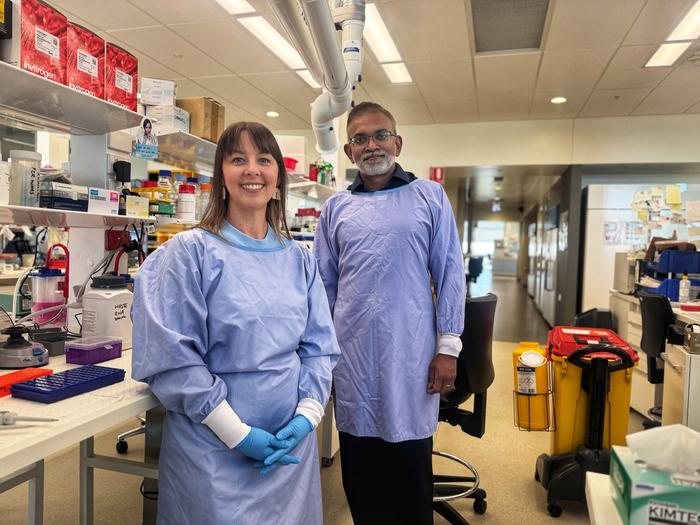
 image: Adelaide University cancer researchers Dr Sarah Boyle and Professor Michael Samuel.
view more
Credit: Adelaide University
A new study led by researchers at Adelaide University and published in Science Advances has revealed why some cancers can grow and survive in the body, while others cannot.
It turns out that intense mechanical pressure experienced by early cancer cells as they grow cramped in a restricted space can benefit some cancer cells, rather than impede growth, as might be expected.
Scientists found that early breast cancer cells used this ‘squeeze’ to their advantage.
Lead researcher Professor Michael Samuel from Adelaide University’s Centre for Cancer Biology and the Basil Hetzel Institute said these breast cancer cells hijack a specific sensor – one that our bodies normally use to perceive touch – and use it to multiply rapidly and help them migrate away from the primary tumour.
“This process leaves a lasting ‘mechanical memory’ in breast cancer cells, continuing to promote aggressive behaviour long after the pressure itself has been relieved,” Professor Samuel said.
“Solid tumours experience intense physical pressure at early stages of the disease, as cancer cells multiply within space-restricted tissues, such as the milk ducts of the breast. Until now, it has been unclear how cancer cells sense this pressure and whether it influences how the disease progresses.
“We tend to think about cancer as a genetic disease, but this work shows that physical forces inside tumours are just as important as cancer-causing genetic changes.”
The researchers found that cancer cells detect pressure through a molecule called PIEZO1, a channel that connects the inside of a cell with the outside environment. When activated by pressure, PIEZO1 allows calcium ions to flow into the cell, triggering a series of signals including the Rho-ROCK pathway – a key regulator of cell movement, shape and growth.
The team showed that brief exposure to mechanical pressure, applied by compressing cancer tissue, was enough to significantly increase tumour growth. In laboratory models of breast cancer, tumours that had been mechanically compressed grew larger and the cancer cells within them divided more rapidly than uncompressed tumours.
Beyond stimulating growth, compression was also found to push cancer cells towards a more aggressive, invasive state through a process known as epithelial-mesenchymal transition. However, when PIEZO1 or the Rho-ROCK pathway had been blocked using appropriate drugs, compression failed to drive cancer aggressiveness, clearly establishing their importance to this process.
Co-lead author Dr Sarah Boyle said that one of the most striking findings was that the effects of compression on cancer aggressiveness persisted long after the force itself was removed.
“Even fairly brief periods of pressure can cause mechanical memory by changing how DNA is packaged inside the cell, through chemical modifications to histone proteins,” Dr Boyle said.
“These modifications, referred to as epigenetic changes, alter how the DNA code is interpreted by the cell, allowing certain genes that drive tumour growth and aggressiveness to be switched on.”
This form of epigenetic mechanical memory provides a molecular explanation for how short-term mechanical forces at the cell level can have long-lasting consequences for how tumours behave.
Importantly, the study found that PIEZO1 is more abundant in human breast cancers than in normal breast tissue, and that the amount of PIEZO1 varies between patients. High levels of PIEZO1 are associated with poor patient survival, suggesting that the same pressure-sensing mechanism identified in experimental models is likely to be relevant in human cancers.
The findings highlight mechanical pressure as an underappreciated driver of cancer aggressiveness and suggest the PIEZO1 -Rho-ROCK pathway is a potential new therapeutic target for use in early intervention.
By disrupting how cancer cells sense and respond to mechanical pressure, future treatments may be able to limit tumour growth and reduce invasiveness, according to the researchers. These findings may also be useful in identifying patients at risk of aggressive breast cancers because of high levels of PIEZO1.
“As cancers are increasingly recognised as mechanically responsive diseases, this work opens the door to a new area of ‘mechanotherapy’ – treatments designed to interfere with the mechanical signals that tumours rely on to grow and spread,” said Professor Samuel.
This study was co-funded by The Hospital Research Foundation Group and their Group charity Australian Breast Cancer Research, Worldwide Cancer Research (UK) and the Federal Government.
‘Compressive stress-driven PIEZO1 activation and Rho-ROCK mechanotransduction promote tumor progression via epigenetic mechanical memory’ is published in Science Advances.
DOI:
Science Advances
DOI10.1126/sciadv.aeb1271
Method of ResearchExperimental study
Subject of ResearchAnimals
Article TitleCompressive stress-driven PIEZO1 activation and Rho-ROCK mechanotransduction promote tumor progression via epigenetic mechanical memory
Article Publication Date4-Mar-2026
Media ContactCandy Gibson
Adelaide University
Journal Science Advances Funder Hospital Research Foundation,Worldwide Cancer Research,
Australian Breast Cancer Research DOI 10.1126/sciadv.aeb1271 Journal
Science Advances
DOI10.1126/sciadv.aeb1271
Method of ResearchExperimental study
Subject of ResearchAnimals
Article TitleCompressive stress-driven PIEZO1 activation and Rho-ROCK mechanotransduction promote tumor progression via epigenetic mechanical memory
Article Publication Date4-Mar-2026
Tags/Health and medicine/Diseases and disorders/Cancer/Breast cancer
bu içeriği en az 2000 kelime olacak şekilde ve alt başlıklar ve madde içermiyecek şekilde ünlü bir science magazine için İngilizce olarak yeniden yaz. Teknik açıklamalar içersin ve viral olacak şekilde İngilizce yaz. Haber dışında başka bir şey içermesin. Haber içerisinde en az 12 paragraf ve her bir paragrafta da en az 50 kelime olsun. Cevapta sadece haber olsun. Ayrıca haberi yazdıktan sonra içerikten yararlanarak aşağıdaki başlıkların bilgisi var ise haberin altında doldur. Eğer yoksa bilgisi ilgili kısmı yazma.:
Subject of Research:
Article Title:
News Publication Date:
Web References:
References:
Image Credits:
Keywords
Tags: Adelaide University cancer researchbreast cancer cell growth under mechanical compressionbreast cancer cell survival mechanismscancer cell adaptation to physical stresscancer cell mechanobiologyearly breast cancer cell behaviorimpact of mechanical squeeze on tumor growthmechanical forces in tumor microenvironmentmechanical microenvironment in cancer developmentphysical pressure effects on cancer cellsrole of compression in cancer progressionScience Advances breast cancer study