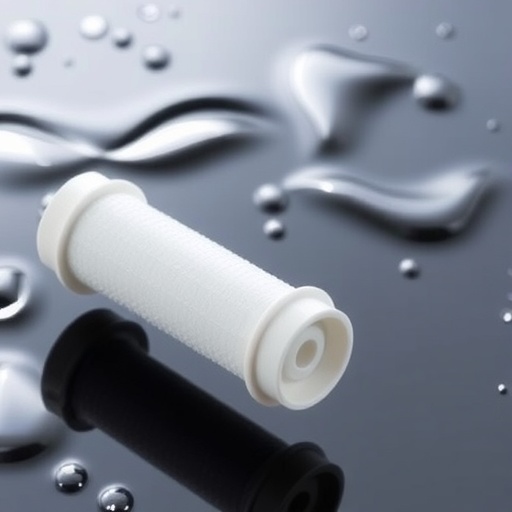
In a groundbreaking development that promises to revolutionize water treatment technologies, researchers from the Korea Institute of Materials Science (KIMS) have unveiled a novel approach to manufacturing ceramic nanofiltration membranes. Led by Dr. Hong-Ju Lee and Dr. In-Hyuk Song, the team has successfully developed a low-temperature co-sintering process combined with a mutual doping technique that significantly smooths substrate surfaces while enhancing interparticle bonding. This innovation addresses long-standing challenges in the fabrication of ceramic membranes, notably mitigating surface roughness and microcrack formation, factors that traditionally limit membrane performance and economic viability.
Ceramic membranes have long served critical roles in treating industrial wastewater, facilitating seawater desalination, and producing ultrapure water essential for semiconductor manufacturing. Their durability under harsh chemical and thermal conditions makes them invaluable for these demanding applications. However, existing manufacturing methods involve complex multi-layer coating processes followed by high-temperature sintering typically above 1300°C, resulting in excessive energy consumption and undesirable surface defects. These defects, specifically microcracks on the membrane’s separation layer, compromise filtration accuracy and reduce operational lifespan, leading to increased costs and inefficiencies.
To overcome these technical barriers, the research team pioneered a Mutual Doping methodology, whereby particles from different layers are finely mixed to reinforce bonding and densification within the membrane matrix. This approach is coupled with a Co-sintering process, wherein all membrane layers are fired simultaneously, thereby reducing fabrication steps and cutting the sintering temperature to around 1000°C. This temperature reduction not only offers substantial energy savings but also promotes the formation of a uniformly dense ceramic structure. Particularly notable is the achievement of an ultra-flat membrane surface with surface roughness halved from 24.49 nm to a remarkable 11.74 nm, a milestone previously unattainable with conventional sequential layering and sintering methods.
The exceptionally smooth and crack-free ceramic substrate formed through this refined process provides an ideal platform for applying a self-developed eco-friendly aqueous zirconia (ZrO₂) sol coating. This coating serves as the active nanofiltration layer, leveraging the combined mechanisms of size-exclusion due to well-controlled nanoscale pores and electrostatic repulsion to selectively filter contaminants. Impressively, this membrane demonstrates the ability to remove over 99.8% of dye molecules from dye-laden wastewater while allowing monovalent salt ions to permeate, even at low operational pressures as gentle as 2 bar—pressures comparable to typical household tap water.
Operating efficiently at such low pressures marks a significant departure from traditional ceramic nanofiltration membranes that generally require pressures near 10 bar to function effectively. Lowering the operational pressure directly translates into reduced energy requirements, substantially decreasing the carbon footprint of large-scale water treatment facilities. Additionally, the membrane’s high water permeability and robust chemical stability extend its functional lifetime and enhance flux recovery capabilities. These factors collectively elevate the economic feasibility of deploying ceramic membranes on an industrial scale, supporting both sustainability goals and cost-effectiveness.
This advanced membrane technology transcends mere contaminant removal by enabling refined separation and resource recovery, expanding the functional horizons of water treatment systems. The ability to selectively separate dyes from ions addresses a critical limitation in current commercial membrane technologies, opening new pathways for treating complex industrial effluents and recycling valuable resources. Moreover, the integration of materials science innovation with streamlined manufacturing underscores the potential of these membranes to meet increasingly stringent environmental regulations worldwide.
From a manufacturing perspective, the research introduces a paradigm shift through its emphasis on reducing process complexity without sacrificing membrane integrity. The combination of mutual doping and co-sintering not only simplifies the fabrication workflow but also establishes a reproducible pathway for producing defect-minimized ceramic membranes with consistent performance. This positions the technology favorably for scaling up to industrial production volumes.
The implications of this research are especially significant for sectors demanding ultra-pure water, such as semiconductor fabrication, where membrane reliability and precision filtration are paramount. By offering a technically advanced yet energy-efficient solution, this ceramic membrane technology promises to curb dependency on imported materials, foster domestic innovation, and bolster national competitiveness in the high-value membrane market traditionally dominated by a few advanced countries.
Ongoing efforts by the KIMS research team focus on translating laboratory-scale innovations to large-area membrane fabrication and mass production. The team has secured patents in both domestic and international jurisdictions to protect the core technologies, underscoring a commitment to commercializing this breakthrough. Plans are underway to validate the technology’s industrial applicability through pilot-scale demonstrations and to facilitate technology transfer to relevant industries poised to integrate this environmentally responsible water treatment solution.
Dr. Hong-Ju Lee emphasized the dual achievement of securing material technologies operable at low pressures and refining manufacturing processes to a near-defect-free state as foundational to future advances. This research, supported by the National Research Foundation of Korea and the Korea Institute for Advancement of Technology, exemplifies the synergistic potential of multidisciplinary collaboration in addressing global water challenges through innovative materials science.
As water scarcity and pollution concerns escalate globally, the ability to deploy highly efficient, durable, and energy-conserving filtration membranes is of paramount importance. The KIMS team’s innovations represent a significant leap towards environmentally sustainable water management technologies that balance performance with economic and ecological considerations. This advancement sets a benchmark for future research in ceramic membrane fabrication, heralding a new era of water treatment capabilities capable of addressing diverse industrial and environmental needs.
By harnessing the synergy between novel material compositions and process engineering, this research exemplifies the transformative potential inherent in next-generation nanomaterials development. The resultant membranes not only offer immediate improvements in water treatment efficacy but also lay the groundwork for broader applications in resource recovery and environmental remediation in the years to come.
Subject of Research: Development of ultra-flat, defect-free ceramic nanofiltration membranes with low-pressure operability through innovative mutual doping and co-sintering fabrication technologies.
Article Title: Controlling substrate surface roughness via co-sintering of MF/UF-range sublayers ceramic membranes for high-integrity mesoporous top-layer coatings
News Publication Date: 1-Feb-2026
Web References: DOI Link
Image Credits: Korea Institute of Materials Science (KIMS)
Keywords
Ceramic Membranes, Nanofiltration, Water Treatment, Mutual Doping, Co-sintering, Zirconia Sol, Surface Roughness, Low-Pressure Filtration, Industrial Wastewater, Process Innovation, Energy Efficiency, Membrane Fabrication
Tags: advanced water treatment materialsceramic nanofiltration membranesenergy-efficient membrane fabricationenhanced interparticle bondinghigh-efficiency ceramic filtersindustrial wastewater treatment technologylow-temperature co-sintering processmicrocrack mitigation in membranesmutual doping techniqueseawater desalination filterssurface roughness reductionultrapure water production membranes