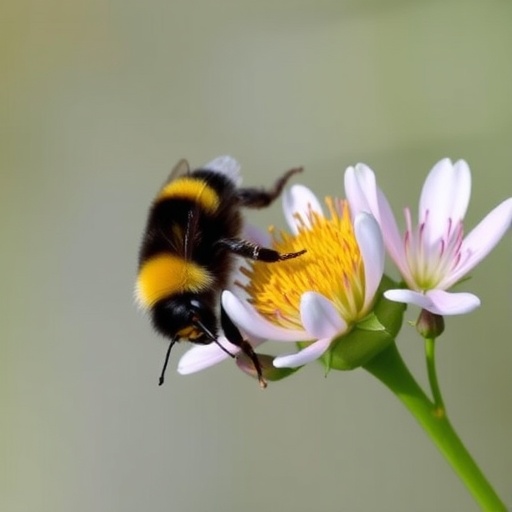
In the dense mosaic of a supermarket fruit aisle, shoppers often rely on visual cues and sensory shortcuts to select the sweetest strawberries. They might instinctively reach for the deep-red berries or follow the most intense, ripe aroma wafting from the container. Intriguingly, such decision-making processes are not exclusive to humans; the humble bumblebee exhibits remarkably similar strategies when foraging. A recent collaborative study led by researchers at the University of Konstanz and the University of Würzburg reveals that bumblebees employ an adaptive, time-efficient approach to processing environmental information, optimizing their foraging decisions by prioritizing certain sensory cues over others.
Bumblebees offer an extraordinary model for studying decision-making at a rapid pace. Foraging for nectar and pollen, an individual bee visits hundreds of flowers daily, necessitating swift yet reliable choices about which blooms to exploit. This constant demand for speed and accuracy offers researchers a window into the neural and behavioral mechanisms underlying complex decisions. Neuroethologist Anna Stöckl emphasizes that bumblebees’ reliance on learned floral traits—primarily color, but also shape, pattern, and scent—parallels how humans integrate sensory information from prior experience to navigate choices in everyday life, such as selecting fruits or vegetables.
To dissect how bumblebees balance efficiency and accuracy, the research team designed controlled experimental trials using artificial flowers. These flowers combined distinctive colors with specific shapes or patterns, linked to differing rewards: a sugar solution mimicking nectar or plain water as a non-reward. In one paradigm, the bees were conditioned to associate a blue star-shaped flower with the sugar reward, while a yellow round flower offered only water. A subsequent challenge involved more subtle color distinctions, such as yellow versus orange hues, testing the bees’ ability to discriminate and remember nuanced visual features.
As the conditioning progressed, the bumblebees demonstrated marked improvement in selecting sugar-rewarding flowers, confirming that they indeed encode and utilize specific flower characteristics in their foraging decisions. However, the pivotal question concerned which attributes dominated their memory and choice: was color overriding shape, or vice versa? To interrogate this, the researchers introduced conflicting combinations during testing; for example, a star-shaped flower painted yellow or a round flower turned blue. The outcomes were revealing—the bees predominantly chose based on color over shape, faithfully revisiting flowers of the learned color irrespective of the altered shape.
This result indicates a hierarchical prioritization in feature processing, suggesting that when color cues are distinct and easily discernible, bees simplify their decision-making by heavily weighting this attribute. Yet, complexity arose when color differences were subtle and harder to differentiate, such as the yellow-orange spectrum. Under these conditions, the bees expanded their cognitive representation to include shape and pattern, compensating for ambiguous chromatic signals by integrating additional visual information. Consequently, in a later phase where all flowers appeared uniformly grey, bees previously trained with similar colors effectively relied on shape cues to identify rewarded flowers.
Crucially, this behavioral flexibility was linked to the amount of time required for learning. Bees trained with distinct, easy-to-differentiate colors required less training time, presumably as encoding and recalling a single dominant feature is cognitively economical. Conversely, when trained with confusable colors, bees invested more time learning to associate multiple features, reflecting greater processing demands. This dynamic adjustment exemplifies an optimization strategy balancing cognitive load and ecological payoff, whereby bees ‘learn as much as necessary but as little as possible.’
Underlying these findings is a principle resonant with human cognition: economizing cognitive resources by minimizing information processing when sufficient discriminative cues exist, yet flexibly expanding the informational scope when environmental uncertainty demands it. In humans, a similar heuristic enables rapid decisions in typical scenarios but prompts deeper analysis under ambiguous or complex conditions. This shared strategy between an insect with a tiny brain and humans underscores convergent evolution toward efficient decision-making mechanisms optimized for survival and success.
On a neurobiological level, this study enriches understanding of how perceptual and memory systems interact to guide behavior in animals with limited neural capacity. It suggests that bumblebees possess neural circuits capable of flexibly weighting sensory modalities based on task demands and environmental context. Integrating multiple floral features requires more extensive neural encoding but yields more reliable foraging success when simple cues fall short. Thus, these insects cleverly allocate their neural resources in ways dynamically attuned to informational complexity.
Furthermore, this research contributes novel insights into animal cognition and ecological adaptation by revealing that behavioral strategies are not static but can be fine-tuned by experience and environmental pressures. This plasticity has implications for how pollinators respond to environmental changes, such as habitat loss or shifting floral communities, wherein previously reliable cues may become less informative, necessitating flexible learning strategies.
By extending beyond the often simplistic assumption that insects rely on hardwired stimulus-response patterns, the study opens avenues for exploring how decision-making heuristics evolve across taxa and contexts. It invites a reevaluation of cognitive complexity in invertebrates and highlights the sophistication underpinning even small-brained organisms’ interactions with their environments.
These findings also resonate with broader themes in neuroscience and behavioral ecology around the trade-offs between speed, accuracy, and resource expenditure in information processing. They demonstrate that efficiency does not come at the expense of adaptability but rather that adaptive shortcuts can coexist with context-dependent elaboration of sensory cues.
Ultimately, the bumblebees’ nuanced approach to identifying rewarding flowers serves as a compelling example of an elegant cognitive economy: prioritizing salient features when they suffice and augmenting information gathering when required. This mirrors everyday human choices where, for instance, a shopper selects ripe strawberries primarily by color unless all berries appear uniformly ripe, prompting reliance on aroma or texture. Such parallels emphasize the fundamental nature of decision heuristics across species, shaped by similar ecological challenges and neural constraints.
This study, published in Science Advances, invites a deeper appreciation of animal intelligence and offers a foundation for future research probing the mechanisms and evolution of flexible decision strategies. It advances our understanding of how organisms integrate sensory inputs under real-world pressures, offering insights that could inform the design of artificial intelligence systems inspired by biological efficiency and adaptability.
Subject of Research: Animals
Article Title: Bees flexibly adjust decision strategies to information content in a foraging task
News Publication Date: 25-Feb-2026
Web References: https://www.science.org/doi/10.1126/sciadv.adw9320
References: Johannes Spaethe, Selma Hutzenthaler, Alexander Dietz, Karl Gehrig, James Foster, Anna Stöckl (2026): Bees flexibly adjust decision strategies to information content in a foraging task. Science Advances.
Keywords: Life sciences, Behavioral neuroscience, Cognitive neuroscience, Animal science, Animals
Tags: adaptive foraging strategiesbumblebee foraging behaviorcomparative decision-making in animalsefficient decision-making in insectsfloral trait learning in bumblebeeshuman and insect sensory integrationneural mechanisms of insect decision-makingneuroethology of pollinatorsrapid choice behavior in insectssensory cue prioritization in bumblebeestime-efficient information processingvisual and olfactory cues in pollinators