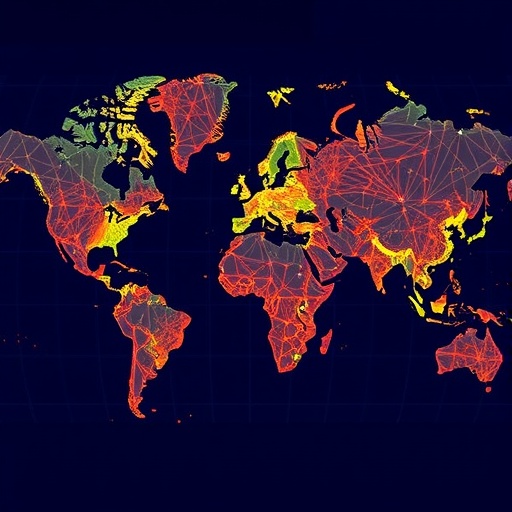
In a groundbreaking study poised to revolutionize our understanding of global maritime logistics, researchers have unveiled unprecedented insights into the temporal dynamics governing tanker shipping networks. The study, conducted by Teo, Arnold, Hone, and colleagues, and soon to be published in Nature Communications, delves deeply into the intricate choreography of vessel movements that underpin one of the most critical infrastructures of the global economy. By harnessing advanced data analytics and network science methodologies, the team has peeled back the layers of complexity that define tanker fleets’ operational rhythms, revealing patterns that blur the lines between individual vessel behavior and collective fleet dynamics.
The global tanker shipping network, an intricately interwoven system ferrying petroleum and chemical products across vast oceanic expanses, operates under a veil of temporal complexity. Despite its economic importance—accounting for a significant fraction of global trade volume and energy distribution—systematic temporal analyses of tanker operations have remained relatively underexplored. Historically, studies have focused more on spatial routes, capacity utilization, or economic impact rather than the temporal sequencing and synchronization of vessel movements. This research rectifies that imbalance by applying novel temporal network analysis frameworks designed to extract meaningful patterns from extensive time-series data capturing tanker activities.
The research team utilized Automatic Identification System (AIS) data, a prolific source of real-time vessel location and movement information. Over several years, millions of data points chronicled the trajectories, speeds, and port calls of thousands of tankers worldwide. This immense spatiotemporal dataset served as the foundation for constructing temporal interaction networks, where vessels and ports are nodes interconnected by journeys occurring at specific times. Through meticulous preprocessing and cleaning stages, the team established a robust data model capable of revealing both macroscopic trends and fine-grained operational nuances.
Central to their findings was the concept of “temporal motifs,” repetitive time-dependent patterns within the network that manifest on scales ranging from hours to months. These motifs capture the sequence and timing of tanker activities such as loading, unloading, transit, and waiting phases. Intriguingly, the study identified distinct motifs characterizing different categories of tankers, for instance, crude oil carriers versus product tankers, highlighting how operational roles are encoded in temporal behavior. This nuanced understanding opens pathways to optimize fleet scheduling and reduce port congestion by aligning operations with recognized temporal motifs.
Beyond individual tankers, the collective dynamics that emerge from temporal interdependencies were a core focus. The researchers applied advanced community detection algorithms adapted for temporal networks to identify clusters of vessels whose operations exhibit synchronized timing. These clusters often corresponded to regional trade corridors or specialized supply chains, revealing how micro-level timing decisions aggregate into macro-level patterns. Such temporal communities illuminate the emergent structure of tanker networks, where coordination arises spontaneously from operational constraints and market demands rather than explicit centralized control.
The implications of these temporal insights are profound. For maritime logistics, understanding when clusters of tankers are likely to converge at strategic choke points enables stakeholders to anticipate bottlenecks and optimize resource allocations. Furthermore, temporal pattern recognition can aid in anomaly detection, flagging deviations from expected operational rhythms that may signify disruptions such as mechanical failures, geopolitical events, or illicit activities. This predictive capability offers a powerful tool for enhancing maritime security and resilience, critical in an era marked by geopolitical uncertainty and environmental concerns.
Technically, the study employed an innovative blend of time-series clustering, network theory, and machine learning. Temporal snapshots of the tanker network were analyzed using sliding time windows, capturing evolving connectivity patterns. The researchers introduced novel metrics quantifying temporal centrality and persistence, enabling them to track the evolving influence of individual vessels and ports over time. These metrics revealed how certain strategic hubs exhibit persistent temporal centrality, serving as temporal linchpins that stabilize the entire network’s dynamics.
The methodological advancements also extended to visualization techniques. The team developed dynamic graphical representations that intuitively depict temporal interaction sequences, enabling domain experts to visually discern repetitive temporal patterns and sudden perturbations. These visualizations are more than mere illustrative tools; they form an analytical bridge connecting quantitative analyses with operational interpretations, facilitating communication between data scientists and maritime practitioners.
This research also intersects with environmental concerns by offering insights that could help mitigate shipping-induced pollution. Temporal pattern analysis can inform strategies for smoother traffic flow, reducing idle times and inefficient maneuvers known to increase fuel consumption and emissions. By aligning shipping schedules along optimized temporal corridors, it is possible to achieve greener maritime operations without compromising economic throughput.
The study’s cross-disciplinary nature highlights the power of integrating computational science with maritime economics and logistics. By transcending traditional siloed approaches, the researchers have unlocked a multi-dimensional understanding of tanker shipping networks that captures both the granularity of individual vessel behavior and the emergent properties of the collective system. Such integrative research exemplifies the future of complex system analysis, where data-driven insights propel operational innovations.
Looking forward, the authors envision extending their framework to incorporate additional data layers, such as weather conditions, global market fluctuations, and port infrastructure availability. Incorporating such exogenous variables could enrich temporal models, enhancing their predictive power and adaptability. Furthermore, expanding the approach to cover other shipping sectors, like container or bulk carriers, could reveal whether similar temporal principles govern broader maritime logistics.
Beyond maritime applications, this study sets a precedent for temporal network analysis in other domains where timing and sequencing are crucial, such as air traffic management, public transportation systems, and even biological networks. The demonstrated ability to dissect temporal motifs and communities holds promise for optimizing a variety of complex, time-sensitive infrastructures.
With the shipping industry facing mounting pressures from climate regulations, geopolitical shifts, and technological transformations like autonomous vessels, understanding temporal dimensions of operation will be increasingly valuable. The insights from Teo et al.’s work furnish a foundational step toward smarter, more resilient, and sustainable maritime logistics, representing a rare confluence of deep theoretical innovation and high practical relevance.
In summary, this landmark research reveals that tanker shipping networks are not merely spatially distributed fleets but dynamic temporal systems rich with identifiable motifs and collective rhythms. By unveiling these temporal structures, the study provides a powerful lens to optimize, safeguard, and decarbonize global maritime logistics. As the data revolution continues to transform traditional industries, temporal network analysis stands out as an indispensable methodology with wide-reaching impacts across scientific and industrial frontiers.
The full paper, available in Nature Communications, promises to catalyze further research and development aimed at harnessing the untapped potential within the time dimension of maritime operations. For industry leaders, policymakers, and scientists alike, the study is a clarion call to embrace temporal thinking, effectively turning the tide on shipping challenges and opportunities in the decades ahead.
Subject of Research: Temporal network analysis of tanker shipping operations and their emergent individual and collective patterns.
Article Title: Unveiling individual and collective temporal patterns in the tanker shipping network.
Article References:
Teo, K., Arnold, N., Hone, A. et al. Unveiling individual and collective temporal patterns in the tanker shipping network. Nat Commun (2026). https://doi.org/10.1038/s41467-026-70013-1
Image Credits: AI Generated
Tags: advanced data analytics in shippingchemical tanker shipping routesglobal tanker fleet operationsnetwork science applied to maritime transportoperational rhythms of tanker fleetspetroleum transportation logisticssynchronization of tanker vessel schedulestanker shipping network analysistemporal dynamics in maritime logisticstemporal network analysis in shippingtime-series analysis of maritime datavessel movement patterns over time