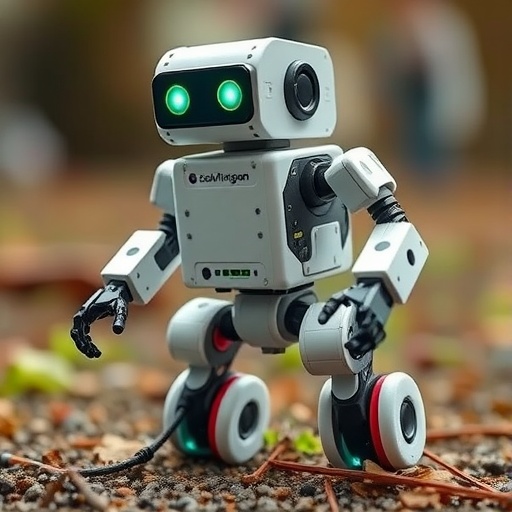
In the relentless quest to decipher the intricacies of animal locomotion, scientists have often found themselves constrained by the complex interplay of biological variables that resist isolation. Recent advances, however, have introduced an innovative approach that bridges biology and robotics, promising unprecedented insights into the mechanics behind nature’s fastest and most enduring creatures. At the forefront of this development is a novel, modular robotic platform aptly named The Robot of Theseus, or TROT, engineered at the University of Michigan. This open-source creation is revolutionizing the way researchers investigate biomechanical properties by mimicking animal limb morphology with customizable, reconfigurable parts—all at a fraction of the typical research cost.
The inspiration behind TROT stems from an extensive interest in the evolutionary biology of locomotion, specifically addressing questions long debated among scientists: What attributes of a cheetah’s anatomy grant it unparalleled sprinting speed? How do wolves sustain grueling endurance over long distances? Conventional animal experiments provide partial answers, yet they are often limited by the confounding variables inherently present in living organisms. By replicating these anatomical features in robotic form, TROT delivers a controlled environment to analyze discrete biomechanical contributions to movement.
One of the most compelling aspects of TROT’s design is its modularity and adaptability. Borrowing philosophical symbolism from the “Ship of Theseus,” the robot is constructed from commercially sourced motors and 3D-printed components that researchers can rearrange to emulate diverse quadrupedal configurations. Unlike robots specifically crafted to imitate individual extinct species over years of design, TROT compresses this evolutionary experimentation timeframe drastically. Assistant Professor Talia Moore, the lead visionary behind this project, emphasizes that with TROT, evolutionary variations encompassing tens of millions of years can be simulated within mere minutes, facilitating direct comparative studies across a spectrum of limb morphologies and sizes.
The accessibility of the platform is another breakthrough. TROT’s assembly involves straightforward processes achievable without specialized robotics expertise, relying on equipment ubiquitously available in modern research universities. This democratization of robotic biomechanical investigation lowers the barrier for evolutionary biologists and zoologists alike, fostering interdisciplinary collaboration. Moreover, the affordability—requiring under $4,000 in parts—dramatically contrasts with the usual expense and complexity associated with traditional research-grade robots.
Beyond flexibility and cost-efficiency, TROT incorporates sophisticated biomechanical realism through its actuation system. It eschews the use of physical springs or elastic components, which are known to introduce noise and variability in experimental data. Instead, TROT employs backdrivable motors that simulate the spring-like properties inherent in muscular and tendon systems by capturing and recycling mechanical energy during movement reversals. This innovation allows for precise quantification of energetic costs and benefits tied to changes in limb properties, thereby refining biomechanical models with greater fidelity than previously possible.
A quintessential example of TROT’s investigatory prowess lies in revisiting the classic 1974 experiment that examined energy costs in running cheetahs and goats. While physics predicts that limbs with mass distributed closer to the hip require less energy to swing—a principle quantified by the moment of inertia—the original study paradoxically found minimal energy cost differences between these species. Moore’s group surmounted this paradox by isolating the limb mass distribution variable on TROT, adjusting only this parameter while keeping all else constant. The robot definitively demonstrated the direct energetic implications of limb mass positioning, unclouded by other biological variances. This breakthrough exemplifies how modular robotic platforms can disentangle longstanding evolutionary biomechanics puzzles.
TROT’s reconfigurability extends beyond simulating extinct and extant species. Researchers are empowered to experiment with theoretical limb architectures that evolution may not have explored. This capability opens pathways to probe the biomechanical viability of novel morphologies, shedding light on evolutionary constraints and potential innovations in animal and robotic locomotion design. Such insights hold transformative potential not only for biological understanding but also for robotics engineering, where limb optimization tailored to specific tasks and terrains could dramatically enhance performance.
The practical engineering design of TROT prioritizes simplicity and rapid iteration. With a minimal part count and uniquely fitting components, assembly is intuitive and expedient. Most parts can be produced using commodity fused deposition modeling (FDM) 3D printers, with only a handful requiring stereolithography (SLA) printers for finer details. This means that institutions with moderate fabrication capacities can construct and modify these robots independently, facilitating faster cycles of hypothesis testing and experimental refinement.
Despite its primarily research and pedagogical orientation, TROT’s findings and methodologies could ripple into commercial quadruped robotics. Presently, commercial quadrupeds often feature standardized fore and hind limbs for manufacturing expediency, yet TROT’s data-driven insights might encourage differentiated limb designs optimized for diverse operational requirements. Quantitative evaluation of these design trade-offs could culminate in more versatile and efficient real-world robots engineered to navigate varied terrains or perform specialized tasks.
Importantly, TROT also embodies a replicable, open-science philosophy. All design schematics, assembly instructions, and component specifications are freely available for download, enabling a global community of researchers and robotics enthusiasts to participate in and accelerate biomechanical discovery. This openness nurtures an ecosystem of innovation where incremental improvements and diverse applications can flourish, propelling the fields of evolutionary biology and robotics forward symbiotically.
The confluence of evolutionary biology, mechanical engineering, and robotics that TROT represents signals a new paradigm for studying form and function in the natural world. By peeling back the layers of complexity obscuring the mechanics of animal locomotion, this modular robot stands to illuminate not only the past evolution of species but also to seed the future of robotic mobility with principles distilled directly from nature’s own designs.
As robotics and biology continue to entwine, tools like The Robot of Theseus demonstrate that the synthesis of these disciplines can yield elegant solutions to intricate scientific challenges. Through TROT, researchers inch closer to decoding the marvel of motion that defines so much of life on Earth.
Subject of Research: Biomechanics and evolutionary biology through modular legged robotics.
Article Title: The Robot of Theseus: A Modular Robotic Testbed Unlocking Evolutionary Secrets of Animal Locomotion.
Web References:
https://deepblue.lib.umich.edu/data/concern/data_sets/5425kb79h?locale=en
https://dx.doi.org/10.1088/1748-3190/ae3ec1
References:
Moore, Talia et al., “The Robot of Theseus: A modular robotic testbed for legged locomotion,” Bioinspiration & Biomimetics, DOI: 10.1088/1748-3190/ae3ec1
Image Credits: University of Michigan
Keywords: Robotics, Biomimetics, Evolution, Evolutionary biology, Robotic designs, Applied sciences and engineering
Tags: animal locomotion researchbiomechanical analysis of movementcontrolled environment for researchcustomizable robotic platformsevolutionary biology of locomotioninnovations in robotic designinsights into animal anatomyinterdisciplinary research in biology and roboticsmodular roboticsopen-source roboticsrobotic limb morphologyTROT robot University of Michigan