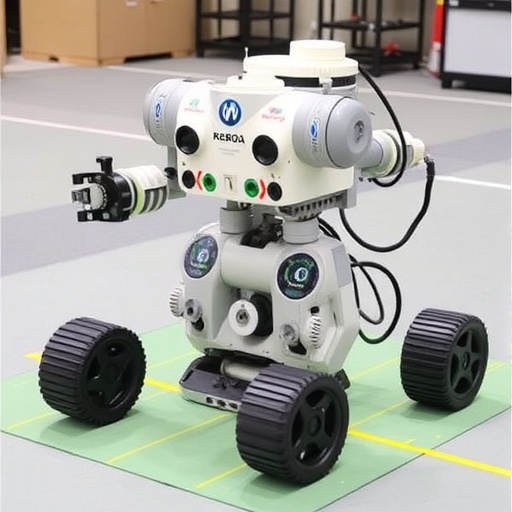
In a groundbreaking development published in the journal Robot Learning, researchers have unveiled a revolutionary learning-based path planning framework that harnesses the power of Transformer models to enable mobile robots to navigate through complex environments safely and efficiently. This innovative system, known as the Path Planning Transformer (PPT), draws on a rich history of path-planning algorithms, particularly the Improved Rapidly-exploring Random Tree (IRRT*) combined with Reduced Random Map Size (RRMS) techniques, to facilitate reliable navigation and dynamic replanning in multi-robot scenarios.
As industries increasingly adopt autonomous mobile robots in factories, warehouses, and service environments, the demand for reliable and efficient navigation systems continues to rise. These robots must be equipped to deliver materials and perform mundane tasks while also being capable of reacting swiftly to unexpected obstacles and interactions with other robots. Traditional navigation systems often incorporate complex multi-faceted pipelines for mapping, localization, and planning that typically require extensive computational resources, limiting their real-world applicability.
The PPT framework diverges from these traditional approaches by employing a machine learning strategy that eliminates the need for continuous online mapping. Instead, it learns to generate efficient paths by analyzing occupancy maps and simulating expert trajectories that were produced using an enhanced version of the classic RRT* algorithm. This innovative methodology allows for a significant reduction in computational overhead while simultaneously improving navigation efficacy.
In an exclusive insight into their research, one of the lead authors remarked, “While traditional planners like A or RRT have a long-standing reputation for reliability, they frequently encounter challenges in smoothly adjusting plans amid dynamic environments—especially when multiple robots operate simultaneously.” This observation has shaped the researchers’ objective to develop a model capable of absorbing planning behaviors and replicating them with remarkable efficiency in real-time scenarios, thereby advancing the capabilities of robots in unpredictable situations.
To ensure the robustness of the PPT model, the research team trained it on a vast dataset consisting of thousands of automatically generated examples of successful path navigation. Each of these examples illuminates how an optimal trajectory circumvents obstacles without compromising speed or safety. Once the model was adequately trained, it could predict and generate smooth, dynamic paths by leveraging Transformer architecture principles—a type of neural network that was originally developed for natural language processing but is now gaining traction in various branches of robotics.
The study goes a step further by integrating a modified right-of-way rule into the system to enhance its functionality in the presence of multiple robots. When one robot detects another or an unanticipated obstacle via its LiDAR sensor, it updates its navigation map by introducing a virtual obstacle that prescribes a preferential passing direction. This ingenious method facilitates independent replanning for each robot without the need for elaborate communication protocols or centralized control systems, enabling them to avoid collisions effectively and continue their tasks unimpeded.
Experimental evaluations conducted in both simulated and real-world environments with two mobile robots yielded promising results. Notably, the learning-based path planner outperformed traditional methodologies by consistently producing smoother pathways with fewer directional changes. While some classical planners occasionally delivered shorter routes, they often required abrupt turns or complicated maneuvers that are far from ideal for practical robotic applications. The superiority of the PPT system is indicative of its adaptability and precision in dynamic conditions.
It is also noteworthy that all experiments and simulations were orchestrated on a standard laptop equipped with MATLAB, Robot Operating System (ROS), and Gazebo, underscoring the practicality of this system without necessitating specialized hardware. The compelling results demonstrate that the PPT framework can be effectively implemented in real-world settings, potentially revolutionizing how robots navigate intricate spaces.
The research findings suggest a promising future where learning-based planners serve to augment traditional algorithm frameworks, enhancing path smoothness, adaptability, and overall efficiency while maintaining low computational demands. With its potential applications spanning across industrial automation, warehouse robotics, and collaborative robot systems, the implications of this research are vast and variable.
Although the current work is centered around two-robot scenarios in two-dimensional environments, the researchers expressed a keen interest in expanding their investigations to encompass larger teams of robots and exploring the possibilities of three-dimensional navigation utilizing voxel-based maps. Such advancements could usher in a new era of sophisticated and collaborative robotic systems capable of tackling previously insurmountable challenges in navigation and path planning.
In summary, the Path Planning Transformer marks a significant stride forward in the domain of robotics, poised to transform how autonomous mobile robots operate in dynamic environments. With ongoing developments set to enhance their capabilities further, the horizon looks bright for these intelligent systems as they continue to evolve and integrate into our increasingly automated world.
Subject of Research: Not applicable
Article Title: Path Planning Transformers supervised by IRRT*-RRMS for multi-mobile robots
News Publication Date: 5-Feb-2026
Web References: http://dx.doi.org/10.55092/rl20260005
References: 10.55092/rl20260005
Image Credits: Aphilak Lonklang and János Botzheim/ELTE Eötvös Loránd University
Keywords
Robotics, Path Planning, Machine Learning, Autonomous Robots, Navigation Systems.
Tags: autonomous mobile robot navigationdynamic replanning for robotsefficient path generation algorithmsImproved Rapidly-exploring Random Treeindustrial robotics applicationslearning-based navigation systemsmachine learning in roboticsmulti-robot path planningoccupancy map analysis in roboticsreal-time obstacle avoidance in robotsReduced Random Map Size techniquesTransformer models for navigation