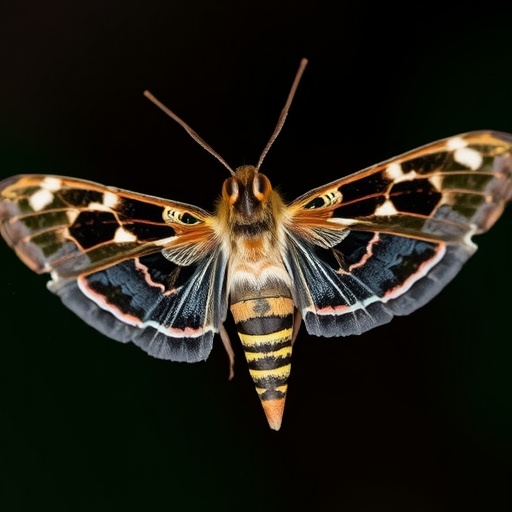
In a groundbreaking advancement poised to redefine the landscape of infectious disease research, scientists at the University of Exeter have successfully engineered the world’s first genetically modified wax moths (Galleria mellonella). This pioneering achievement not only promises to revolutionize the speed and ethical standards of antimicrobial resistance (AMR) testing but also offers a transformative alternative to the traditional reliance on rodent models such as mice and rats. With AMR emerging as one of the most urgent global health threats, the scientific community is in desperate need of innovative, scalable platforms that can accelerate drug discovery while adhering to strict ethical considerations.
The research, published in the prestigious journal Lab Animal, details how the Exeter team adapted cutting-edge genetic technologies, including PiggyBac transgenesis and CRISPR/Cas9 gene editing, originally developed in fruit fly studies, to generate fluorescent transgenic and gene knockout lines of the greater wax moth. This feat surmounts a significant barrier that has historically limited the utility of Galleria mellonella, a model organism increasingly recognized for its cost-effectiveness and ethical advantages. Unlike many alternative models, these moths can be raised at 37°C, the exact human body temperature, facilitating a more physiologically relevant environment for infection research.
What makes Galleria mellonella remarkably valuable is its immune response, which closely parallels mammalian innate immunity in battling bacterial and fungal infections. Until now, however, the moth’s lack of genetic tractability hindered in-depth mechanistic studies and the development of real-time, dynamic infection biosensors. By harnessing transgenic technology, the Exeter researchers have now enabled the generation of “sensor moths” that emit fluorescence in response to infection or antibiotic exposure. This innovation provides researchers with an unprecedented living window into host-pathogen interactions, offering continuous, non-invasive monitoring of infection progression and treatment efficacy.
Dr. James Pearce, a leading scientist on the project, emphasized the urgent necessity for new research modalities in the face of mounting AMR challenges. “Engineered wax moths present a fast, ethical, and scalable approach to infection research,” Pearce explained. “Our work eliminates a critical bottleneck, positioning these insects to replace mammalian models in many scenarios while delivering data that is highly predictive of human outcomes.” This resonates strongly with the ethical imperative to reduce animal suffering and the practical imperative to accelerate drug discovery pipelines.
A unique feature of Galleria mellonella is its ability to host human pathogens such as Staphylococcus aureus—a notorious superbug—and Candida albicans, a common opportunistic fungal pathogen. The larvae’s responses to these infections mirror those seen in mammals, making them an ideal intermediate model bridging simplistic cell cultures and complex mammalian experiments. By genetically modifying these moths, researchers can now interrogate immune pathways with unparalleled precision and validate antimicrobial candidates in a living organism that more accurately represents human infection dynamics.
Professor James Wakefield highlighted the advantages of visualizing the infection process in real time: “Genetically engineered fluorescence enables us to build biosensor systems within the moth, giving immediate feedback when infection sets in or when antimicrobial agents act.” This form of live imaging bypasses many limitations of endpoint assays and invasive sampling in rodents, enabling more refined and ethical experimentation. It also opens avenues for high-throughput screening of novel compounds, potentially shortening the timeline from discovery to clinical application.
The implications for animal welfare and the 3Rs principle—replacement, reduction, and refinement of animal use in scientific research—are profound. Current estimates indicate that approximately 100,000 mice are used annually in the UK for infection biology studies alone. If the wax moth model replaces just a fraction of these experiments, thousands of rodents could be spared each year without compromising scientific rigor. Moreover, scaling insect colonies is considerably more cost-effective and resource-efficient compared to maintaining mammalian facilities, presenting further logistical benefits.
The development at Exeter underscores a broader trend towards refining research models with advanced genetic toolkits. The integration of PiggyBac-mediated transgenesis—a technique that allows stable gene insertion—and CRISPR/Cas9-mediated gene knockout provides remarkable flexibility in manipulating the moth’s genome. This dual approach allows researchers to both illuminate cellular responses via fluorescent markers and dissect gene function by targeted deletion, facilitating a comprehensive understanding of host-pathogen interactions and gene roles in immunity.
Furthermore, the Exeter team has institutionalized their innovation by establishing the Galleria Mellonella Research Centre, a collaborative hub supporting over twenty research groups worldwide. This center not only supplies genetically modified moth lines but also offers training and standardization resources, fostering global adoption of this model and enhancing reproducibility across laboratories. Such openness and collaboration accelerate the pace of discovery and ensure that these technological advances benefit the wider scientific community rapidly.
This study also reflects a successful partnership between academia and government bodies, including investment from the National Centre for the Replacement, Refinement and Reduction of Animals in Research (NC3Rs) and collaboration with the Defence Science and Technology Laboratory. These alliances highlight the recognition of alternative research models as vital tools in public health strategy and biosecurity preparedness, particularly in combating resistant infections.
Looking ahead, the capacity to engineer live biosensors within Galleria mellonella larvae heralds a future where infection research is not only more humane but also more insightful. By enabling dynamic, real-time reporting of infection and immune responses within a whole organism, this platform provides a powerful new lens through which scientists can visualize the complexities of microbial pathogenesis and host defense. Such insights are essential for developing next-generation antimicrobials that can outpace evolving resistance.
In summary, this breakthrough ushers in a new era whereby an insect model, genetically engineered for the first time, stands to reshape infectious disease research. With profound ethical, scientific, and economic advantages, this innovation offers a compelling solution to accelerate antimicrobial research without compromising on human relevance or animal welfare. The future of infection biology may well glow—in vibrant fluorescence—within the humble wax moth.
Subject of Research: Animals
Article Title: PiggyBac mediated transgenesis and CRISPR/Cas9 knockout in the greater waxmoth, Galleria mellonella
News Publication Date: 10-Feb-2026
Web References:
10.1038/s41684-025-01665-7
Keywords: Animal research, Antibiotic resistance
Tags: alternatives to rodent modelsantimicrobial resistance testingcost-effective research modelsCRISPR gene editing in insectsethical standards in researchGalleria mellonella as a model organismgenetically modified moths in researchinfectious disease research advancementsinnovative drug discovery platformsphysiological relevance in infection studiestransgenic moths for health researchUniversity of Exeter scientific breakthroughs