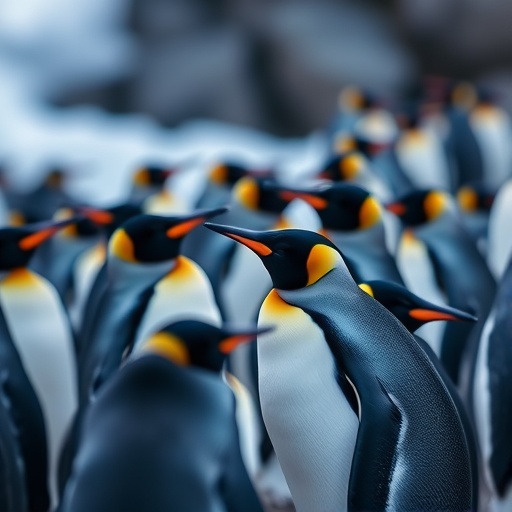
In a groundbreaking study poised to transform our understanding of wildlife immunology, scientists have successfully demonstrated that vaccination against highly pathogenic (HP) H5 avian influenza virus can induce a sustained immune response in wild king penguins. This revelation, detailed in a recent publication in Nature Communications, charts new territory for disease management in wild animal populations, underscoring the feasibility of long-term disease control through vaccination in species beyond domesticated animals. As avian influenza continues to pose a significant threat to both wildlife and human health, these findings mark a crucial step toward mitigating viral outbreaks in vulnerable species.
The study focuses on the immunological responses of king penguins, a species residing in the sub-Antarctic, to the H5 subtype of highly pathogenic avian influenza (HPAI). Historically, research on avian influenza management has largely centered on poultry and migratory birds, with little attention paid to wild non-migratory species such as penguins. These findings reveal that a single dose of vaccine can elicit a robust and durable immune response, potentially protecting these birds from fatal viral infections. This is especially vital given the increased frequency of avian influenza outbreaks linked to climate change and ecosystem disruptions.
Researchers employed a recombinant vaccine specifically designed to target the H5 hemagglutinin protein, responsible for viral attachment and entry into host cells. The vaccinated penguins were monitored over an extended period to evaluate the persistence of humoral immunity, characterized by the presence of neutralizing antibodies. Remarkably, serum analyses indicated that antibody titers remained elevated for several months post-vaccination, suggesting that the immune protection afforded is both potent and long-lasting. These findings counter previous assumptions that wild birds could not sustain vaccine-induced immunity without natural viral exposure.
In addition to serological assessments, the study incorporated cellular immunology assays to delineate the mechanisms underlying the observed immune memory. The researchers identified a significant proliferation of memory B cells specific to the H5 antigen, alongside detectable T-cell activation, which collectively contribute to a heightened state of readiness against potential viral challenges. This sophisticated immune orchestration provides strong evidence that vaccination can not only prime but also maintain an adaptive immune response in wild penguins, a concept previously unverified in non-domesticated avifauna.
The implications of this research are multifaceted. From an ecological standpoint, preventing viral epidemics among king penguins preserves key species within sub-Antarctic ecosystems that play pivotal roles in nutrient cycling and food web dynamics. Furthermore, by curtailing the reservoir of HPAI in wild bird populations, the risk of zoonotic transmission to humans and other animals is significantly reduced. This global health perspective adds a crucial layer to One Health initiatives, which advocate for integrated approaches to managing human, animal, and environmental health.
Methodologically, the study overcame significant logistical challenges inherent in studying remote wildlife populations. The researchers designed minimally invasive protocols for vaccine administration and blood sampling that ensured minimal stress to the animals, complying with stringent ethical standards. Moreover, the study incorporated state-of-the-art immunological techniques, including enzyme-linked immunosorbent assays (ELISAs) to quantify antibody responses and flow cytometry for detailed cellular profiling. This comprehensive approach validates the robustness of the findings and sets a new standard for wildlife immunology research.
Notably, the persistence of antibody responses challenges the paradigm that wild birds rely primarily on repeated natural exposure to maintain immunity against avian influenza viruses. The study’s long-term monitoring demonstrated stable antibody titers even in the absence of natural infection, suggesting that vaccination could serve as a proactive intervention rather than a reactive measure. This paradigm shift opens new avenues for preventing viral spillover events, particularly amidst ongoing threats from increasingly virulent avian influenza strains.
Furthermore, this research highlights the potential for expanding vaccination programs to other vulnerable wildlife species that face similar viral threats. The successful immunization of king penguins serves as a proof of concept that could be adapted for broader conservation efforts, encompassing endangered birds and other taxa susceptible to viral pathogens. This intersection of conservation biology and immunology is an emerging frontier, emphasizing the role of biomedical interventions in species preservation amid escalating global challenges.
The study also contributes to the broader understanding of avian influenza virus evolution and host-pathogen interactions. By establishing the immune competence of wild penguins through vaccination, researchers gain insights into how host immunity shapes viral selection pressures and mutation rates in natural reservoirs. This knowledge is vital for predictive modeling of viral dynamics and for informing the design of next-generation vaccines that anticipate viral antigenic drift and shift.
From a technological perspective, this investigation underscores the importance of employing recombinant vaccines tailored to target specific viral epitopes, maximizing immunogenicity while minimizing adverse effects. The vaccine platform utilized in this study exemplifies the convergence of molecular biology and wildlife disease management, illustrating how biotechnological advances can be harnessed to address conservation challenges. This alignment of technology and ecology represents a promising pathway for future intervention strategies.
In addition to its scientific contributions, the study fosters collaborative efforts across disciplines and borders. The research team brought together virologists, immunologists, conservationists, and field biologists, exemplifying the integrative nature of contemporary ecological health research. Such multidisciplinary collaborations are essential for addressing complex biological questions and translating findings into actionable conservation policies.
Looking forward, the authors advocate for longitudinal studies to assess the long-term ecological impact of vaccination programs on population dynamics and viral circulation. Further research is also needed to evaluate the feasibility of large-scale vaccination deployment in wild bird colonies, balancing logistical constraints with conservation priorities. These efforts will determine the scalability and sustainability of vaccination as a tool in wildlife disease mitigation.
The study’s viral implications extend beyond avian influenza, providing a template for managing infectious diseases in diverse wildlife systems. As emerging infectious diseases continue to threaten biodiversity, the demonstration that vaccine-induced immunity can persist in wild animals offers hope for innovative strategies that transcend traditional containment approaches. This breakthrough underscores the evolving landscape of disease ecology and the critical role of biomedical interventions.
In summary, the vaccination of wild king penguins against H5 highly pathogenic avian influenza virus manifests a crucial advancement in wildlife disease control. By illuminating the mechanisms and durability of vaccine-induced immunity in a wild, non-migratory species, this research paves the way for novel conservation tactics that safeguard not only species but entire ecosystems. As avian influenza continues to challenge both ecological stability and public health, these findings bring a message of optimism grounded in scientific innovation and interdisciplinary collaboration.
This remarkable work catalyzes a paradigm shift, inspiring new hope for employing immunological defenses to protect wildlife amidst a rapidly changing world. It serves as a clarion call to researchers, policymakers, and conservationists to embrace integrative, evidence-based strategies aimed at preserving the delicate balance between wildlife health and global disease dynamics—a balance upon which the future of biodiversity precariously depends.
Subject of Research: Immune response to vaccination against H5 highly pathogenic avian influenza virus in wild king penguins.
Article Title: Vaccination against H5 HP avian influenza virus leads to persistent immune response in wild king penguins.
Article References:
Lejeune, M., Tornos, J., Bralet, T. et al. Vaccination against H5 HP avian influenza virus leads to persistent immune response in wild king penguins. Nat Commun 17, 1395 (2026). https://doi.org/10.1038/s41467-026-69094-9
Image Credits: AI Generated
DOI: https://doi.org/10.1038/s41467-026-69094-9
Tags: avian influenza management strategiesclimate change impact on wildlife healthH5 avian flu vaccinehighly pathogenic avian influenza researchking penguins immune responselong-term disease control in wildlifepenguin health and disease preventionrecombinant vaccines for wildlifesub-Antarctic species conservationvaccination in non-migratory speciesviral outbreak mitigation in birdswildlife immunology breakthroughs