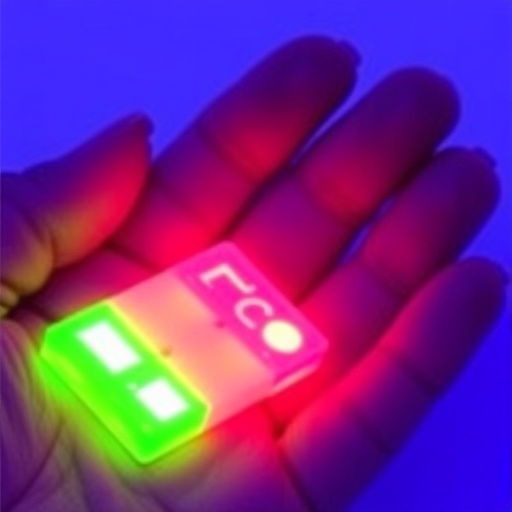
In a groundbreaking advance poised to revolutionize blood typing and immunohematology, researchers have unveiled an innovative paper-based fluorescent assay that leverages bioengineered red blood cells (RBCs) capable of long-term ambient storage. This technique promises to transform how blood typing and antibody titer determination are conducted, enabling rapid, reliable, and cost-effective testing without the need for refrigeration or complex laboratory equipment.
At the heart of this breakthrough is the use of bioengineered RBCs that maintain their functional integrity even after extended storage at room temperature. Traditional blood typing relies heavily on fresh blood samples or refrigerated reagents, which limits accessibility, especially in resource-poor settings or emergency situations. By contrast, the bioengineered RBCs described in this new assay exhibit remarkable stability, allowing their use in paper-based platforms without the stringent cold chain requirements typically necessary to preserve biological specimens.
The assay itself employs fluorescent tagging to identify specific blood group antigens and corresponding antibodies. When placed on the paper-based test strip, these bioengineered RBCs interact with patient serum, binding to antibodies present if a match exists. The presence and concentration of these antigen-antibody complexes are then detected via fluorescence, providing a highly sensitive and specific readout of blood type and antibody titers. This fluorescence-based detection enhances the accuracy and quantitative capability far beyond traditional agglutination or colorimetric assays.
One of the critical challenges in developing this assay was ensuring the stability of the bioengineered RBCs over extended periods under ambient conditions. The researchers tackled this by modifying the membrane structure and intracellular environment of the RBCs to resist degradation and maintain receptor functionality. Additionally, optimization of the paper substrate ensured compatibility and minimal interference with fluorescent signaling. These innovations collectively enable the test strips to be stored and transported easily without cold storage, expanding their reach to remote clinics and field operations.
The implications of this technology are vast, particularly for transfusion medicine and diagnostics in underserved regions. Blood typing is fundamental for safe transfusions and transplantation, but conventional methodologies require sophisticated equipment, trained personnel, and access to fresh reagents. The introduction of a stable, portable, and easy-to-use fluorescent assay platform could democratize blood typing, permitting on-site determination and rapid decision-making even in disaster zones, rural areas, or developing countries.
Moreover, the ability to determine antibody titers quantitatively opens avenues for improved monitoring of immune responses and alloimmunization post-transfusion or transplantation. Currently, methods to monitor antibody levels are often cumbersome and limited to laboratory settings. This assay’s fluorescence output offers not only identification but also a scalable means to assess antibody strength, which could inform clinical decisions regarding compatibility and immune modulation.
Technical details of the assay reveal that the bioengineered RBCs are embedded with specific fluorescent markers linked to known blood group antigens such as ABO and Rh systems. Upon incubation with patient serum, antibodies recognizing these antigens form complexes, enhancing fluorescence signals that can be captured and quantified using standard portable fluorescence readers or even smartphone-based devices. The choice of fluorescent dyes and their conjugation chemistry were carefully optimized to avoid quenching or nonspecific binding, ensuring signal clarity and reproducibility.
The paper-based format itself offers multiple advantages. It is low-cost, lightweight, easy to manufacture at scale, and disposes safely after use, reducing biohazard risks associated with liquid bio-nanomaterials. In addition, paper substrates allow for capillary flow, enabling mixing and reaction of reagents without the need for pumps or external forces, thereby simplifying the assay workflow to just a sample drop and incubation.
In validation studies, the assay demonstrated excellent concordance with gold standard blood typing methods, including gel card and tube agglutination tests. Test strips retained high performance after storage at room temperature for several months, highlighting their robustness. Sensitivity and specificity metrics surpassed 95%, reflecting the assay’s reliability for clinical or field application.
Future iterations will focus on integrating multiplexing capabilities to screen additional blood group antigens and antibodies simultaneously, offering comprehensive immunohematological profiling with a single test. There is also ongoing research into adapting the platform for direct whole blood samples without preprocessing, further streamlining point-of-care usability.
From a public health perspective, this innovative assay may help improve transfusion safety and reduce the incidence of alloimmunization-related complications worldwide. By decentralizing blood typing and antibody testing, healthcare providers can better match donors and recipients, tailor transfusion strategies, and monitor immunogenicity more effectively.
The development team also highlights the potential for scalability and customization, envisioning deployment in various settings such as blood banks, emergency rooms, military field hospitals, and international aid organizations. The assay’s compatibility with smartphone-based fluorescence readers could enable real-time data capture, integration with electronic health records, and telemedicine support.
In summary, this paper-based fluorescent assay employing long-term ambient-stored bioengineered RBCs represents a significant leap forward in transfusion medicine technology. By combining bioengineering, fluorescence detection, and innovative paper microfluidics, it addresses long-standing challenges related to reagent stability, assay portability, and quantitative antibody detection. It holds the promise of making blood typing and antibody monitoring accessible, rapid, and reliable worldwide, ultimately enhancing patient care and outcomes.
As with any novel diagnostic tool, regulatory approval and large-scale clinical validation will be essential next steps before widespread adoption can occur. However, the initial results and peer-reviewed publication in a leading journal underscore its transformative potential. This technology may soon become a cornerstone in modern blood compatibility testing, much like how rapid antigen tests revolutionized infectious disease diagnostics in recent years.
The implications extend beyond blood typing — the platform and approach could inspire new bioengineered cell-based assays in other diagnostic areas requiring long-term reagent stability and sensitive detection. It represents an exciting convergence of synthetic biology, materials science, and clinical diagnostics that could spur innovations across personalized medicine and point-of-care testing.
In closing, the study not only addresses critical gaps in transfusion medicine but also exemplifies the power of interdisciplinary innovation to solve global healthcare challenges. The prospect of carrying reliable, easy-to-use blood typing kits in your pocket—functional after prolonged storage without refrigeration—could soon become a reality, reshaping how emergency and routine blood compatibility is determined worldwide.
Subject of Research: Development of a paper-based fluorescent assay for blood typing and antibody titer determination using bioengineered red blood cells stable under long-term ambient storage conditions.
Article Title: Paper-based fluorescent assay for blood typing and antibody titer determination using long-term ambient-stored bioengineered RBCs.
Article References:
Li, Y., Zhang, Y., Liang, S. et al. Paper-based fluorescent assay for blood typing and antibody titer determination using long-term ambient-stored bioengineered RBCs. Nat Commun (2026). https://doi.org/10.1038/s41467-026-69213-6
Image Credits: AI Generated
Tags: antibody detection assayantigen-antibody complex detectionbioengineered red blood cellscost-effective immunohematology solutionsfluorescent paper-based blood typingfluorescent tagging in diagnosticsinnovative blood type identificationlong-term ambient storage of RBCsrapid blood typing techniquesresource-poor blood testingstability of blood reagentstransformative medical testing methods