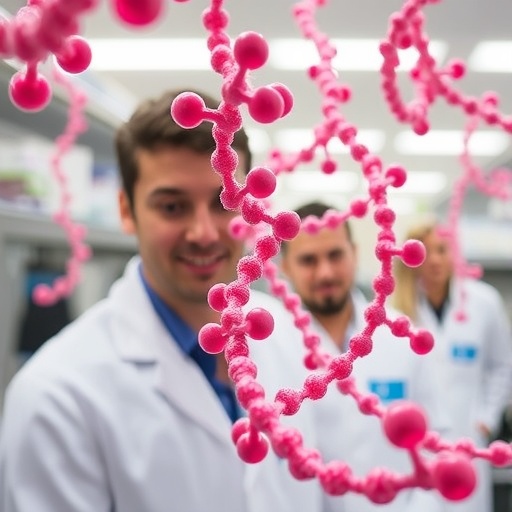
In a groundbreaking advancement poised to reshape our understanding of gene regulation, scientists have developed a novel deep learning model known as PARM (Promoter Activity Regulatory Model), revealing that the mechanisms controlling gene activity are far more predictable than previously conceived. This transformative discovery, recently published in the prestigious journal Nature, marks a decisive step toward decoding the intricate biological language that dictates when and how genes switch on or off within different cellular contexts.
For decades, geneticists have relied on the classical genetic code to interpret how DNA sequences translate into proteins. However, a profound mystery persisted: the regulatory framework governing gene expression plasticity remained elusive. While regulatory elements like promoters are known to modulate gene activity, the complex ‘grammar’—or regulatory syntax—that orchestrates precise gene toggling had not been deciphered. This regulatory system is responsible for spatiotemporal gene expression, determining cell identity, behavior, and response to environmental cues.
The urgency of decoding this genomic control system cannot be overstated, especially given that many cancer-related mutations reside in non-coding regions traditionally deemed as “junk DNA.” These mutations often disrupt gene regulation and contribute to tumor development and progression. Historically, interpreting the pathogenic potential of such mutations was a major bottleneck in cancer research. PARM directly addresses this challenge by providing a sophisticated computational tool that can interpret regulatory DNA sequences and predict their effects on gene activity with exceptional accuracy.
The development of PARM was made possible through a collaborative initiative, the PERICODE project, which united seven research groups under the Oncode Institute. Utilizing cutting-edge experimental techniques pioneered in the Bas van Steensel laboratory at the Netherlands Cancer Institute (NKI), researchers employed massively parallel reporter assays (MPRA) to generate millions of quantitative measurements. These experiments systematically tested how myriad short DNA sequences influenced gene expression levels in specific cell types, thereby creating an unprecedented data repository linking promoter architecture to functional output.
Yet, possessing vast data alone is insufficient for biological insight. Here, Jeroen de Ridder’s group at UMC Utrecht harnessed advanced artificial intelligence algorithms to model these experimental results. Unlike conventional AI models that rely on imperfect proxy data, PARM benefited from precisely engineered, high-fidelity datasets explicitly crafted for deciphering gene regulation. This intentional synergy between experimental design and machine learning empowered the creation of an ultra-efficient model fine-tuned for specific cellular environments. By training on meticulously controlled datasets, PARM captures nuanced, cell-type specific regulatory logics that previous models missed.
Demonstrating extraordinary predictive power, PARM elucidates how gene regulation varies not only between cell types but also dynamically changes under environmental stimuli, such as exposure to drugs or hormones. This dynamic modeling revealed the detailed architecture of regulatory elements—effectively exposing each gene’s “on” and “off” control switches and their combinatorial interactions. Importantly, the scientific team subjected every prediction to rigorous experimental validation, assuring the robustness and biological fidelity of the model’s insights.
PARM also innovates through its remarkable computational efficiency. Previous state-of-the-art models, like Google DeepMind’s AlphaGenome, while powerful, demanded colossal computational resources making them less accessible to many research laboratories worldwide. PARM’s architecture requires approximately one thousand times less computing power, making it achievable for typical academic environments. This efficiency was achieved without sacrificing performance, meaning researchers worldwide can now simulate complex regulatory landscapes using modest laboratory setups and conventional computing hardware within a single day.
This breakthrough has profound implications for cancer biology and therapeutic development. By enabling accurate prediction of regulatory mutation impacts in specific cell types and conditions, PARM opens novel avenues for precision oncology, such as designing patient-specific diagnostics and stratified treatments. The ability to forecast how tumor cells may adapt or resist therapeutics at the level of gene regulation provides an invaluable resource for drug discovery and personalized medicine.
The success of PARM underscores the power of multidisciplinary collaboration bridging genomics, computational biology, and experimental biophysics. Funded by notable institutions such as the Oncode Institute and the AVL Foundation, this collective effort amalgamated expertise from Bas van Steensel’s group at NKI, Jeroen de Ridder’s team at UMC Utrecht, and several other leading genomic research labs. Such integration of experimental high-throughput approaches with deep learning signifies a paradigm shift in decoding biological complexity.
Importantly, PARM’s design also bridges the gap between scalability and interpretability, two features often mutually exclusive in AI. By tailoring its predictive models to highly specific cellular states, PARM manages to retain mechanistic interpretability—insight into the regulatory grammar—while scaling analyses across millions of variants. This combination promises to accelerate functional genomics research across a broad spectrum of diseases and biological systems beyond oncology.
Looking forward, the research community anticipates PARM’s versatility to expand substantially. Researchers can now systematically map gene regulatory changes across diverse human tissues, developmental stages, and disease contexts. The model’s adaptability to incorporate different stimulus-response patterns also sets the stage for unraveling how environmental factors and pharmacological agents reshape epigenetic landscapes, further enriching our understanding of gene control in health and disease.
As the frontiers of genomics advance deeper into the realm of regulatory DNA, tools like PARM will be indispensable for translating vast sequence data into actionable biological knowledge. This model not only demystifies how non-coding DNA dictates cellular phenotypes but also empowers a new generation of genomic medicine that integrates predictive, customizable insights into clinical workflows.
In sum, the advent of PARM signifies a scientific milestone: the ability to ‘read’ the language of gene regulation at unparalleled resolution and scale. By transforming gene regulatory decoding from an enigmatic black box into an interpretable and computable framework, PARM promises to accelerate breakthroughs in cancer biology, therapeutic design, and fundamental genomics, heralding a new era of precision in biomedical science.
Subject of Research: Cells
Article Title: Regulatory grammar in human promoters uncovered by MPRA-based deep learning
News Publication Date: 3-Feb-2026
Web References:
Nature article
PARM model portal
References:
Bas van Steensel, Jeroen de Ridder, et al. Regulatory grammar in human promoters uncovered by MPRA-based deep learning. Nature, 2026. DOI: 10.1038/s41586-025-10093-z
Image Credits: ©Netherlands Cancer Institute / Sanne Hijlkema
Keywords: Gene expression, Machine learning
Tags: advancements in genetic researchAI innovation in biological researchdecoding gene expression plasticitydeep learning in geneticsenvironmental cues and gene regulationgene regulation mechanismsgene toggling and cell identitynon-coding DNA and cancerPromoter Activity Regulatory Modelregulatory elements in gene activityspatiotemporal gene expressionunderstanding genetic mutations