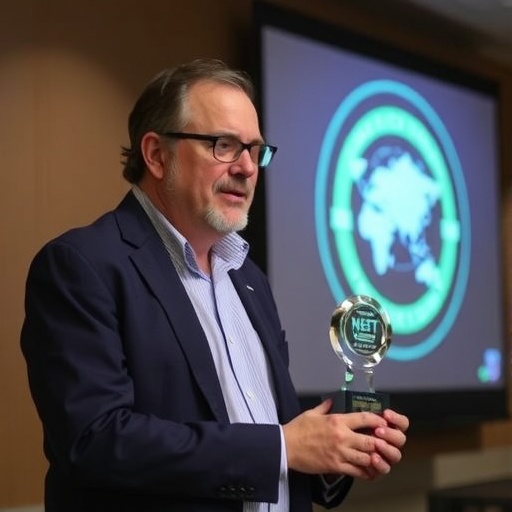
The enigma of how collective motion and intelligence arise among animals—from flocks of birds and swarms of locusts to schools of fish and human crowds—has fascinated scientists for decades. At the forefront of this inquiry stands Professor Iain Couzin, whose groundbreaking research has profoundly deepened our understanding of the neurological structures and underlying principles governing the coordinated actions of thousands of individuals in natural systems. This pioneering work has recently been recognized with the prestigious Hector Science Award from the Hector Foundation II, honoring Couzin’s exceptional contributions to collective behaviour studies.
On January 30, 2026, in Heidelberg, the Hector Foundation II officially presented this distinguished award to Couzin in an event attended by former laureates, underscoring the significance of his research. Alongside Couzin, biochemist Stefanie Dimmeler from Goethe University Frankfurt was also honored. Each awardee received a personal prize of 200,000 euros, emphasizing the foundation’s commitment to fostering scientific excellence in Germany.
Professor Couzin expressed his gratitude, emphasizing that the accolade is not simply a testament to his individual efforts but a reflection of the collective creativity and dedication of his research team, including students and postdoctoral researchers. These collaborators have been instrumental in unpacking the complex mechanisms behind emergent coordinated behaviour and collective decision-making in biological entities. Couzin’s roles as Professor of Biology at the University of Konstanz, Director at the Max Planck Institute of Animal Behavior, and Speaker of the Centre for the Advanced Study of Collective Behaviour (CASCB) position him at the nexus of interdisciplinary scientific innovation.
Katharina Holzinger, Rector of the University of Konstanz, praised Couzin’s achievements, noting not only the honor brought to the university but also the broader implications for the institutional research agenda. The Hector Science Award highlights the university’s strategic focus on collective behaviour, reinforcing the ongoing global influence of CASCB even as its funding phase under the German Excellence Strategy approaches completion.
Quantitative behavioural biology is the field within which Couzin has carved out his pioneering legacy. This discipline leverages rigorous theoretical frameworks coupled with high-dimensional data acquisition to elucidate the behaviours of animals in groups. By shifting away from reductionist studies of isolated individuals, Couzin’s approach examines the emergent phenomena resulting from interactions within collectives, ranging from insect swarms to human crowds. His research has fundamentally reshaped how we conceptualize the organization, movement dynamics, and collective decision-making processes across species.
Technological innovation underpins much of Couzin’s research methodology. His laboratory employs state-of-the-art high-precision tracking systems capable of monitoring thousands of individuals simultaneously with unparalleled spatiotemporal resolution. These empirical data are augmented with AI-driven analytical tools and experimental paradigms such as virtual reality environments tailored for animals, allowing researchers to manipulate social and sensory cues in real time. This integrated toolkit enables a granular dissection of how individual interactions scale to complex group-level behaviours, advancing our theoretical understanding of collective intelligence.
Challenging conventional wisdom, Couzin’s findings have nuanced traditional theories of collective motion. Beyond purely mechanical models of movement coordination, his work reveals the critical role of neural synchronization and information flow across members of a group, drawing parallels to neural networks in the brain. Such insights not only enrich biological sciences but also impact robotics, where engineering teams strive to emulate natural swarm intelligence in fleets of autonomous machines. Furthermore, social scientists have leveraged Couzin’s discoveries to better interpret human crowd dynamics and collective decision-making in societal contexts.
The international scientific community has acknowledged Couzin’s sustained impact, demonstrated by his recurrent inclusion in Clarivate Analytics’ “Global Highly Cited Researchers” list between 2018 and 2025. His high-profile publications in leading journals have set benchmarks in the field. Prior accolades include the Fyssen International Prize (2024), the Gottfried Wilhelm Leibniz Prize (2022), the Lagrange Prize (2019), and the Scientific Medal of the Zoological Society of London (2018). Additionally, his selection as a Fellow of the Royal Society in 2025 cements his status among the global scientific elite.
The Hector Science Award itself, established in 2009 by the Hector Foundation II, recognizes trailblazing professors at German universities and research institutes who demonstrate both outstanding research achievements and exceptional dedication to mentoring emerging scientists. Award recipients also join the Hector Fellow Academy, a young science academy inaugurated in 2013 to promote interdisciplinary collaborations and solutions to worldwide challenges. This holistic approach enriches the scientific ecosystem by supporting early-career researchers through a vibrant network of excellence.
Couzin’s trajectory exemplifies how interdisciplinary collaboration, enabled by cutting-edge technology, can unravel the complexities of natural collectives. His comprehensive datasets and theoretical models push the envelope, facilitating predictive insights into how neural and behavioral rules at the individual level give rise to adaptive collective phenomena. Such research not only deepens fundamental biological knowledge but also informs the design principles for synthetic collective systems, from bio-inspired robotics to collective artificial intelligence.
Situated at the University of Konstanz and Max Planck Institute of Animal Behavior, the CASCB operates as a global hub for studying collective behaviour spanning multiple species and organizational scales. Funded as a Cluster of Excellence under Germany’s Excellence Strategy from 2019 through 2027, CASCB exemplifies the power of institutional synergy, bridging biology, physics, computer science, and engineering. The center’s work resonates far beyond academia, influencing policy, conservation efforts, and technology development.
Couzin’s intellectual contributions continue to inspire evolving perspectives on collective systems. By elucidating the multiscale mechanisms that coordinate thousands of individuals, his research champions a synthesis between empirical observation and quantitative modeling. This paradigm shift opens new avenues for unlocking the principles of collective intelligence, with implications extending into ecology, neuroscience, engineering, and the social sciences.
In recognizing Iain Couzin with the Hector Science Award, the scientific community celebrates not only a visionary researcher but also the transformative potential of collective behaviour studies. As the field advances, the integration of biology and technology promises profound innovations that could revolutionize how society understands and harnesses the power of collective systems in both natural and artificial realms.
Subject of Research: Collective behaviour and intelligence in animal groups, including neurological and interactional principles underlying coordinated motion and decision-making.
Article Title: Decoding Collective Intelligence: Professor Iain Couzin Awarded the 2026 Hector Science Award for Pioneering Research in Collective Behaviour
News Publication Date: January 30, 2026
Web References:
https://www.uni-konstanz.de/fileadmin/pi/fileserver/2026/iain_couzin_erhaelt_den_hector_wissenschaftspreis_1.jpg
https://www.uni-konstanz.de/fileadmin/pi/fileserver/2026/iain_couzin_erhaelt_den_hector_wissenschaftspreis_2.jpg
Image Credits: Marco Schilling
Keywords: collective behaviour, animal intelligence, quantitative behavioural biology, neural synchronization, swarm robotics, decision-making, high-precision tracking, interdisciplinary research, collective motion, Centre for the Advanced Study of Collective Behaviour (CASCB), Hector Science Award, behavioural data analysis
Tags: collaborative research in sciencecollective motion in animalsemergent coordinated behaviourHector Foundation II award ceremonyHector Science Awardhuman crowd intelligenceIain Couzinneurological structures in collective behaviourpioneering research in biologyschools of fish dynamicsscientific excellence in Germanyswarms of locusts research