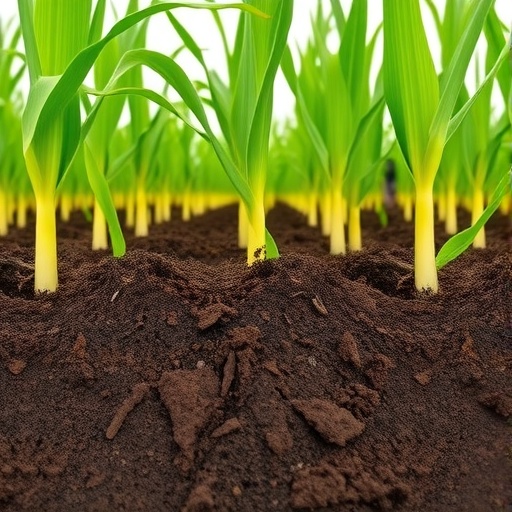
Corn, one of the world’s most vital staple crops, may soon benefit from a revolutionary genetic breakthrough with profound implications for agriculture and the environment. Recent work conducted at the University of Illinois Urbana-Champaign has unveiled that introducing specific genes from corn’s wild ancestor, teosinte, into modern commercial corn strains suppresses soil microbes that cause nitrogen loss and greenhouse gas emissions. This discovery promises to reshape soil microbial communities and significantly reduce nitrogen loss without sacrificing crop yield, signaling a new era in sustainable farming.
At the heart of this groundbreaking research lies the intricate interplay between corn genetics and soil microbiology. Corn fields traditionally suffer from substantial nitrogen loss, which not only diminishes soil fertility but also contributes to environmental pollution and climate change. Nitrogen fertilizers are a cornerstone of modern agriculture, yet a significant portion of applied nitrogen escapes into air and water systems through microbial processes known as nitrification and denitrification. The microbes responsible transform beneficial ammonium nitrogen into nitrate and nitrogen gases, some of which are potent greenhouse gases like nitrous oxide.
Angela Kent, lead researcher and professor at the Department of Natural Resources and Environmental Sciences at the University of Illinois, elaborates on these microbial dynamics. “Nitrifying bacteria convert ammonium into nitrate, which easily leaches into waterways causing eutrophication. Meanwhile, denitrifying bacteria convert nitrate into gaseous forms. Under certain conditions common in conventional farming—like oxygen-rich soil or carbon-poor environments—these bacteria produce nitrous oxide, a greenhouse gas far more potent than carbon dioxide.”
The researchers dug deeper into the genetic origins of these traits by revisiting corn’s ancestral lines. During the Green Revolution, breeding focused primarily on aboveground traits such as yield and pest resistance, inadvertently neglecting root traits and the rhizosphere—the microbe-rich zone surrounding the roots. This oversight allowed nitrifying and denitrifying bacteria to flourish, exacerbating nitrogen loss issues. The team posited that genes lost during modern breeding might be present in teosinte, the wild and weedy ancestor of modern maize.
Previous findings from 2021 revealed that teosinte roots secrete chemicals capable of suppressing the activity of nitrifying and denitrifying microbes. This fascinating microbial inhibition maintains soil nitrogen in the more stable ammonium form, reducing losses and enhancing nitrogen use efficiency. The new study expanded on this insight by examining near-isogenic lines (NILs), which are modern corn lines containing small gene segments from teosinte. By growing 42 NILs alongside pure B73 (a well-characterized modern inbred corn line) and teosinte itself in field trials, they monitored changes in rhizosphere microbial populations and nitrification potential.
The results were remarkable. Two NILs exhibited a striking 50% decrease in nitrification activity compared to B73, while two others showed similarly robust suppression of denitrification. Many additional lines reduced denitrification to varying extents. These introgressed teosinte genes selectively modulated root chemistry in a way that negatively impacted nitrifier and denitrifier activity without compromising the plant’s ability to absorb nitrogen. Moreover, these microbiome-mediated traits are robust; they behave dominantly, persisting even when introgressed into hybrid corn backgrounds, and crucially, they do so without any yield penalty.
Alonso Favela, assistant professor at the University of Arizona and first author of the study, highlights the significance of these findings. “The nitrification inhibition trait appears to be dominant, and when bred into hybrid corn backgrounds, it preserves yield. This means we can engineer high-performing crops that are simultaneously sustainable, conserving nitrogen and mitigating greenhouse gas emissions.”
Corn is grown on over 97 million acres in the United States alone. If the nitrification inhibition trait were scaled to this level, it could revolutionize nitrogen management across the country’s vast corn belt. The potential environmental benefits are vast, including reductions in water pollution, lower nitrous oxide emissions, and decreased reliance on synthetic nitrogen fertilizers — the manufacture of which consumes tremendous fossil fuel resources.
From a technical standpoint, the research underscores a new paradigm in plant breeding, extending selection to include effects on the rhizosphere microbiome. This “extended phenotype” approach centers on the plant’s influence over the soil microbial community, a dynamic and critical interface in nutrient cycling and plant health. By harnessing genetic loci from wild relatives, breeders can reintroduce beneficial microbial interactions lost during decades of focusing on aboveground traits.
This innovation also raises intriguing prospects for integrating other beneficial microbial functions into crops. Kent envisions combining microbiome traits that conserve nitrogen with those that enable symbiotic nitrogen fixation, a process currently absent in cereal crops like maize. Such synergies could lead to breakthrough reductions in the need for synthetic fertilizers, pushing agriculture towards true sustainability.
Further research funded by major agencies including the National Institute of Food and Agriculture, National Science Foundation, and the Department of Energy’s Center for Advanced Bioenergy and Bioproducts Innovation aims to decipher the precise genes and molecular pathways responsible for these interactions. The maize genetic resources housed at the Maize Genetics Cooperation Stock Center provide an invaluable repository for identifying candidate genes controlling rhizosphere chemistry.
Looking ahead, translating these findings from experimental lines into commercially viable varieties will hinge not only on breeding but also on regulatory approvals and farmer adoption. However, the absence of yield penalties paired with significant environmental benefits strengthens the case for adoption in modern agriculture. As nitrogen pollution remains a global challenge, innovations like this could play a critical role in balancing food security with ecosystem health.
In summary, rediscovering the genomic legacy of corn’s wild ancestor offers a promising avenue to mitigate the environmental footprint of one of the world’s most important crops. By embracing the microbial ecology beneath our feet, scientists are pioneering novel strategies to conserve resources, reduce pollution, and build a resilient agricultural future. This study exemplifies the power of combining cutting-edge genetics with ecological insights to address some of the most pressing challenges facing global food production and environmental stewardship.
Subject of Research: Agricultural sustainability, soil microbiome modulation, nitrogen cycling in corn
Article Title: Lost and found: Rediscovering microbiome-associated phenotypes that reshape agricultural sustainability
Web References: DOI: 10.1126/sciadv.aed3360
Image Credits: Lauren Quinn, University of Illinois
Keywords: corn genetics, teosinte, nitrification inhibition, denitrification suppression, soil microbiome, nitrogen loss, greenhouse gas emissions, sustainable agriculture, rhizosphere, nitrogen cycling
Tags: agricultural sustainabilitycorn genetics and environmentgreenhouse gas emissionsmicrobial dynamics in agriculturemodern agricultural challengesnitrogen fertilizer alternativesnitrogen loss reductionsoil fertility enhancementsoil microbial communitiessustainable farming practicesteosinte genetic traitswild ancestor corn genes