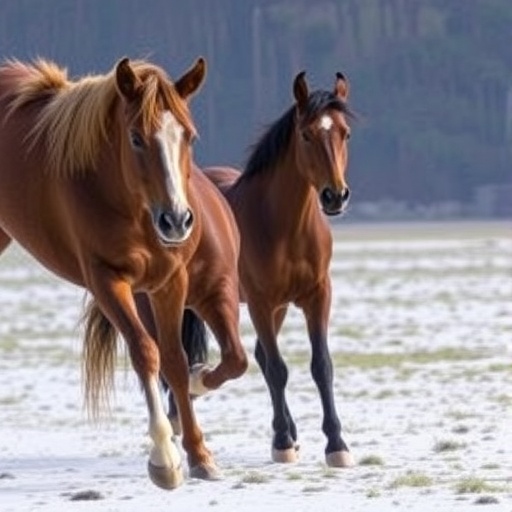
In a groundbreaking study that challenges our understanding of interspecies communication, researchers from INRAE and IFCE have unveiled compelling evidence that horses can perceive and respond to human emotional states through olfactory signals. While olfaction has long been recognized as a critical sensory modality for animals within their species, particularly in reproductive contexts, this innovative research extends its significance by demonstrating that olfactory cues also facilitate emotional contagion across species boundaries. This discovery not only deepens our knowledge of animal cognition and behavior but also has profound implications for the welfare and management of domestic animals, especially horses which maintain close and complex relationships with humans.
The core of the investigation revolved around assessing whether chemical signals emitted by humans during distinct emotional experiences influence equine behavior and physiological responses. To this end, the researchers meticulously collected sweat samples from thirty human volunteers undergoing controlled emotional states, specifically joy and fear, induced via video stimuli. Fear was elicited using excerpts from the horror film Sinister, known for its intense psychological impact, while joy-related emotions were evoked through a curated compilation of comedy sketches and musicals. This methodology ensured a consistent and potent emotional stimulus with robust biochemical signatures in human sweat, forming the basis for subsequent exposure to horses.
Subsequently, forty-three horses were exposed to the human-derived olfactory samples: pads impregnated with fear-induced sweat, joy-induced sweat, and unscented control pads. This triadic design allowed the researchers to isolate the specific effects of emotional odours while controlling for the presence of any scent. The experimental framework incorporated multiple behavioral assays and physiological measurements, including heart rate monitoring and salivary cortisol analysis, to comprehensively evaluate the horses’ reactions. Importantly, these tests comprised two interaction scenarios—involving grooming and an approach test—as well as two fear challenge tests featuring sudden stimulus and novel object presentation, thereby probing both social engagement and fear responsiveness.
The results were unequivocal: horses exposed to human fear odours displayed significantly heightened fear-related behaviors compared to those exposed to joy odours or control conditions. Behavioral changes included increased vigilance, reluctance to engage in social interaction with humans, and elevated stress indicators. In the suddenness test, these horses manifested stronger startle reactions upon the abrupt opening of an umbrella, a stimulus designed to provoke innate fear responses. Additionally, during the unfamiliar object test, they exhibited increased fixation gazes, indicating heightened anxiety and skepticism toward novel environmental elements. Physiological correlates reinforced behavioral observations, with fear-odour-exposed horses experiencing elevated heart rates and higher salivary cortisol levels, markers consistent with acute stress.
Intriguingly, the presence of human fear odours also altered the horses’ social behavior. In grooming and approach tests, fundamental to human-equine interactions and welfare, affected horses demonstrated reduced physical contact and engagement. This behavioral shift underscores the potency of olfactory emotional cues in shaping social dynamics, suggesting that the horses not only detected the emotional state chemically but also emotionally ‘caught’ it. This phenomenon of emotional contagion, well-documented within species such as canines reacting to humans, here emerges for the first time in horses, signifying that the chemical communication of emotions transcends phylogenetic distances and informational channels.
At a mechanistic level, the study posits that volatile organic compounds (VOCs) present in human sweat carry emotional information, modulating the neurobiological pathways in horses that govern fear and social behavior. These findings suggest an evolutionary conservation or convergence of chemosensory emotional signaling pathways, possibly enhanced by domestication and the prolonged coexistence of humans and horses. Domestication may have selected horses that are more attuned to human emotional cues, facilitating cooperative interactions critical for riding, farming, and sport.
The ramifications of this research extend beyond scientific curiosity into practical domains. Understanding that horses can chemically perceive human emotional states necessitates reconsidering the environments and contexts in which humans interact with them. Trainers, caretakers, and equestrians need to recognize how their own emotional expressions, even subtle and unconscious ones, may influence horse behavior and welfare. This insight prompts the development of guidelines and interventions to minimize stress and optimize the emotional climate surrounding human–horse interactions, potentially reducing incidents linked to fear or anxiety in equines.
Moreover, the study advances ethology—the scientific study of animal behavior—by introducing a novel paradigm of cross-species emotional communication grounded in chemistry rather than solely visual or auditory cues. This finding invigorates the field’s exploration of the sensory world of animals and how these sensory experiences shape complex social and emotional landscapes. The integration of physiological measurements with rigorous behavioral observations further elevates the methodological rigor and robustness of the conclusions.
The broader implications resonate with animal welfare science, highlighting the crucial necessity of considering multisensory and emotional factors in managing domestic animals. Welfare encompasses physical health but equally involves psychological well-being, which can be profoundly impacted by unrecognized emotional contamination. As the role of emotional contagion becomes clearer, ethologists and animal welfare professionals are better equipped to devise environments and protocols that foster positive emotional states, thereby enhancing the quality of life for horses and potentially other species engaged in human care.
Perhaps most transformative, this research illuminates a subtle but powerful communication channel that has likely been operating unnoticed within horse-human relationships. It challenges the anthropocentric view of emotional communication and invites a reassessment of how deeply interconnected our species are with their domestic companions. It also raises compelling questions about the extent to which other animals might similarly perceive and react to human emotional states through olfactory signals, opening new frontiers for research across taxa.
In conclusion, this pioneering study unequivocally demonstrates that olfactory cues associated with human emotions can induce corresponding emotional states in horses, manifesting as altered behavior and physiological stress responses. The findings underscore the complexity and interconnectivity of sensory and emotional processes in animal behavior and highlight the evolutionary and ecological significance of chemical communication beyond species barriers. This work not only enriches scientific understanding but also emboldens efforts to improve animal welfare practices through nuanced recognition of emotional interspecies synchronicity.
As research progresses, unraveling the chemical composition of fear- and joy-associated odours and their neurobiological impact on horses will be paramount. Such advancements hold promise for developing innovative strategies to mitigate stress, enhance training protocols, and strengthen the human–horse bond. This study sets a foundational precedent, heralding a new era of interdisciplinary exploration at the intersection of chemistry, neurobiology, ethology, and animal welfare.
Subject of Research: Human emotional odours influence on horse behavior and physiology
Article Title: Human emotional odours influence horses’ behaviour and physiology
News Publication Date: 14-Jan-2026
Web References: 10.1371/journal.pone.0337948
Image Credits: INRAE – Christophe Maitre
Keywords: emotional contagion, olfactory communication, human-horse interaction, animal behavior, stress physiology, domestication, ethology, cortisol, heart rate, chemical signals, cross-species communication, animal welfare
Tags: animal cognition and emotional contagionbiochemical signals in equine behavioremotional signals in animal managementequine responses to human emotionshorse behavior and emotional responseshorses and human relationshipshuman emotional states and horsesimpact of fear scent on equinesimplications for domestic animal careinterspecies communication through olfactionolfactory cues in animal welfareresearch on olfactory communication in animals