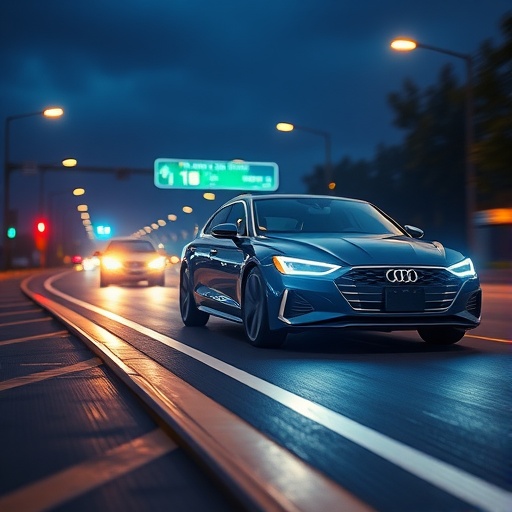
In an era where hybrid vehicles are becoming increasingly popular, a groundbreaking study led by Riegelbeck, C., Vadamalu, R.S., and Stalp, A. conjures a potential paradigm shift in the field of automotive efficiency. Their research, titled “Potential analysis of a predictive energy management strategy designed to increase the efficiency of the powertrain in a hybrid vehicle with use of online available route information,” unveils a sophisticated predictive energy management strategy that could dramatically enhance the performance of hybrid powertrains. This innovative approach leverages real-time data, making it an exciting advancement in vehicular technology.
As urban congestion and environmental concerns escalate, there is an urgent need for more efficient powertrain solutions. The core of Riegelbeck and colleagues’ study focuses on the ability to optimize fuel consumption and reduce emissions in hybrid vehicles, which traditionally balance between internal combustion engines and electric motors. Their strategy is enticing not merely for the potential to boost energy efficiency but also for its ability to capitalize on existing online data regarding traffic patterns and route conditions. This cutting-edge methodology could serve as a blueprint for future vehicle designs and energy management systems.
At the heart of the proposed energy management strategy is its adaptability. By utilizing algorithms that process real-time route information, such as traffic signals, road gradients, and vehicle-specific parameters, the system can adjust the hybrid powertrain’s operation dynamically. This means that the vehicle can decide, on-the-fly, whether to engage the electric motor, the internal combustion engine, or run on a combination of both, based on the most efficient energy utilization for the given conditions. A seamless integration of these components is essential, and the study offers insights into how this integration can be achieved more effectively.
Moreover, the predictive nature of this strategy means that the management system can anticipate changes in driving conditions. For instance, if a congested area or a steep incline is detected ahead via online mapping services, the system will tactically shift power distribution between the electric motor and the internal combustion engine preemptively. Adapting to these changes before they occur not only enhances energy efficiency but also provides superior driving experience and performance. This application of predictive analytics marks a significant leap forward in automotive technology.
Research has consistently shown that hybrid vehicles can achieve fuel economy improvements compared to their purely combustion-engine counterparts. However, Riegelbeck et al.’s approach could potentially exceed existing benchmarks of efficiency through its tailored responses to real-time data inputs. Given the impressive advancements in artificial intelligence and machine learning, this predictive management strategy stands to benefit from continuous learning over time. The adaptability of such systems could unlock remarkable efficiencies that would otherwise be unattainable.
Among the most compelling aspects of the research is the emphasis on environmental impact. Not only do hybrid vehicles aim to reduce fuel consumption, but they also strive to diminish harmful emissions. By achieving optimal management of energy sources through this new predictive strategy, the study suggests that emissions can be significantly lowered. With governmental regulations increasingly focused on sustainability and clean energy standards, this research aligns perfectly with these global goals and could capture the attention of policymakers and industry leaders alike.
Considering the practical application of this predictive strategy, the implications extend beyond personal vehicles. Public transportation and fleet operations, for instance, could significantly benefit from such innovations. Buses and commercial delivery vehicles often operate under specific schedules and routes, meaning that they could implement this technology to further fuel savings and reduce operational costs. The economic impact of optimizing entire fleets with predictive management strategies could be profound, bringing down overall emissions and operational costs concurrently.
Despite the promising conclusions drawn from the research, it remains essential to consider the challenges that could arise when deploying this technology in real-world scenarios. Data privacy and the reliability of information sources are critical aspects that require thorough examination. Ensuring that the necessary infrastructure is in place to support real-time data collection and processing will be key to the successful implementation of this energy management system.
In conjunction with these challenges, the complexities involved in integrating such advanced technology into existing vehicle models should not be underestimated. Automobile manufacturers would need to invest significantly in both research and development efforts to incorporate these features into new hybrids and electric vehicles. However, the potential return on investment through enhanced vehicle performance and reduced operational costs may ultimately justify the expenditure.
The research does not merely chart a course for improved hybrid vehicles but also sets the stage for future innovations in the automotive industry. With advancing technology, the next step could involve the development of fully autonomous vehicles that utilize similar predictive energy management systems. Such future vehicles could redefine our understanding of personal and public transport, ensuring that sustainability remains at the forefront of transportation solutions.
In conclusion, the transformative potential of Riegelbeck, Vadamalu, and Stalp’s study cannot be understated. Their predictive energy management strategy presents a compelling vision for the future of hybrid vehicles, showcasing how the combination of advanced technology and modern data science can create more efficient and environmentally friendly transportation solutions. As the automotive industry continues to evolve, innovations of this nature will undeniably play a pivotal role in shaping the future of how we drive.
The intersection of technology and transportation continues to inspire researchers and industry professionals alike, making Riegelbeck et al.’s study pivotal in the quest for greater efficiency and sustainability. As we lean into the future of automotive advancement, the tools and strategies developed in this research phase are set to influence a new generation of intelligently-designed vehicles, paving the road toward cleaner air and reduced congestion.
The study’s findings argue for not just technological adoption but a broader cultural shift towards sustainable practices in automotive engineering. As consumers demand more eco-friendly options, automakers who grasp the implications of this research will stand at the forefront of the industry. Ultimately, the research extends beyond academic interest, pushing boundaries and redefining what we expect from our vehicles in both performance and sustainability.
Subject of Research: A predictive energy management strategy designed to increase hybrid vehicle powertrain efficiency using real-time route information.
Article Title: Potential analysis of a predictive energy management strategy designed to increase the efficiency of the powertrain in a hybrid vehicle with use of online available route information.
Article References:
Riegelbeck, C., Vadamalu, R.S., Stalp, A. et al. Potential analysis of a predictive energy management strategy designed to increase the efficiency of the powertrain in a hybrid vehicle with use of online available route information.
Automot. Engine Technol. (2026). https://doi.org/10.1007/s41104-025-00166-6
Image Credits: AI Generated
DOI:
Keywords: Hybrid vehicles, Energy management, Predictive analytics, Automotive technology, Sustainability, Emissions reduction, Powertrain efficiency.
Tags: algorithms for energy managementenergy efficiency in hybrid powertrainsenhancing hybrid vehicle performanceenvironmentally friendly vehicle technologiesfuture trends in hybrid vehicleshybrid vehicle powertrain optimizationinnovative automotive research studiesonline data for automotive technologypredictive energy management strategiesreal-time route data for fuel efficiencyreducing emissions in hybrid carsurban congestion solutions in vehicles