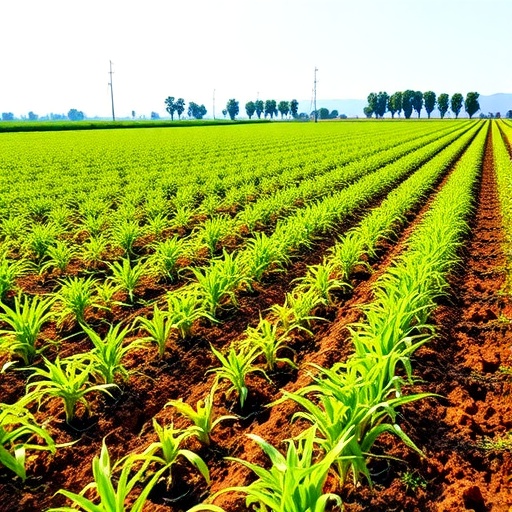
In the relentless quest to address the global challenge of food security, researchers are increasingly turning to artificial intelligence (AI) for innovative solutions. A groundbreaking study published in Scientific Reports in 2026 presents a novel approach to enhancing crop yield prediction accuracy through an interpretable deep learning model named MHCNN-LSTM-MHA. This impressive advancement holds the potential to revolutionize agricultural planning, resource allocation, and ultimately, food production worldwide.
Crop yield prediction is a notoriously complex task, influenced by a multitude of environmental, biological, and management factors. Traditional statistical models often fall short in capturing nonlinear relationships and high-dimensional data interactions inherent in agricultural systems. Researchers from leading institutions have now addressed these limitations by creating a hybrid deep learning architecture that integrates multiple advanced neural network components. The MHCNN-LSTM-MHA model combines Multi-Head Convolutional Neural Networks (MHCNN), Long Short-Term Memory networks (LSTM), and Multi-Head Attention (MHA) mechanisms to decode the subtle patterns in crop data.
Fundamentally, the Multi-Head Convolutional Neural Network component excels at extracting spatial features from large-scale input datasets, such as satellite imagery, soil properties, and climatic variables. These convolutional layers parse through the heterogeneous data to identify key features related to crop health and development stages. The parallelization in the multi-head structure allows the model to learn different aspects of the data concurrently, ensuring a comprehensive feature representation.
Complementing this, the LSTM units within the model are adept at capturing temporal dependencies. Agricultural growth is a dynamic process influenced by time-series variables including weather fluctuations, irrigation schedules, and pest population dynamics. The LSTM layers provide the ability to remember and propagate critical sequence information through time steps, thereby improving the accuracy of future yield predictions based on past and current agricultural conditions.
The inclusion of the Multi-Head Attention mechanism adds another dimension of sophistication to the model by enabling it to weigh the importance of various input features adaptively. Rather than treating all inputs equally, the attention module allocates greater focus to more influential factors, effectively magnifying their contribution to prediction outcomes. This adaptive weighting not only improves model performance but also enhances interpretability by highlighting which features drive agricultural productivity under specific conditions.
Interpretability, a crucial aspect often overlooked in deep learning applications, stands at the forefront of this research. Crop management decisions benefit immensely from transparent AI systems where domain experts can validate and trust the insights generated. The MHCNN-LSTM-MHA model incorporates interpretability by integrating attention weights that offer insight into the decision-making process of the network, allowing agronomists and policymakers to identify critical variables affecting yield in diverse environmental scenarios.
The researchers evaluated the proposed model across multiple benchmark datasets representing a broad spectrum of crops, climatic zones, and farming practices. Results consistently demonstrated superior predictive accuracy compared to state-of-the-art deep learning models and conventional approaches. Furthermore, the model exhibited robustness against noisy and incomplete data, a common challenge in agricultural datasets, thereby underscoring its practical applicability.
Beyond accuracy, the model’s scalability makes it suitable for deployment in real-world agricultural monitoring systems that involve large volumes of heterogeneous data streaming from satellites, IoT devices, and ground sensors. The integration of multi-modal data sources into the predictive framework aligns with the growing trend of precision agriculture—a farming management concept that uses data-driven insights to optimize field-level management regarding crop farming.
The availability of precise and timely crop yield forecasts has far-reaching implications for global food markets, supply chain logistics, and rural development. Enhanced predictions enable farmers to adjust cultivation strategies, optimize the application of fertilizers and pesticides, and schedule harvests more effectively to maximize output and minimize losses. On a macro scale, governments and international bodies can leverage these forecasts to anticipate supply shortages and plan interventions to stabilize food prices and distribution.
Additionally, the interpretability features built into the MHCNN-LSTM-MHA model promote collaborative advancements by bridging the gap between AI specialists and agricultural scientists. By revealing the underlying mechanisms through which environmental and management variables impact yields, this model fosters a better understanding of agroecosystem dynamics and encourages data-driven policy formulation.
The broader impact of this technology extends to sustainability efforts as well. Improving yield prediction accuracy helps reduce wasteful agricultural practices, lowers environmental footprints associated with overuse of inputs, and contributes to resilient food systems amid climatic uncertainties. In an era where climate change poses significant threats to crop productivity, tools like the MHCNN-LSTM-MHA offer critical support for adaptive agricultural strategies.
While the results are promising, the researchers acknowledge future work is necessary to refine and expand the model’s capabilities. Integrating real-time remote sensing data, exploring additional crop species, and enhancing the model’s ability to process diverse agroecological variables remain important avenues. Continued collaboration between data scientists, agronomists, and policymakers is essential to translate these technological breakthroughs into tangible improvements for global agriculture.
In summary, the innovative MHCNN-LSTM-MHA model marks a significant leap forward in crop yield prediction technology by merging advanced neural network techniques with a focus on interpretability and practical relevance. As the world grapples with feeding a growing population under increasing climatic and environmental stresses, investments in intelligent agricultural forecasting tools offer a beacon of hope for sustainable food security.
This pioneering research exemplifies the transformative potential of artificial intelligence when thoughtfully adapted to the complexities of natural systems, and it sets a new benchmark for interdisciplinary approaches in agricultural science. The integration of deep learning architectures with explainability mechanisms paves the way for smarter, more responsible technology adoption in sectors vital to human well-being.
With continuous development and deployment, models like MHCNN-LSTM-MHA could soon become standard components of precision farming technologies worldwide, empowering farmers and stakeholders to make informed decisions that optimize crop production and resource use. This advancement underscores the crucial interplay between cutting-edge AI innovation and the timeless human endeavor of nurturing the earth for future generations.
Subject of Research: Enhancing crop yield prediction accuracy using interpretable deep learning models integrating spatial, temporal, and attention mechanisms.
Article Title: Enhancing crop yield prediction accuracy with a novel interpretable deep learning model: MHCNN-LSTM-MHA.
Article References:
Cheema, I.A., Hanif, M.K., Khokhar, A.M.A. et al. Enhancing crop yield prediction accuracy with a novel interpretable deep learning model: MHCNN-LSTM-MHA. Sci Rep (2026). https://doi.org/10.1038/s41598-026-53616-y
Image Credits: AI Generated