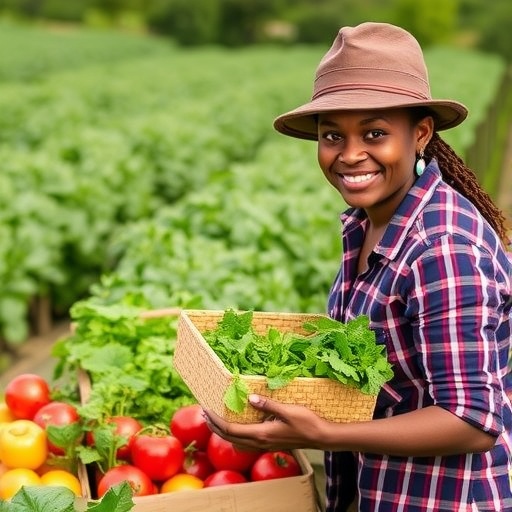
The intricate web of global food supply chains has long overshadowed the stark realities of diverse farming practices across nations. Despite the universal necessity of food production, the dynamics of national consumption versus agricultural output reveal significant disparities. A comprehensive study sheds light on small-scale farmers’ crucial but often overlooked contributions to national food consumption, particularly in high-income nations. This nuanced analysis juxtaposes agricultural production data with agri-food trade metrics, illustrating the multifaceted role of farmers across the globe.
Current agricultural paradigms tend to oversimplify farmers’ roles by associating national food consumption directly with local production. However, this misalignment becomes evident when one considers how interdependent global trade networks function. The research demonstrates that countries often rely heavily on agricultural imports from nations whose farming systems starkly differ. In these cases, it is essential to disentangle the local contributions of farmers to national food security from the global trading patterns that influence diet and availability.
Intriguingly, small-scale farmers have been substantially undervalued in economic assessments. The study highlights that in high-income countries, small farms collectively contribute to approximately one-third of the food consumed. This revelation not only alters our perceptions of small farming’s economic impact but also presents critical questions about how policies and subsidies have historically favored larger agricultural enterprises. The recognition of small farms as vital contributors warrants a paradigm shift in agricultural policy and resource distribution.
In contrast, when examining regions where small-scale farming is predominant, the perspective shifts dramatically. Countries within West Asia, North Africa, and East Africa, where small farms are a prevalent facet of the agricultural landscape, often rely on agricultural imports predominantly sourced from nations characterized by large-scale farming practices. This reliance on imports raises illuminating considerations about the sustainability of food systems in such regions and underscores the interconnectedness of global agricultural economies.
The findings of this research emphasize the complexity surrounding food systems and the mistaken assumption that self-sufficiency equates to resilience. While policymakers are often drawn to the metrics of national production outputs, the study suggests that understanding farmer contributions and consumption patterns across national boundaries may yield deeper insights into food security. Moreover, it reiterates the importance of fostering agricultural practices that acknowledge and enhance the capabilities of small-scale farmers, even amid prevailing trade structures dominated by larger operations.
Additionally, the analysis expresses concerns regarding the vulnerabilities inherent in depending too heavily on large-scale agricultural imports. By failing to recognize and integrate the roles of small-scale farmers, nations might inadvertently compromise their food sovereignty. This overlooked dimension of food systems could lead to vulnerabilities characterized by a loss of local knowledge and a decrease in agricultural diversity, elements that are essential for resilient food systems.
Furthermore, the current research advocates for a radical shift in future agricultural studies to include the differentiated capabilities and challenges faced by farmers. The complexities of global food systems necessitate investigations that are multi-dimensional in understanding how local, regional, and international agricultural dynamics impact food security. Scholars and policymakers are called upon to reassess how small- and large-scale farming realities intersect with consumption and nutrition on a national scale, leading to more effective and fair policies.
Among the pressing implications of these findings is a necessity for global agricultural discourse to expand beyond merely tallying production outputs. Integrating diverse agricultural contributions into this dialogue will not only enhance understanding but also guide towards more equitable policy frameworks. By elevating the voices of smaller operations and recognizing their value within the larger agricultural narrative, we can cultivate more inclusive food systems that respect local needs and empower marginalized farmers.
In conclusion, the study provides a clarion call to better understand the agricultural landscape and its impact on national food consumption. It highlights an essential truth: the complexity of food systems stretches far beyond simplistic models of production. Future research must delve into these complexities, ensuring that agricultural practices evolve in synergy with the multitude of factors that influence what we eat, how we eat, and whom we ultimately rely upon for this crucial sustenance.
Recognizing the position of small farmers in high-income nations, while also drawing attention to the import-dependent practices popular in different regions, invites a re-evaluation of current agricultural strategies and trade policies. The upcoming dialogue on food systems must incorporate these insights, leading to thoughtful collaboration across borders that appreciates both local contributions and the broader frameworks of food security. This holistic understanding of both small and large-scale farming can be foundational in building more resilient food systems that can face the uncertainties of tomorrow.
Future dialogues might also entertain innovative ideas around consumer education, emphasizing the impact of purchasing decisions on local and small-scale farmers. By encouraging consumer awareness and promoting the benefits of supporting small agricultural operations, we can begin to shape societal norms around food consumption that align with greater sustainability and equity in food systems. Cultivating this consciousness around food sources will be key to crafting a future where smaller farmers are recognized and supported in their vital roles within national food chains.
Subject of Research: The contributions of small-scale farmers to national food consumption and the dynamics of agricultural production patterns in global food supply chains.
Article Title: Small farms contribute a third of the food consumed in high-income nations.
Article References:
Taherzadeh, O., Cai, H. & Mogollón, J.M. Small farms contribute a third of the food consumed in high-income nations.
Nat Food 7, 66–73 (2026). https://doi.org/10.1038/s43016-025-01276-y
Image Credits: AI Generated
DOI: January 2026
Keywords: food supply chains, small-scale farming, agricultural trade, food security, high-income nations, consumption patterns
Tags: agricultural production vs consumptioneconomic value of small farmsfood consumption patterns in wealthy nationsfood security and tradeglobal food supply chainshigh-income countries agricultureinterdependence in agriculturelocal vs global food systemsoverlooked farmers contributionssmall farms contribution to food supplysmall-scale farming impactsustainable farming practices