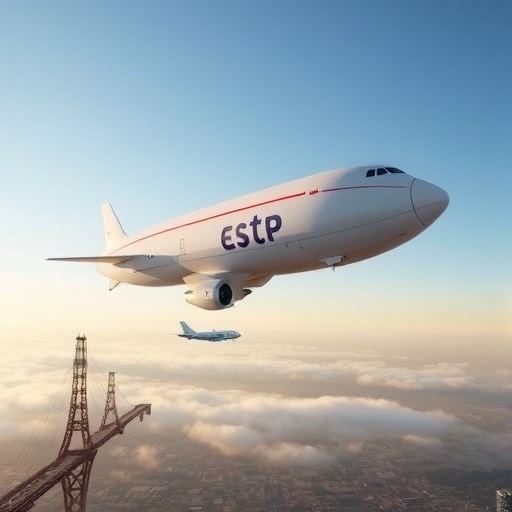
In a groundbreaking study set to be published in 2026, researchers Zhang, Peng, and Wang delve into the realm of stratospheric airships, exploring robust cooperative control mechanisms that promise to revolutionize their operation under dynamic nonlinear conditions. As the world increasingly turns its gaze upward, understanding how these aerial giants can work together seamlessly becomes essential for various applications, from environmental monitoring to data collection and transportation. This exploratory venture not only enhances our grasp of airship technology but also raises questions about future innovations in aeronautics.
The stratosphere, where these airships operate, presents a unique set of challenges and opportunities. According to the research, one of the pivotal issues in this altitude is the unpredictable nature of atmospheric dynamics, which can lead to disturbances that significantly impact airship control. The study aims to address these challenges by proposing a robust cooperative control framework, which ensures that multiple airships can maintain stable flight paths even when faced with external perturbations.
The cooperative control strategy involves advanced algorithms that enable communication and coordination between airships. By utilizing real-time data sharing, airships can adjust their trajectories collectively, ensuring their formation remains intact and adaptive to environmental shifts. The researchers emphasize that the success of this approach hinges on the ability of each airship to process complex information rapidly and execute precise maneuvers in response to changing conditions.
Utilizing nonlinear control theory, the study highlights how traditional control mechanisms may fall short when applied to the nonlinear dynamics inherent in stratospheric environments. The researchers undertake a comprehensive analysis of existing control strategies, identifying their limitations and proposing modifications that enhance robustness without sacrificing responsiveness. This rigorous examination sets the stage for a new generation of airship control technologies tailored for the unique requirements of high-altitude operation.
Furthermore, the role of sensor technology in enhancing the capability of airships cannot be overstated. The study discusses the integration of advanced sensors that can detect minute variations in atmospheric conditions, allowing for more granular control. These sensors play a critical role in the proposed cooperative framework, enabling airships to receive accurate data about wind patterns, temperature fluctuations, and other environmental factors that influence flight dynamics.
Additionally, the researchers explore the potential applications of their cooperative control framework across various fields. In environmental science, for instance, stratospheric airships equipped with sophisticated sensors could monitor climate changes, track pollution, and gather data on atmospheric phenomena. The scalability of the cooperative control system means that entire fleets of airships could be deployed to gather comprehensive data sets that are crucial for effective environmental management.
Moreover, the military and defense sectors stand to benefit significantly from enhanced airship coordination. The ability to deploy multiple airships that communicate and operate as a cohesive unit could improve reconnaissance missions and extend operational reach without relying heavily on traditional aircraft. This flexibility and adaptability could redefine aerial strategies and operational frameworks in defense scenarios.
In the realm of telecommunications, the potential of stratospheric airships is expansive. By forming a network of airships that work in tandem, it becomes possible to provide reliable, high-speed internet connectivity to remote areas, bridging the digital divide. The research underscores how the cooperative control framework enables these airships to position themselves optimally for signal transmission, enhancing coverage and reliability.
The safety implications of this study cannot be overlooked. As airships become more prevalent, the need for a robust system capable of ensuring their safe navigation becomes paramount. The proposed cooperative control strategies not only aim to optimize operational efficiency but also prioritize safety, reducing the risk of collisions and ensuring a safe airspace for both manned and unmanned operations.
The implications of this research extend beyond technical advancements; they also intersect with socio-economic considerations. As airship technology matures, it has the potential to create new industries and job opportunities, ranging from engineering and maintenance to data analysis and environmental science. The cooperative control system could thus serve as a catalyst for economic growth while addressing pressing global challenges.
The research conducted by Zhang, Peng, and Wang stands at the intersection of innovation and necessity, proposing a solution that aligns with the growing demand for sustainable and efficient aerial solutions. As airships find their place within broader discussions of climate change and technological advancement, the findings of this study offer a compelling glimpse into a future where human ingenuity meets the natural world in a harmonious dance of cooperation.
Ultimately, the robust cooperative control for stratospheric airships presents a new frontier in aerospace engineering. The implications are far-reaching, suggesting a future where multiple airships can not only cohabitate the skies with minimal disruption but also work collaboratively towards common goals. As researchers continue to refine these strategies and technologies, the aviation community eagerly anticipates the day when stratospheric airships fulfill their potential, providing unparalleled access to the rich tapestry of our atmosphere.
As this research is set to be published soon, it opens the door to further investigations and innovations that may one day redefine how we understand and utilize the skies above us. The possibilities are as expansive as the horizon itself, and the journey to harness the full potential of stratospheric airships is just beginning.
In conclusion, the robustness and adaptability of cooperative control systems discussed in this study not only pave the way for enhanced functionality in stratospheric airships but also inspire a reimagining of aerial technologies. By combining advanced algorithms, real-time data sharing, and innovative sensor technologies, researchers are navigating uncharted territories, promising a future where airships not only soar through the stratosphere but thrive, evolving into essential components of our airborne infrastructure.
Subject of Research: Robust cooperative control for stratosphere airships under dynamic nonlinear conditions
Article Title: Robust cooperative control for stratosphere airships under dynamic nonlinear conditions
Article References:
Zhang, P., Peng, Z., Wang, X. et al. Robust cooperative control for stratosphere airships under dynamic nonlinear.
AS (2026). https://doi.org/10.1007/s42401-025-00436-z
Image Credits: AI Generated
DOI: 27 January 2026
Keywords: Stratospheric airships, cooperative control, nonlinear dynamics, aerospace engineering, environmental monitoring, telecommunications, safety, economic implications.
Tags: advanced algorithms for airship coordinationairship technology innovationsatmospheric dynamics challengesautonomous airship formation flyingdynamic nonlinear controlenvironmental monitoring with airshipsfuture of aeronautics and airshipsreal-time data sharing for airshipsrobust cooperative control mechanismsstable flight paths for airshipsstratospheric airship collaborationtransportation applications of airships