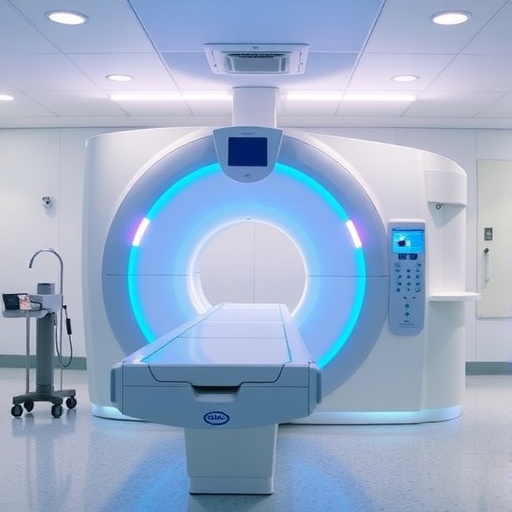
In a groundbreaking study published in the journal Pediatric Radiology, researchers led by Narum, S.A., along with colleagues Yu, L. and McCollough, C.H., have revealed promising advances in cardiac imaging technology. Their investigation centers around a novel approach using high-pitch cardiac computed tomography (CT) featuring photon-counting detector technology. This study’s findings suggest that this innovative imaging technique could achieve similar contrast-to-noise ratios (CNR) at significantly lower radiation doses compared to traditional CT when spatial resolution is taken into account.
The implications of this research are monumental. Traditional CT imaging has long been the standard in assessing cardiac anatomy and pathology, but it often comes with the downside of increased radiation exposure, which poses inherent risks, especially to vulnerable populations. The recent explorations into high-pitch cardiac CT aim to mitigate these risks while maintaining diagnostic quality. Narum and colleagues argue that their results mark a transformative moment in the field of radiology, where patient safety can be prioritized without compromising image quality.
The essence of photon-counting detector technology lies in its ability to measure individual photons. Unlike conventional CT systems, which operate using energy-integrating detectors, photon-counting systems offer enhanced sensitivity and improved accuracy in quantifying X-ray signals. This increased precision allows for higher spatial resolution and potentially greater CNR, critical factors that can influence the diagnosis of various cardiac conditions.
To benchmark their findings, the researchers meticulously matched the spatial resolution of photon-counting imaging to that of the conventional CT systems. This careful calibration ensures that the results of their comparisons are valid and reliable. By maintaining similar spatial resolution, the study effectively isolates the effects of the imaging technology itself, allowing for an unambiguous analysis of the resulting CNR and dose levels.
One of the study’s standout features is its focus on lowering radiation doses while maintaining diagnostic capability. This focus is particularly relevant in pediatric populations, who are more sensitive to radiation’s deterministic and stochastic effects. By demonstrating that high-pitch cardiac CT can provide adequate diagnostic information with lower radiation exposure, the authors address a critical challenge in imaging children, who represent a significant portion of patients requiring cardiac evaluations.
Furthermore, the findings have broader implications for adult populations as well. With the increasing incidence of cardiac diseases globally, it has become imperative to find imaging modalities that can effectively monitor and diagnose conditions while minimizing risk. The implications of reduced radiation exposure can enhance patient compliance and encourage earlier diagnosis and treatment, leading to improved health outcomes across demographics.
The intricacies of implementing high-pitch cardiac CT in clinical practice present both opportunities and challenges. While the initial results are promising, further large-scale studies are required to validate these findings and ascertain the long-term benefits of this imaging modality in various clinical settings. Additionally, understanding the cost implications and training requirements for radiologists will be vital for mainstream adoption.
As the healthcare industry increasingly emphasizes patient-centered approaches, this research underscores the importance of innovation in medical imaging. Technology that enables enhanced safety while upholding diagnostic standards is crucial. As healthcare providers seek to adopt more responsible and effective practices, such studies pave the way for future advancements.
The researchers anticipate that their work will stimulate ongoing discussions within the radiology community about the future of cardiac imaging. With increasing awareness regarding radiation risks, radiologists are urged to remain at the forefront of emerging technologies to safeguard their patients and optimize diagnostic processes. This study serves as a clarion call for further investigations into new imaging modalities that prioritize safety without sacrificing quality.
In conclusion, the study by Narum et al. serves as a landmark contribution to the evolving landscape of cardiac imaging. The exploration into high-pitch cardiac CT with photon-counting detectors not only provides a direction for future research but also emphasizes a transformative shift toward safer medical imaging practices. The integration of these advanced technologies in routine clinical use holds the promise of superior diagnostics while ensuring that patient safety remains paramount in contemporary healthcare delivery.
The results of this research may prompt regulators and health organizations to reconsider recommendations surrounding the use of imaging technologies in medical practice. As attention continues to grow regarding radiation exposure issues, studies that demonstrate the efficacy of safer imaging options will be critical in shaping both public policy and clinical guidelines.
As pediatric and adult patient populations brace for innovative advancements in cardiac imaging, the study by Narum, Yu, and McCollough serves as a beacon of hope. The potential to achieve high-quality diagnostic imaging while significantly reducing radiation exposure could represent a pivotal moment in radiological history, encouraging further technological innovation in the years to come.
In summary, the research not only sheds light on the practical applications of high-pitch cardiac CT technology but also encapsulates a broader narrative about the future of medical imaging. This pioneering work underscores the delicate balance of improving clinical outcomes while prioritizing patient safety—a crucial goal in the ever-evolving field of healthcare.
Subject of Research: High-pitch cardiac CT using photon-counting detector technology
Article Title: High-pitch cardiac CT with photon-counting-detector CT would result in similar CNR at lower radiation doses compared to conventional CT when spatial resolution is matched.
Article References: Narum, S.A., Yu, L. & McCollough, C.H. High-pitch cardiac CT with photon-counting-detector CT would result in similar CNR at lower radiation doses compared to conventional CT when spatial resolution is matched. Pediatr Radiol (2026). https://doi.org/10.1007/s00247-026-06529-x
Image Credits: AI Generated
DOI: 27 January 2026
Keywords: Photon-counting detector technology, high-pitch cardiac CT, radiation dose reduction, contrast-to-noise ratio, pediatric imaging.
Tags: advanced imaging for cardiac pathologycardiac CT innovationscontrast-to-noise ratio in imaginghigh-pitch cardiac CT benefitsimproved X-ray signal quantificationlower radiation dose imagingpatient safety in medical imagingpediatric radiology advancementsphoton-counting CT technologyradiation exposure reduction in diagnosticssensitivity of photon-counting detectorstransformative radiology techniques