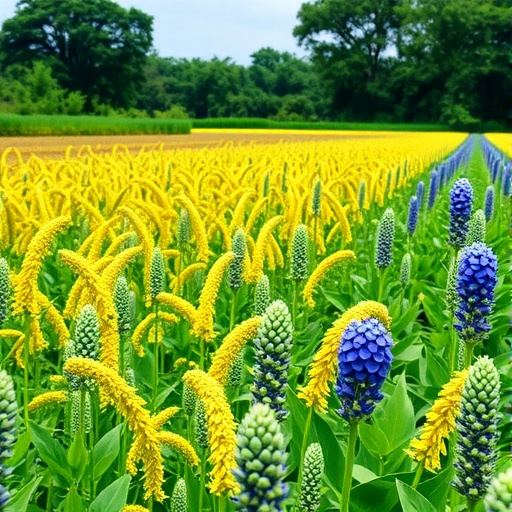
In an era where agricultural sustainability is not just a preference but a necessity, groundbreaking findings illuminate a promising path forward. The recent publication by Raveloaritiana and Wanger, slated for 2026 in Nature Communications, presents compelling evidence that long-term agricultural diversification can simultaneously enhance financial profitability, biodiversity, and ecosystem services. This comprehensive second-order meta-analysis synthesizes vast datasets, affirming that diversifying crops and farming practices over extended periods offers multi-dimensional benefits—a revelation with profound implications for global food security and environmental resilience.
At its core, the study challenges the prevailing monoculture paradigm that dominates much of modern agriculture. Monocultures, while often economically efficient in the short term, have well-documented drawbacks including susceptibility to pests, soil degradation, and biodiversity loss. By integrating a wide array of prior meta-analyses, the authors construct a robust framework demonstrating how diverse cropping systems can mitigate these issues. This approach holistically unites ecological and economic metrics, presenting a nuanced picture that balances farmer profitability with ecosystem health.
Central to their methodology is the use of second-order meta-analysis, a statistical technique designed to aggregate and reconcile findings across multiple meta-analyses. This approach ensures that the conclusions drawn are not artifacts of isolated studies but reflect consistent patterns observable on a global scale. By systematically assessing variables such as crop species richness, rotation length, and landscape heterogeneity, Raveloaritiana and Wanger reveal the lasting impacts of diversification strategies on complex agroecosystems.
One of the study’s most striking revelations concerns financial outcomes. Contrary to the assumption that diversification dilutes economic returns by demanding greater management complexity, the analysis finds that diversified agriculture can increase profitability over the long term. This stems from several mechanisms including improved yield stability, reduced input costs due to pest and disease regulation, and market advantages linked to the production of a wider array of products. Farmers adopting diversified systems not only hedge risks but also tap into emerging niche markets emphasizing sustainability.
Biodiversity enhancement emerges as another critical benefit of long-term diversification. Ecosystem function depends heavily on species richness and interactions among plants, insects, and soil microbes. By fostering a mosaic of crop types and cultivation practices, diversified farms support greater population densities and varieties of pollinators, natural pest predators, and beneficial microorganisms. These biological agents contribute to natural pest control and nutrient cycling, reducing the need for synthetic chemicals and promoting healthier soils.
The ecosystem service improvements identified extend beyond biodiversity alone. The research highlights improvements in soil structure and fertility, water retention and quality, and carbon sequestration capacities. These services underpin agricultural productivity and contribute to climate change mitigation efforts. For example, diversified fields often experience less erosion and nutrient leaching, enhancing long-term soil sustainability. Moreover, diversified landscapes tend to increase above- and below-ground biomass, which helps capture atmospheric carbon and mitigate greenhouse gas emissions.
Crucially, the long-term perspective adopted by Raveloaritiana and Wanger uncovers benefits that conventional short-term studies tend to overlook. Many diversification effects accumulate incrementally and manifest fully only over multiple growing seasons. Crop rotations that disrupt pest life cycles, for instance, confer benefits that amplify with time, while soil microbial communities build resilience and functional diversity gradually. This temporal dimension underscores the importance of adopting patience and persistence when transitioning away from monocultures.
The study’s geographic scope is impressively comprehensive, encompassing a range of climatic zones and agricultural systems worldwide. From temperate grain belts to tropical vegetable farms, the positive impacts of diversification persist across diverse contexts. This universality suggests that farmers globally can adapt diversification strategies to local conditions, tailoring crop selection and management methods accordingly. It also affirms the relevance of diversification for both smallholder and industrial-scale agriculture.
While the authors emphasize the clear advantages of diversification, they also acknowledge barriers to widespread adoption. These include knowledge gaps, market structures that favor standardized products, and policy frameworks that historically subsidize monoculture-driven practices. Overcoming these challenges will require concerted efforts involving education, innovation in supply chains, and supportive agricultural policies that incentivize ecological stewardship alongside profitability.
In their discussion, Raveloaritiana and Wanger advocate for integrated approaches that combine diversification with other sustainable intensification techniques. Precision agriculture, agroforestry, and conservation tillage can synergize with diversified cropping to maximize benefits. They also emphasize the role of interdisciplinary collaborations bridging agronomy, ecology, economics, and social sciences to design context-specific interventions that meet the needs of farmers and ecosystems alike.
Moreover, this synthesis provides valuable insights for scientists and policymakers aiming to align agricultural systems with the United Nations’ Sustainable Development Goals, particularly those related to zero hunger, climate action, and life on land. The ability of diversified farming systems to simultaneously advance economic and ecological objectives presents a powerful model for sustainable development that can be scaled up globally.
Another dimension tackled by the paper relates to resilience in the face of climate change. By supporting greater genetic and species diversity, diversified systems inherently buffer against weather variability and extreme events. Crop diversity offers insurance against drought, frost, and pest outbreaks by spreading risks across different species with varied tolerance levels. This hedging mechanism is invaluable as farmers confront increasing climatic uncertainties and strive to safeguard their livelihoods.
The implications of this work extend beyond agriculture into broader ecosystem conservation dialogues. Maintaining biodiversity on farms helps create habitat corridors and refuges for wildlife, contributing to landscape-level connectivity. This has cascading effects on ecosystem stability and the provision of ecosystem services that benefit human societies, including clean water and pollination.
In conclusion, the second-order meta-analysis by Raveloaritiana and Wanger marks a seminal advance in our understanding of agricultural diversification’s role in sustainable food systems. By integrating ecological complexity with economic pragmatism over an extended timeframe, the research offers a robust evidence base supporting diversified agriculture as a cornerstone of resilient and profitable agri-food production. As global pressures intensify to feed a growing population while preserving natural capital, these insights could catalyze a paradigm shift in how agriculture is practiced, incentivized, and perceived worldwide.
This study is poised to inspire further research and policy innovation, fostering agricultural landscapes that nurture both humanity and the planet. Through embracing diversity at the heart of farming systems, we can reimagine agriculture not only as a means of production but as a biodiverse, multifunctional enterprise that delivers lasting ecological and social value.
Subject of Research: Agricultural diversification and its impacts on financial profitability, biodiversity, and ecosystem services
Article Title: Long-term agricultural diversification increases financial profitability, biodiversity, and ecosystem services: a second-order meta-analysis
Article References:
Raveloaritiana, E., Wanger, T.C. Long-term agricultural diversification increases financial profitability, biodiversity, and ecosystem services: a second-order meta-analysis. Nat Commun (2026). https://doi.org/10.1038/s41467-025-67757-7
Image Credits: AI Generated
Tags: agricultural sustainabilitybiodiversity enhancementdiverse cropping systems benefitsecological and economic metricsecosystem services improvementenvironmental resilience in agriculturefinancial profitability in farmingglobal food security implicationslong-term crop diversitymonoculture drawbackssecond-order meta-analysis in agriculturesustainable farming practices