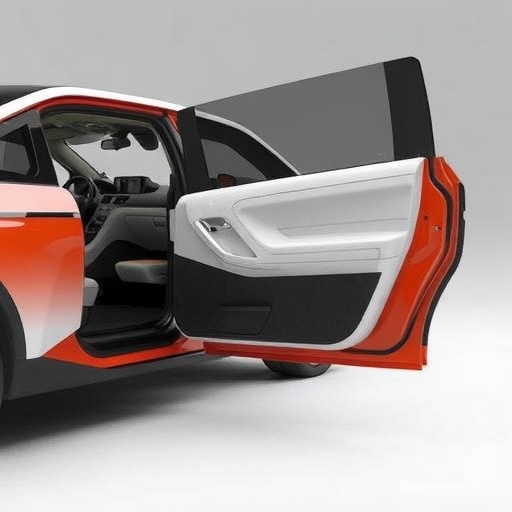
The pursuit of lightweight automotive components has become paramount in the industry, primarily due to its significant implications for fuel efficiency, emissions reductions, and overall vehicle performance. In the recent study conducted by Li and Fang, published in the esteemed journal “Automotive Engine Technology,” the authors delve deep into an innovative design approach focusing on a multi-material vehicle door, seamlessly integrating Long-Fiber Thermoplastics (LFT) with metals. This groundbreaking concept not only exemplifies modern engineering trends but also challenges traditional manufacturing paradigms, marking a transformative shift in the automotive sector.
The vehicle door, often taken for granted, serves as a critical interface between the driver and the external environment. Traditionally, these components have been constructed from single materials, typically steel or aluminum, which can limit design flexibility and increase weight. However, by employing a composite of LFT and metal, Li and Fang introduce a design that optimally balances structural integrity with weight savings, a necessity in today’s quest for improved automotive efficiencies. The incorporation of LFT not only lowers the door’s weight but also enhances its impact resistance, making it a formidable option for vehicle manufacturers looking to optimize safety without compromising performance.
A core tenet of the research is the methodology by which the LFT-metal combination is realized. The authors provide a thorough examination of various design parameters, emphasizing the necessity of a tailored approach to material selection. By evaluating factors such as the mechanical properties of LFT and metal at various temperatures and stress states, the team devised a composite structure that demonstrates superior performance metrics compared to conventional materials. The innovative approach to the design and integration of these materials could represent a paradigm shift in how automotive components are engineered.
The weight reductions achieved through LFT incorporation are significant and underscore a critical component of automotive design in the context of regulatory pressures surrounding emissions and efficiency. As governments tighten regulations surrounding fuel efficiency, vehicle manufacturers must innovate solutions that not only meet these demands but can do so without extensive re-engineering of existing production lines. Li and Fang’s design caters to this market need by fostering a manufacture-friendly framework while still emphasizing performance and safety.
Moreover, the research touches upon the production techniques necessary for effectively implementing this design. The authors explore a variety of methods for joining LFT to metal, which presents unique challenges due to the dissimilar material properties. Understanding the right combination of adhesives, welding techniques, and even mechanical fastening methods is crucial, as improper integration could lead to compromised structural integrity over the lifespan of the vehicle. Their findings shed light on the best practices for enhancing joint strength and durability while maintaining efficient manufacturing processes.
Crashworthiness is another focal point in the study. With vehicle safety under constant scrutiny, ensuring that multi-material designs can withstand impact without failing is essential. Li and Fang meticulously detail their findings on energy absorption characteristics of the proposed material combinations. By utilizing computational simulations alongside physical testing, they present compelling data that indicates the enhanced protective capabilities of their LFT-metal vehicle door design in crash scenarios, a critical consideration for both manufacturers and consumers alike.
Interestingly, the potential applications of this innovative design extend beyond just vehicle doors. The research hints at vast opportunities for other automotive components where weight reduction and multi-material integration could yield significant benefits. From dashboards to structural supports, the principles established in this study may pave the way for a new generation of automotive components that embrace the versatility of advanced materials. The implications of the research signify a broader movement towards sustainability in manufacturing, aligning with global initiatives to reduce automotive environmental footprints.
In summary, the study conducted by Li and Fang is an exemplary representation of the state-of-the-art in automotive engineering. By skillfully merging modern materials science with practical manufacturing concerns, they push the boundaries of what is possible in vehicle design. As we stand on the cusp of a new era in automotive engineering, the concepts presented in their research serve as a beacon for future innovations that prioritize safety, efficiency, and sustainability. The industry must heed the lessons drawn from this pioneering work as it strives to meet the challenges of the 21st century.
The journey toward reimagining vehicle components is ongoing, but forward-thinking studies like this one are essential to cementing a future where material science and engineering harmoniously converge. As suppliers and manufacturers begin to adopt similar multi-material approaches, the automotive landscape is bound to evolve, driven by the lessons gleaned from Li and Fang’s research.
The compelling nature of this study not only showcases the potential for technical advancements but also underscores the importance of interdisciplinary approaches in engineering. By combining insights from material science, manufacturing engineering, and automotive design, the authors provide a holistic perspective that could significantly influence future developments in the industry. Their work encourages a re-examination of how vehicles are constructed, leaning heavily on innovation to address the myriad challenges facing the automotive world today.
As consumers become more attuned to sustainability and technological advancements, the demand for lighter, safer, and more efficient vehicles will only intensify. Li and Fang’s lightweight design approach of a multi-material vehicle door will surely resonate within industry circles as a benchmark for best practices in future automotive component designs.
In conclusion, the work titled “Lightweight design approach of an LFT-metal multi-material vehicle door concept” not only provides a glimpse into the future of automotive design but also raises the bar for innovation and sustainability in an industry that is constantly evolving.
Subject of Research: Lightweight design of an LFT-metal multi-material vehicle door concept.
Article Title: Lightweight design approach of an LFT-metal multi-material vehicle door concept.
Article References:
Li, D., Fang, X. Lightweight design approach of an LFT-metal multi-material vehicle door concept.
Automot. Engine Technol. 7, 385–407 (2022). https://doi.org/10.1007/s41104-022-00121-9
Image Credits: AI Generated
DOI: December 2022
Keywords: Lightweight design, multi-material, vehicle door, LFT, automotive engineering, structural integrity, crashworthiness, material science, sustainability.
Tags: automotive performance optimizationcomposite materials in vehicle manufacturingemissions reduction strategiesenhancing vehicle safety featuresfuel efficiency in vehiclesinnovative automotive engineeringlightweight automotive componentsLong-Fiber Thermoplastics integrationmodern automotive technology advancementsmulti-material vehicle door designstructural integrity in automotive designtransformative shifts in manufacturing paradigms