A research team led by scientists from the University of Texas at Austin and Zhejiang University has created a self-assembling molecular fabric capable of separating industrial chemicals using significantly less energy than conventional methods. In an experimental study published in the journal Nature, the researchers demonstrated that their multi-thread, interlocking material can efficiently filter carcinogenic benzene from cyclohexane, an essential precursor used across global manufacturing. Chemical separations represent one of the largest energy sinks in modern industry, and the newly developed material addresses this persistent engineering challenge by adapting the mechanics of textile weaving to nanoscale molecular networks.
The separation of benzene and cyclohexane has long posed a severe operational challenge in industrial chemical manufacturing. Companies routinely produce cyclohexane to manufacture consumer and commercial materials such as nylon, paints, detergents, and polyurethane foams used in furniture. However, synthesized cyclohexane is typically made from benzene, leaving residual amounts of the unwanted, toxic carcinogen in the final mixture. Because benzene and cyclohexane share nearly identical boiling points, traditional thermal distillation cannot easily vaporize one compound away from the other without significant complication, expensive chemical additives, and enormous thermal energy consumption.
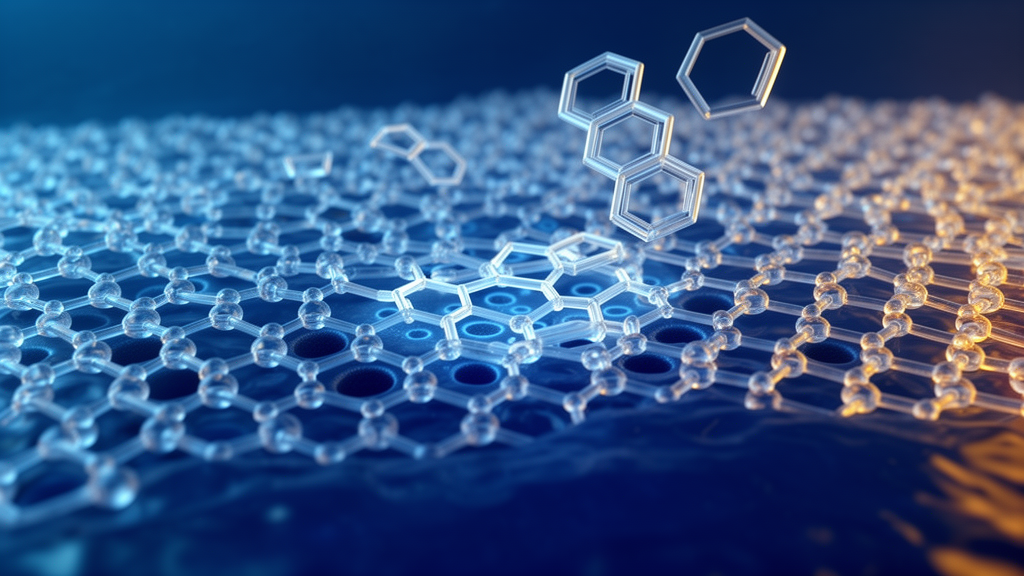
To overcome the limits of traditional distillation, the research team engineered a two-dimensional triaxial molecular fabric composed of four distinct molecular networks that weave over and under one another in an intricate, interlocking motif. Each individual layer exhibits chirality, or structural handedness, existing either in a form where the networks cross in a clockwise spiral or in an inverted mirror-image form where they cross in a counterclockwise spiral. By stacking these alternating regular and mirror-image layers atop each other, the researchers constructed a three-dimensional, springy filter medium that possesses greater structural strength than linearly woven materials fabricated from single threads.
A critical operational attribute of the new woven material is its spontaneous self-assembly. The molecular networks arrange and interconnect on their own based on the underlying chemistry, allowing the material to be created in a facile way.
In laboratory performance trials led by Sessler along with Zhejiang University professors Feihe Huang and Guangfeng Li, the researchers tested the fabric against an equal mixture consisting of 50 percent benzene and 50 percent cyclohexane. When poured through the woven material, the fabric selectively absorbed 97.9 percent of the benzene from the mixture. The authors observed that multiple passes through the material could be utilized for industrial applications requiring even higher purity thresholds, and they further confirmed that the woven architecture successfully separated several other compounds of commercial interest.
Beyond high selectivity, the molecular filter is also reusable. Following exposure to a benzene-containing mixture, the trapped benzene can be driven off simply by heating the fabric to vaporize the captured molecules, returning the material to an active state for subsequent cycles. Scientists at Zhejiang University have already demonstrated the feasibility of deploying the fabric on a larger, industrial scale, establishing a pathway toward practical processing environments.
Although a comprehensive economic analysis has not yet been completed, the researchers anticipate that replacing distillation columns with woven molecular filters could substantially cut industrial power consumption across chemical facilities producing paint, nylon, and synthetic foams. The experimental work was coauthored by the late Sir Fraser Stoddart, a 2016 Nobel laureate in Chemistry, and received funding from the Robert A. Welch Foundation, the National Natural Science Foundation of China, the Zhejiang Provincial Natural Science Foundation of China, the Ministry of Education of China, the China Postdoctoral Science Foundation, and regional research programs in Zhejiang.
Subject of Research: Molecularly woven fabric for energy-efficient chemical separations
Article Title: New molecular fabric uses much less energy to separate chemicals
Article References: New molecular fabric uses much less energy to separate chemicals. Original publication (Bibliographic details unavailable.)
Image Credits: AI Generated
DOI: Not provided
Keywords: molecular fabric, chemical separation, benzene, cyclohexane, self-assembly, chirality, distillation alternative, reticular chemistry, Jonathan Sessler, Feihe Huang, Guangfeng Li, University of Texas at Austin, Zhejiang University, Nature, industrial manufacturing, carcinogen filtration, energy efficiency
News Source: Denise Maddox. (November 11, 2026). Self-Assembling Molecular Fabric Separates Benzene From Cyclohexane With High Energy Efficiency. Scienmag.