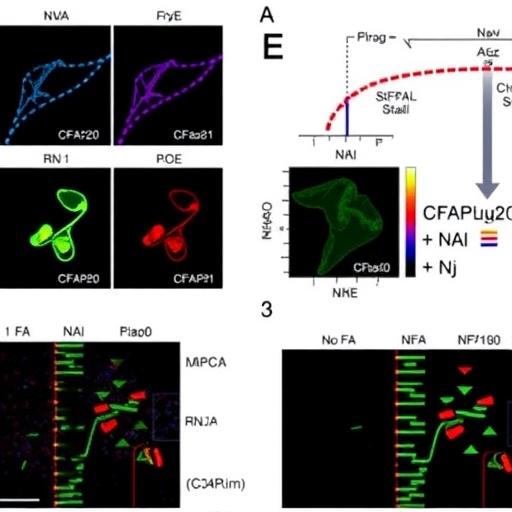
In a groundbreaking study published in Nature, researchers have uncovered a surprising role for the protein CFAP20, a molecule previously associated with ciliary function, revealing its critical influence on human cell fitness through mechanisms beyond its known roles. This discovery not only challenges existing paradigms about CFAP20’s cellular functions but also opens fresh avenues in understanding cellular growth regulation and the complexities underpinning protein interactions within the nucleus.
The study centers on the observation that human cells lacking CFAP20, referred to as CFAP20 knockout (KO) cells, exhibit significant growth defects compared to their wild-type counterparts. Initial experiments demonstrated that CFAP20-KO cells grow at a substantially reduced rate, a phenotype consistently confirmed through competitive growth assays employing flow cytometry. These assays revealed that CFAP20-KO cells rapidly succumb to competitive pressures in co-culture with wild-type cells, underscoring a marked fitness disadvantage.
Intriguingly, the growth impairment observed in CFAP20-KO cells could be rescued by reintroducing the wild-type CFAP20 gene fused to GFP, but not by expression of a mutant version harboring the R100C point mutation. This mutation presumably disrupts the protein’s functional capacity, suggesting that the growth-promoting role of CFAP20 is tightly linked to its intact molecular configuration. Such findings hint at a non-ciliary function of CFAP20 that is integral to cell proliferation and survival.
Dissecting the cell cycle characteristics of CFAP20-KO cells revealed no significant differences in canonical cell cycle profiles compared with wild-type cells. However, a notable increase in the proportion of cyclin A-negative cells within the G2 phase was observed in CFAP20-deficient populations. This phenomenon implies a propensity for cell cycle exit or arrest rather than classical cell cycle progression defects, hinting at an intricate regulatory role played by CFAP20 in cell cycle dynamics.
To unravel the genetic underpinnings driving the poor growth phenotype, the researchers deployed a genome-wide CRISPR screen aimed at identifying gene knockouts that could restore fitness in CFAP20-KO cells. Remarkably, guide RNAs targeting multiple subunits of the Mediator coactivator complex surfaced as potent enhancers of cellular fitness, indicating that the Mediator complex exacerbates the growth defects caused by CFAP20 loss.
Focusing on the Mediator kinase module, the team specifically knocked out CCNC, the gene encoding cyclin C, in CFAP20-KO cells. This CCNC knockout in a CFAP20-deficient background significantly improved colony formation capacity, effectively reversing growth defects. Moreover, the increase in cyclin A-negative G2 cells seen after CFAP20 deletion was normalized, suggesting that Mediator kinase activity, through cyclin C, plays a key role in modulating the cell cycle disturbances arising from CFAP20 loss.
Further explorations employing zebrafish models revealed unexpected nuances. While CCNC knockdown failed to rescue characteristic phenotypes of cfap20-null larvae, such as anterior-posterior body axis curvature, it induced additional defects including microphthalmia and pericardial oedema. This divergence suggests that, although CCNC loss ameliorates certain cellular fitness issues in human cells, it does not rectify the ciliary dysfunction attributable to CFAP20 loss and may even provoke developmental abnormalities, highlighting species-specific or context-dependent functions.
The cumulative evidence positions CFAP20 as a critical salvager of arrested RNA polymerase II (RNAPII) complexes when they encounter the relentless progression of co-directional DNA replication forks, a function distinct from its structural role within cilia. Loss of CFAP20 appears to precipitate detrimental transcription-replication conflicts that activate pathways involving the Mediator kinase module, which exacerbate cellular stress and impair proliferative capacity.
This study dramatically expands our understanding of the interplay between replication dynamics and transcriptional regulation, positioning CFAP20 as a guardian of transcriptional integrity during S-phase progression. It underscores the Mediator complex—in particular, the cyclin C module—as a pivotal modulator of fitness defects stemming from replication-transcription collisions and sets the stage for therapeutic targeting of these interactions in diseases marked by genomic instability.
These insights hold profound implications for developmental biology, cancer research, and molecular medicine. Aberrations in transcription-replication coordination are a hallmark of many pathological states, and elucidating the precise molecular players advances our capacity to devise targeted interventions. CFAP20 emerges not merely as a ciliary component but as a versatile regulator ensuring seamless cohabitation of replication and transcription machineries.
In conclusion, this research unearths a dualistic role for CFAP20 that straddles ciliary maintenance and safeguarding transcriptional progression during DNA replication. Its loss triggers maladaptive responses amplified by the Mediator kinase complex, thus impacting cellular viability and fitness. Continued exploration of CFAP20’s molecular pathways promises to deepen our grasp of genome stability and cellular homeostasis, potentially unveiling novel biomarkers or drug targets for clinical exploitation.
Subject of Research: The role of CFAP20 in cellular growth, transcription-replication conflict resolution, and the impact of Mediator kinase module on cell fitness in CFAP20-deficient human cells.
Article Title: CFAP20 salvages arrested RNAPII from the path of co-directional replisomes.
Article References:
Uruci, S., Boer, D.E.C., Chrystal, P.W. et al. CFAP20 salvages arrested RNAPII from the path of co-directional replisomes. Nature (2026). https://doi.org/10.1038/s41586-025-09943-7
Image Credits: AI Generated
DOI: https://doi.org/10.1038/s41586-025-09943-7
Tags: cellular fitness disadvantageCFAP20 knockout cellsCFAP20 protein functionciliary function and cellular fitnesscompetitive growth assaysGFP fusion gene studiesgroundbreaking cellular biology researchhuman cell growth regulationmolecular configuration in protein functionprotein interactions in the nucleusR100C point mutation effectsRNAPII rescue mechanism