In a groundbreaking study poised to reshape our understanding of cellular endurance under metabolic stress, researchers have uncovered a pivotal mechanism by which cells safeguard their lysosomes — the crucial degradative organelles responsible for recycling nutrients. This process, intimately involved with maintaining cellular homeostasis, reveals how lysosomes repair their membranes when confronted with energy crises, such as glucose starvation. Central to this discovery is a protein called TECPR1, which orchestrates a sophisticated repair system involving membrane tubulation, a mechanism previously unexplored in lysosomal biology.
Lysosomes, often described as the cell’s recycling centers, play an indispensable role in degrading and recycling cellular components. During periods of energy scarcity, such as glucose deprivation, cells ramp up the internalization of lipid droplets by lysosomes to harness alternate energy sources. However, this adaptive response carries the unintended consequence of provoking damage to the lysosomal membranes themselves. Until now, the molecular underpinnings that enable lysosomes to actively repair such damage and sustain their vital functions during metabolic stress remained obscure.
The research team identified TECPR1, a tectonin beta-propeller repeat-containing protein, as an essential mediator facilitating lysosomal membrane repair. Under conditions of glucose starvation or chemical-induced membrane permeabilization via L-leucyl-L-leucine methyl ester (LLOMe), TECPR1 relocates specifically to compromised lysosomes. This recruitment hinges on TECPR1’s selective affinity for phosphatidylinositol 4-phosphate (PI4P), a specialized lipid that accumulates on lysosomal membranes upon damage, acting as a molecular beacon signaling the site of injury.
One of the most striking revelations of the study is how TECPR1 collaborates with kinesin motor protein KIF1A to drive the formation of membrane tubules from the damaged lysosomes. This tubulation process is thought to facilitate the physical removal or remodeling of damaged membrane sections, effectively peeling away injured regions and allowing the lysosome to seal and restore its integrity. This dynamic remodeling represents a critical rescue pathway, enabling lysosomes not just to survive but to reclaim their function amidst an energy crisis.
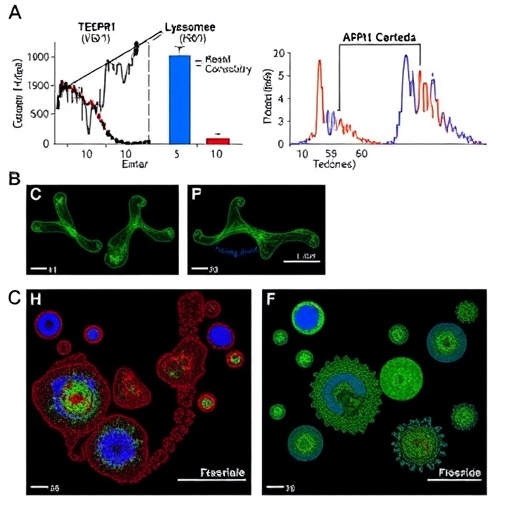
To elucidate the mechanistic basis of this repair, the researchers employed a reconstituted in vitro system utilizing giant unilamellar vesicles enriched with PI4P, mimicking the lipid environment of damaged lysosomes. Remarkably, TECPR1 and KIF1A together induced robust tubulation of these vesicle membranes, thereby recapitulating the repair process outside of living cells. This reconstitution highlights the direct role of TECPR1 in driving membrane curvature and tubule formation, as well as its reliance on KIF1A-driven motor activity.
The biological significance of TECPR1-mediated lysosomal repair extends beyond cell culture models. In animal studies using a high-fat diet-induced metabolic associated fatty liver disease (MAFLD) mouse model, deficiency of TECPR1 markedly aggravated starvation-induced liver damage. These findings offer compelling in vivo evidence that lysosomal membrane repair via TECPR1 is indispensable for preserving lipid metabolism and protecting tissues against damage during metabolic stress, with broad implications for liver health in metabolic disorders.
This research not only unveils an elegant cellular repair strategy but also opens new avenues for understanding lysosomal contributions to metabolic homeostasis. Given that lysosomal dysfunction is implicated in a spectrum of degenerative and metabolic diseases, from neurodegeneration to fatty liver disease, targeting the TECPR1-mediated repair pathway may represent a promising therapeutic angle. By enhancing lysosomal resilience, it might be possible to mitigate the cellular consequences of energy crises frequently encountered in these pathologies.
Moreover, the study shines light on the role of phosphoinositides, specifically PI4P, as crucial signaling lipids in the lysosomal damage response. PI4P’s accumulation as a distress signal on lysosomal membranes offers a molecular target for intervention and a marker for monitoring membrane integrity. The recruitment of TECPR1 to PI4P-rich domains underscores the sophisticated lipid-protein interplay governing organelle maintenance.
Interestingly, the identified function of TECPR1 transcends its previously known roles, positioning it as a versatile effector coordinating cytoskeletal motor activity with membrane dynamics. The interaction with the microtubule-based motor protein KIF1A emphasizes the importance of cytoskeletal transport in organelle quality control. It suggests that motor proteins are not merely cargo transporters but active participants in membrane remodeling and organelle repair processes.
The implications of these findings extend to broader cellular stress responses. Energy crises like glucose starvation simulate pathological and physiological states such as fasting, ischemia, or metabolic imbalance, where lysosomal preservation is critical for cell survival. By mediating membrane repair under these conditions, TECPR1 emerges as a vital factor enabling cells to adapt and thrive despite adverse environments.
This work also enriches the expanding narrative of lysosomal membrane permeabilization (LMP), a phenomenon increasingly recognized for its double-edged nature. While controlled LMP can trigger protective autophagy or immune responses, unchecked damage spells catastrophe. The TECPR1-triggered tubulation represents a novel countermeasure, tipping the balance towards preservation and recovery rather than cell death.
Furthermore, the innovative approach combining advanced cell biology, lipid biochemistry, and in vitro reconstitution exemplifies the power of multidisciplinary techniques in unraveling complex cellular processes. The detailed dissection of TECPR1’s recruiting signals, interaction partners, and function sets a benchmark for future studies investigating organelle integrity mechanisms.
As metabolic diseases continue to challenge global health, mechanistic insights like those provided by TECPR1’s role in lysosomal repair offer glimmers of hope. They pave the way for designing targeted therapies to bolster cellular defenses against metabolic stress, thereby mitigating disease progression. The lysosome, once considered a static organelle, emerges here as a dynamic hub with built-in repair machinery essential for systemic metabolic health.
In conclusion, this seminal study ushers in a new paradigm in lysosomal biology, revealing how TECPR1-mediated membrane tubulation operates as a crucial defense against lysosomal damage during energy crises. This mechanism ensures lysosomal functionality and cellular survival, with significant consequences for understanding and treating metabolic and lysosome-related disorders. The integration of lipid signaling, motor protein activity, and membrane remodeling represents a highly sophisticated cellular toolkit bespoke to mitigate the ravages of metabolic stress.
This discovery compels the scientific community to reexamine lysosomes not merely as endpoints of cellular degradation but as resilient organelles equipped with active maintenance and repair programs. Future research building upon these insights will no doubt expand into other facets of organelle physiology, potentially identifying further molecular players in maintaining cellular equilibrium under stress and disease.
Subject of Research:
Lysosomal membrane repair mechanisms and cellular adaptation to energy stress.
Article Title:
Repair of damaged lysosomes by TECPR1-mediated membrane tubulation during energy crisis.
Article References:
Chen, H., Zhang, C., Fu, Y. et al. Repair of damaged lysosomes by TECPR1-mediated membrane tubulation during energy crisis. Cell Res (2026). https://doi.org/10.1038/s41422-025-01193-6
Image Credits:
AI Generated
DOI:
https://doi.org/10.1038/s41422-025-01193-6
Tags: cellular endurance under metabolic stresscellular nutrient management strategiesenergy crisis response in cellsglucose starvation effects on lysosomeslipid droplet internalization by lysosomeslysosomal biology advancementslysosomal membrane repair mechanismsmembrane tubulation in lysosomesmetabolic stress adaptation in cellsnutrient recycling in cellular homeostasisorganelle integrity during energy scarcityTECPR1 protein function