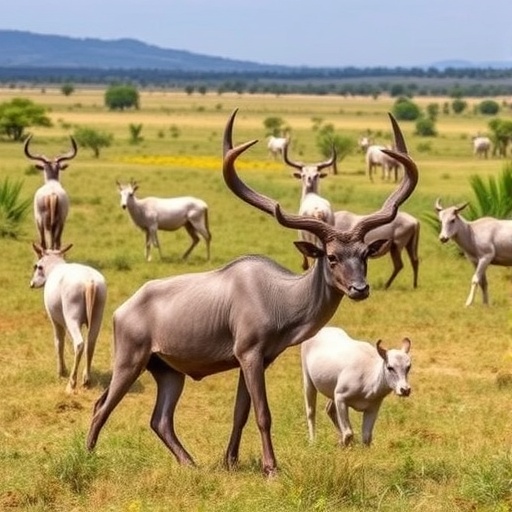
In a breakthrough study published in the journal “Discover Animals,” researchers Gonhi and Mahakata delve into the complex dynamics between livestock and wild animal populations in the ecosensitive region surrounding the Sengwa Wildlife Area in Gokwe South, Zimbabwe. This region is characterized by a diverse array of wildlife and agricultural practices, where the livelihoods of local communities depend significantly on the health and productivity of subsistence livestock. The interaction between these two groups raises essential questions about biodiversity and agricultural sustainability.
Understanding the intricate relationships between wild and domesticated animals is vital for enhancing livestock production. Livestock serves as a primary source of income and food security for rural communities. However, these animals are often adversely affected by the presence of wild fauna, which can lead to direct conflicts. The encroachment of wildlife into pastures can result in competition for resources, promoting health disparities and economic losses among farmers. This delicate balance calls for a thorough investigation into behavioral patterns and ecological interactions that define their coexistence.
In their research, Gonhi and Mahakata focus on specific interactions, framing their analysis around the principles of cohabitation and competition. They cite a growing body of literature indicating that the overlap between livestock and wildlife can lead to both beneficial and detrimental effects. While wildlife can be vectors for disease transmission, there are scenarios where the natural behaviors of wild animals help in pest control and seed dispersion, contributing positively to the ecosystem. The dialectic of these interactions should be understood in the context of socio-economic factors and traditional farming methods that have persisted for generations.
Utilizing both qualitative and quantitative methodologies, the researchers assessed the direct impacts of wildlife interactions on livestock well-being. They conducted field studies involving interviews with local farmers, surveys on livestock health, and observation of wild animal behaviors to gather comprehensive data. This multi-faceted approach allowed for a nuanced understanding of the scope of the issue, presenting a view that transcends mere anecdotal evidence and embraces empirical findings.
Importantly, the findings highlight the socio-economic implications of livestock management amid wild animal interactions. Farmers reported significant losses attributed to wildlife, ranging from physical harm to livestock to the psychological stress of managing these risks. As farmers navigate their daily operations, they face a dilemma—a choice between protecting their livestock through fencing and other control measures, and fostering an environment that respects wildlife conservation efforts. This tension underscores the critical need for developing integrated management strategies.
The study goes beyond simply reporting losses; it encourages stakeholders to view wildlife not merely as competitors but as integral components of the ecosystem. The researchers suggest that policies aimed at wildlife conservation should be harmonized with agricultural policies to promote a synergistic relationship. This is especially relevant in areas where wild animal populations are economically significant, such as in eco-tourism or biodiversity hotspots.
Additionally, the effects of climate change on these interactions cannot be ignored. As temperatures rise and weather patterns shift, the behaviors of both livestock and wild animals will inevitably change. The researchers point out that these environmental stressors exacerbate existing conflicts, as both groups struggle for limited resources. Such findings display the need for adaptive strategies to be built into livestock management practices, ensuring resilience against climatic shifts.
The potential for integrated agroecological practices is also explored in the study. By incorporating wildlife-friendly practices, such as rotational grazing or crop diversification, farmers can establish a more harmonious existence with neighboring wildlife. The researchers advocate for community-led initiatives that educate farmers about sustainable practices that benefit both their livelihoods and conservation efforts. Ultimately, they argue that the fate of livelihoods and wildlife conservation are deeply intertwined, necessitating collective action.
Another significant aspect of the study is its call for enhanced monitoring and research efforts into the dynamics of livestock-wild animal interactions. Gonhi and Mahakata stress that understanding these complex relationships is not a one-time effort but a continuous process requiring long-term commitment from all stakeholders—farmers, wildlife organizations, and government entities. Collaboration will be key in addressing the challenges highlighted by their research, fostering an environment where both livestock and wildlife can thrive.
As their research gains traction, the authors express an optimistic outlook. They believe that their findings could serve as a model for similar regions facing comparable challenges. The study’s implications extend beyond the confines of Zimbabwe, speaking to a broader global audience grappling with issues of biodiversity loss, human-wildlife conflict, and sustainable agricultural practices. Through educating and empowering local communities, it is possible to portray wildlife symbiotically, facilitating coexistence rather than conflict.
The researchers conclude the paper by reiterating the importance of their findings for future policy-making and sustainable practices in the region. They stress the urgency of fostering a holistic approach to managing the interaction of livestock and wildlife, emphasizing that it is not merely an ecological issue but one deeply woven into the socio-economic fabric of rural communities. As the world continues to face challenges relating to food security, biodiversity, and climate change, studies like this are crucial in reshaping our understanding and management of natural resources.
In light of the discoveries made in this study, it appears evident that the framework of coexistence is achievable through a combination of scientific understanding and community collaboration. As we move forward, envisioning a future where agriculture and wildlife can coexist harmoniously must become a priority on the global agenda. Through continued dialogue and research, the potential to transform conflict into cooperation remains a hopeful avenue for both conservationists and agriculturalists alike.
Subject of Research: Effects of livestock-wild animal interactions on subsistence livestock production in areas around Sengwa Wildlife Area in Gokwe South, Zimbabwe.
Article Title: Investigating effects of livestock-wild animal interactions on subsistence livestock production in areas around Sengwa Wildlife Area in Gokwe South, Zimbabwe.
Article References:
Gonhi, P., Mahakata, I. Investigating effects of livestock-wild animal interactions on subsistence livestock production in areas around Sengwa Wildlife Area in Gokwe South, Zimbabwe.
Discov Anim 2, 101 (2025). https://doi.org/10.1007/s44338-025-00154-y
Image Credits: AI Generated
DOI: https://doi.org/10.1007/s44338-025-00154-y
Keywords: livestock, wildlife interactions, subsistence production, Gokwe South, agricultural sustainability, biodiversity conservation.
Tags: biodiversity and agricultural sustainabilitycohabitation of wild and domesticated animalscompetition for resources in farmingecological interactions in livestock farmingeconomic losses in rural communitieshealth disparities in livestockimpact of wildlife on agriculturelivestock production in Zimbabweresearch on wildlife encroachment effectsSengwa Wildlife Area dynamicssubsistence livestock and food securityWildlife and livestock interaction