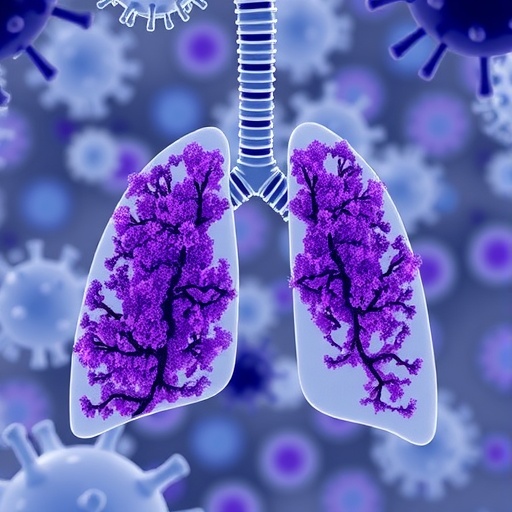
In a groundbreaking study set to revolutionize our understanding of COVID-19 pathogenesis, researchers have successfully engineered lung organoids derived from human-induced pluripotent stem cells (hiPSCs) carrying mutations in the Toll-like receptor 3 (TLR3) gene. This novel model vividly simulates severe COVID-19 manifestations, illuminating the critical interplay between innate immune responses and viral pathogenesis within lung tissues. The findings offer profound insights into why certain individuals develop life-threatening respiratory complications following SARS-CoV-2 infection, potentially guiding precision medicine approaches.
The research pivots on leveraging the transformative potential of hiPSCs—stem cells reprogrammed from adult cells to regain pluripotency—and their subsequent differentiation into three-dimensional lung organoids. These miniaturized, organ-like structures faithfully recapitulate key aspects of human lung physiology, including airway epithelium and alveolar cell composition. By introducing targeted mutations in the TLR3 gene, integral to detecting viral double-stranded RNA and initiating antiviral responses, the study dissects the molecular underpinnings that contribute to heightened COVID-19 severity.
TLR3 is a pattern recognition receptor within the innate immune system that detects viral genetic material and triggers downstream signaling cascades, ultimately promoting interferon production and antiviral defense. Variants or loss-of-function mutations in TLR3 have been linked to impaired immune responses in various viral infections, yet their specific role in SARS-CoV-2 has remained elusive until now. The engineered organoids model enables systematic investigation of how TLR3 disruption alters cellular responses, inflammation, and viral replication dynamics in a controlled human tissue context.
The researchers employed CRISPR-Cas9 gene-editing technology to introduce TLR3 mutations into hiPSCs before differentiation. These modified stem cells were then cultured under defined conditions promoting lung lineage differentiation, culminating in organoids exhibiting structural and cellular hallmarks of distal lung regions. Subsequent exposure to SARS-CoV-2 within biosafety level 3 facilities unveiled stark contrasts between wild-type and TLR3-mutated organoids in viral load, cytokine profiles, and cell viability metrics.
One of the most striking discoveries was the exaggerated inflammatory response in TLR3-deficient lung organoids, marked by hyperactivation of nuclear factor-kappa B (NF-κB) pathways and disproportionate secretion of pro-inflammatory cytokines such as IL-6 and TNF-alpha. This hyperinflammation correlated with increased cell death and tissue damage, paralleling clinical observations in severe COVID-19 patients featuring cytokine storm syndromes. Conversely, interferon-stimulated gene expression was markedly blunted, pinpointing a compromised antiviral defense mechanism.
Intriguingly, the study revealed that the loss of functional TLR3 compromises epithelial barrier integrity, facilitating greater viral entry and dissemination within the lung model. Electron microscopy highlighted ultrastructural anomalies in mutated organoids, including disrupted tight junctions and perturbed surfactant production, factors known to exacerbate respiratory distress. These findings underscore the multifaceted role of TLR3 not only in immune sensing but also in maintaining pulmonary tissue homeostasis during viral insult.
Beyond mechanistic insights, this model opens promising avenues for therapeutic intervention. The organoids serve as a robust platform to screen antiviral agents and immunomodulators tailored for patients with genetic susceptibilities. For example, treatment with interferon lambda partially restored antiviral defenses in TLR3-mutant organoids, suggesting potential benefits of personalized cytokine therapy. Additionally, inhibitors targeting NF-κB activation attenuated inflammatory damage, highlighting strategies to mitigate cytokine storm effects.
This work adds a crucial dimension to the growing evidence that host genetics significantly influence COVID-19 outcomes. Previous population studies have identified loci associated with severe disease, but direct causative modeling in human lung tissues has been lacking. The hiPSC-derived lung organoid system bridges this gap, offering an experimentally accessible, physiologically relevant human model to parse complex gene-environment interactions underlying disease heterogeneity.
Another profound implication of this research lies in its methodology, combining cutting-edge stem cell biology, gene editing, and virology techniques to recapitulate human lung infection pathologies. This integrated approach can be adapted rapidly for emerging viral variants or other respiratory pathogens, accelerating drug discovery pipelines and biomarker identification. The study exemplifies how precision biomedical research can align with public health imperatives amid global pandemics.
Moreover, the ability to generate patient-specific lung organoids harboring distinct genetic backgrounds heralds a new era of personalized medicine. Such ex vivo models can predict individual risk profiles, tailor interventions, and monitor therapeutic efficacy in a prescient manner. The TLR3 mutation paradigm showcased here could be extended to investigate other immune pathway defects implicated in infectious or inflammatory lung diseases.
In conclusion, the meticulous construction and characterization of TLR3-mutated hiPSC-derived lung organoids provide an unprecedented window into the molecular and cellular processes driving severe COVID-19. By enabling direct causal links between innate immune receptor dysfunction and pathophysiological manifestations, the study furnishes a powerful experimental tool and a beacon for personalized antiviral strategies. As we continue grappling with current and future respiratory viral threats, such advances underscore the transformative potential of bioengineered human organ models in biomedical research and therapeutic innovation.
Ultimately, this pioneering work epitomizes the synergy of fundamental biology and translational science, revealing how genetically defined lung organoids can decode the enigmatic mechanisms of viral disease severity. It represents a paradigm shift in modeling human respiratory infections, bridging gaps between genetics, immunology, and clinical outcomes. The implications for tailored therapeutics and improved patient prognosis are immense, establishing this approach as a cornerstone for next-generation infectious disease research.
Subject of Research: Modelling severe COVID-19 using TLR3-mutated human-induced pluripotent stem cell-derived lung organoids.
Article Title: Modelling severe COVID-19 in TLR3-mutated hiPSCs-derived lung organoids.
Article References: Latini, A., Spitalieri, P., Centofanti, F. et al. Modelling severe COVID-19 in TLR3-mutated hiPSCs-derived lung organoids. Cell Death Discov. (2025). https://doi.org/10.1038/s41420-025-02936-5
Image Credits: AI Generated
DOI: https://doi.org/10.1038/s41420-025-02936-5
Tags: airway epithelium and alveolar cellsdouble-stranded RNA detection in viral infectionsengineering 3D lung modelshuman-induced pluripotent stem cells in researchimmune system pattern recognition receptorsinnate immune responses to SARS-CoV-2lung organoids modeling severe COVID-19precision medicine for respiratory complicationsstudying respiratory disease mechanismsTLR3 mutations in COVID-19understanding COVID-19 severity factorsviral pathogenesis in lung tissues