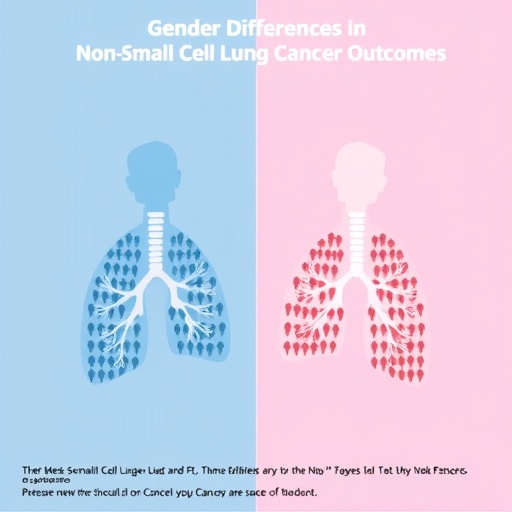
In a groundbreaking exploration published in the upcoming 2025 volume of BMC Cancer, researchers have unveiled compelling evidence highlighting gender as a pivotal prognostic factor in non-small cell lung cancer (NSCLC). This extensive comparative study meticulously examined survival outcomes among male and female patients receiving diverse antitumor treatments, offering novel insights that could revolutionize personalized oncology and therapeutic strategies for lung cancer.
NSCLC remains the most prevalent form of lung cancer worldwide, notorious for its high mortality rate and complex treatment challenges. Despite advances in targeted and immunotherapies, survival disparities between male and female patients have been observed anecdotally but lacked comprehensive scientific validation until now. This study represents one of the largest retrospective cohort analyses, drawing data from 715 pathologically confirmed NSCLC cases treated over a six-year span at a single specialized cancer center.
Employing rigorous propensity score matching techniques to equilibrate baseline clinical characteristics between genders, the study circumvented traditional confounding biases that have previously muddled interpretation. This methodological precision ensured that observed survival differences were less likely attributable to demographic or tumor heterogeneity and more reflective of intrinsic gender-related biological or treatment response factors.
The survival analysis revealed a striking difference: the median overall survival in male patients was 23 months, notably shorter than 29 months observed in females. More granular statistical modeling via multivariate Cox regression confirmed that men faced a 31% increased risk of mortality relative to women. These findings were consistent across adjusted models accounting for critical factors such as tumor staging and treatment modalities, underscoring gender’s independent prognostic value.
One of the study’s most captivating dimensions involved dissecting treatment-specific responses. Among patients administered epidermal growth factor receptor tyrosine kinase inhibitors (EGFR-TKIs), males exhibited a 49% higher mortality risk compared to females. This disparity was absent in the subset receiving immune checkpoint inhibitors, suggesting that gender interactions with molecular targeted therapies may differ significantly from immunotherapeutic approaches.
The research further delineated tumor stage as an essential prognostic indicator, with AJCC classifications for primary tumor extent (T stage), regional lymph node involvement (N stage), and distant metastasis (M stage) all independently correlating with survival outcomes. Intriguingly, chemotherapy and anti-angiogenesis therapy emerged as protective interventions reducing mortality risk, potentially implicating their differential efficacy across genders and tumor microenvironments.
Delving into subgroup analyses, the authors identified patient populations where gender disparities were especially pronounced. Men experiencing early lymph node metastasis (N0-1), no distant metastasis (M0), or lacking brain metastases had significantly poorer prognoses relative to women. Furthermore, male patients undergoing surgical resection demonstrated worse survival, hinting at distinct biological behaviors or treatment responses in early-stage disease beyond what staging alone explains.
The study’s implications extend far beyond mere survival statistics. It challenges the oncology community to integrate gender as a critical variable when devising personalized treatment algorithms. Considering men’s higher mortality risk, especially in the context of EGFR-TKI therapy—the backbone of targeted NSCLC treatment—revising standard therapeutic protocols may be warranted to optimize outcomes. Precision medicine must evolve to encompass not only tumor genomics but also intrinsic patient factors like gender biology.
Biological underpinnings for these differences remain an area ripe for investigation. Hormonal influences, genetic expression profiles, immune landscape variances, and pharmacokinetics discrepancies between sexes may collectively orchestrate the observed prognostic divergence. Unraveling these mechanisms could facilitate the development of gender-specific biomarkers and novel therapeutic targets, enhancing both efficacy and toxicity management.
From a clinical research standpoint, this study underscores the necessity for prospective, multicenter trials explicitly designed to validate gender-specific findings. Current clinical trial designs often underrepresent or inadequately stratify by sex, potentially obscuring critical differential responses. Future studies must incorporate gender as a predefined stratification factor to yield more nuanced and applicable results.
Moreover, this research advocates for a multidisciplinary approach involving oncologists, molecular biologists, pharmacologists, and epidemiologists to holistically address gender disparities in lung cancer prognosis. Collaborative efforts could translate clinical observations into bench-side discoveries, ultimately refining patient stratification and improving survival outcomes.
For patients and healthcare providers alike, awareness of gender as a prognostic and predictive element could enhance shared decision-making. Empowering male patients with knowledge about their comparatively higher risks might encourage adherence to aggressive surveillance and treatment regimens, as well as lifestyle modifications aimed at mitigating comorbidities.
In sum, this landmark study not only establishes gender as a statistically and clinically significant prognostic factor in NSCLC but also paves the way for transformative shifts in cancer therapeutics. As lung cancer remains a global health burden, tailoring interventions to the nuanced interplay of patient-specific factors like gender holds promise for improving the grim statistics that have persisted for decades.
By illuminating how men and women differ in their response to common antitumor modalities, particularly targeted therapies, this research catalyzes a paradigm shift toward truly individualized oncology care. The oncology field eagerly awaits follow-up studies to affirm these findings and decipher the complex biological narratives that underlie gender disparities in lung cancer outcomes.
The findings herald a future where gender-tailored treatment plans become standard practice, enhancing survival, quality of life, and ultimately, the hope for patients confronting non-small cell lung cancer worldwide.
Subject of Research: Prognostic differences between male and female patients with non-small cell lung cancer undergoing various antitumor treatments.
Article Title: A comparative study on prognostic differences between men and women with non-small cell lung cancer across different antitumor treatment modalities.
Article References:
Li, F., Li, F., Lu, H. et al. A comparative study on prognostic differences between men and women with non-small cell lung cancer across different antitumor treatment modalities. BMC Cancer 25, 1802 (2025). https://doi.org/10.1186/s12885-025-15179-5
Image Credits: Scienmag.com
DOI: 10.1186/s12885-025-15179-5
Keywords: Non-small cell lung cancer, gender differences, prognosis, EGFR-TKI, immune checkpoint inhibitors, survival analysis, lung cancer treatment, propensity score matching, biomarker stratification
Tags: antitumor treatment response by genderbiological factors in cancer survivalgender as a prognostic factor in cancergender differences in lung cancer outcomesimmunotherapy outcomes in lung cancernon-small cell lung cancer prognosisNSCLC survival analysis techniquespersonalized oncology for lung cancerretrospective cohort study in lung cancersurvival rates in NSCLC by gendertargeted therapies for non-small cell lung cancertreatment disparities in lung cancer