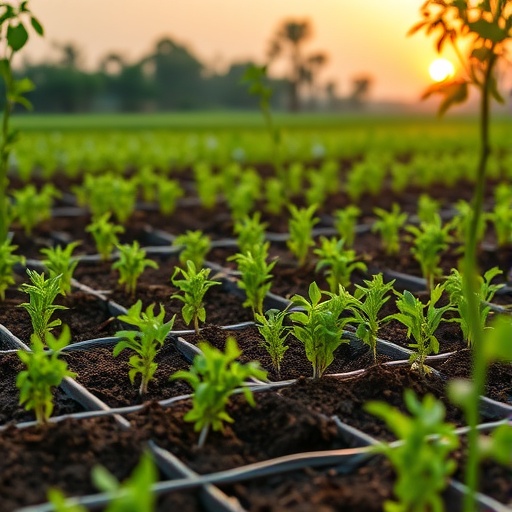
The world of agriculture is currently undergoing a significant transformation, driven by the dual pressures of climate change and economic fluctuations. In their pioneering research, Rath and Mishra delve into the intricate relationship between structural breaks in the agricultural sector and climatic factors affecting the production of major commercial crops in India. This research, published in the journal Discover Agriculture, reveals critical insights about how both immediate and long-term changes in climate and market dynamics impact agricultural output across one of the world’s most populous nations.
Global warming has altered weather patterns, with temperature fluctuations and erratic rainfall becoming the norm. These changes fundamentally affect crop yield and agricultural productivity. Rath and Mishra systematically evaluate historical data, identifying critical points in time when structural breaks occurred—moments when the production of major crops such as rice, wheat, and cotton significantly deviated from established trends. By employing advanced statistical analyses, they correlate these anomalies with climatic data, providing a nuanced understanding of the variables at play.
The findings suggest that temperature increases can lead to reduced yields of certain crops, while wet conditions could impact the growth phases differently. Notably, this research highlights how variations in precipitation levels not only influence immediate crop health but also shape long-term agricultural practices and economic viability for farmers. Through empirical analysis, Rath and Mishra demonstrate that extreme weather events are becoming increasingly frequent, further destabilizing production patterns.
They explore the socio-economic implications of their findings, revealing that regions heavily dependent on specific crops face dire challenges as climate-related disruptions occur. The research emphasizes the need for adaptable farming practices, showcasing how farmers may need to diversify their crops or invest in more resilient varieties that can withstand the new climatic realities. The shift toward such practices is not merely a response to changing weather; it is becoming essential for food security and the economic stability of agricultural communities.
Central to this study is the analysis of structural breaks within the agricultural framework. These breaks, defined as significant and sustained deviations from historical trends, suggest a more profound underlying issue. Rath and Mishra argue that agricultural systems are often slow to adapt, hindered by factors such as limited access to technology, financial resources, and knowledge. By pinpointing specific breaks, their research underscores the urgency for policymakers to understand these dynamics to foster resilient agricultural policies.
The implications of this research extend beyond India, resonating with agricultural practices worldwide. As climate change affects food systems around the globe, countries must scrutinize their local agricultural practices to prepare for future uncertainties. Rath and Mishra’s analyses can serve as a model for conducting similar evaluations in other nations, revealing how bespoke solutions can enhance food security while accommodating for ecological changes.
Attention to potential adaptation strategies is equally crucial. The study suggests that integrating advanced agricultural technologies—such as precision farming or genetically modified organisms (GMOs)—could play a role in mitigating the adverse effects of climate changes. Moreover, these innovations need to be coupled with sustainable practices to ensure that ecological balance is maintained. The marrying of technology with traditional methods is essential for creating a resilient agricultural future that can withstand fluctuating climatic conditions.
Rath and Mishra also acknowledge that increased public awareness is vital in driving changes within the agricultural sector. Public interest and support can lead to increased funding for research into climate-resilient crops and sustainable farming techniques. This awareness, they argue, could serve as a catalyst for governments to implement better policies that prioritize sustainable agricultural practices and provide financial assistance to struggling farmers.
In evaluating the long-term strategies needed for agricultural resilience, the researchers discuss the importance of data-driven approaches to policy formulation. With precise and comprehensive data analysis, agricultural policies can be tailored to meet the specific needs of different regions. By understanding local climatic impacts and agricultural capacities, policymakers can devise strategies that effectively enhance productivity while ensuring environmental sustainability.
Agricultural research thus emerges as a pivotal player in the dialogue surrounding climate change. Rath and Mishra’s study calls for collaboration between scientists, farmers, and policymakers, urging them to foster environments wherein knowledge exchange is prioritized. Such collaboration could ensure farmers are equipped with the necessary tools and information to adapt to forthcoming climatic challenges.
As world agriculture faces unprecedented challenges, the work of Rath and Mishra stands as a crucial reminder of the complexities involved in understanding the impacts of climate change on crop production. Their findings paint a picture of an intricate web of interactions between climate and agriculture that requires holistic approaches to tackle effectively. The global agricultural community must heed these lessons as they chart a path forward, keeping farmers at the forefront of agronomic innovation and sustainability.
The road ahead is daunting, but it is one laden with opportunities for transformation and resilience. By embracing these insights and prioritizing adaptive practice, there is hope for a sustainable agricultural future that not only survives the pressures of climate change but thrives in the face of them.
Subject of Research: The effects of structural break and climatic factors on the production of major commercial crops in India.
Article Title: Tracing the effects of structural break and climatic factors on the production of major commercial crops in India.
Article References:
Rath, B., Mishra, D. Tracing the effects of structural break and climatic factors on the production of major commercial crops in India.
Discov Agric 3, 250 (2025). https://doi.org/10.1007/s44279-025-00428-9
Image Credits: AI Generated
DOI: https://doi.org/10.1007/s44279-025-00428-9
Keywords: Climate change, agricultural productivity, crop resilience, structural breaks, India, sustainable agriculture, food security.
Tags: agricultural productivity and climateclimate adaptation strategies for farmersclimate change effects on agricultureeconomic fluctuations in agricultureimpact of global warming on farmingIndia crop production challengesmajor commercial crops in Indiarainfall variability and crop healthRath and Mishra study on agriculturestatistical analysis in crop researchstructural breaks in agricultural outputtemperature fluctuations and crop yield